

In this article
- 1. Why Is Sales Reporting Important for Businesses in Malaysia?
- 2. What Should a Sales Report Include?
- 3. What Are the Benefits of Sales Reporting?
- 4. What Sales Metrics Should You Track?
- 5. What Is the Difference Between Daily, Weekly, and Monthly Sales Reports?
- 6. How To Create a Useful Sales Report?
- 7. What Are the Common Mistakes in Sales Reporting?
- 8. How Can CRM Software Improve Sales Reporting?
- 9. Why Should Sales Reporting Be Part of Your Growth Strategy?
- 10. Sales Reporting FAQs
Try ask a few SME owners in Malaysia how their sales are doing and many of them will say, “Not bad,” “A bit slow this month,” or “The team is following up.” Fair enough. But when you ask which leads are stuck, which salesperson is closing best, or which product is quietly losing demand, the answer is not always clear. This is exactly why sales reporting matters.
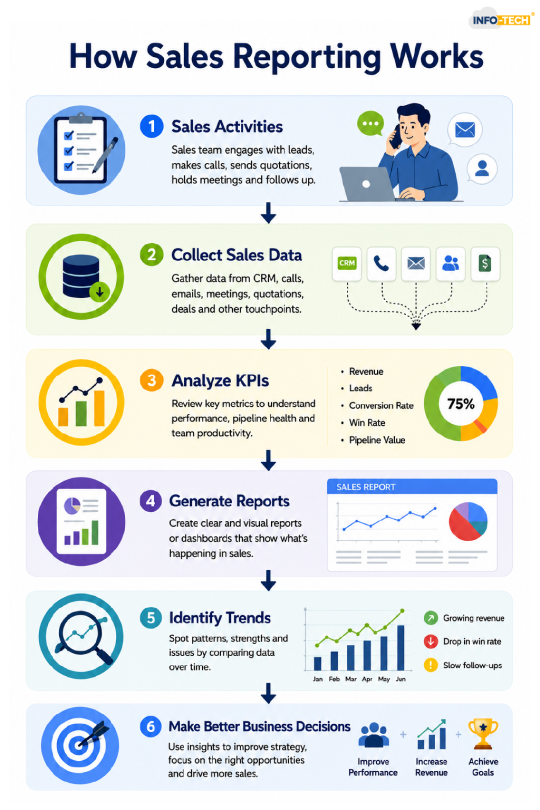
Sales reporting is the process of collecting and reviewing sales related information so a business can understand what is really happening. It is not just a table of sales numbers. A useful sales report shows where leads come from, how many deals are moving, how much revenue is expected, and where the sales team may need support.
For a small team, this may start with just a simple weekly report. For a growing company, it usually becomes a sales dashboard inside CRM software.
Why Is Sales Reporting Important for Businesses in Malaysia?
Malaysian SMEs often deal with leads from many places: WhatsApp, Facebook, website forms, walk-ins, referrals, agents, and repeat customers. When all this information are scattered in different phones, notebooks, spreadsheets, and chat groups, it becomes hard to see the full picture clearly.
Sales reporting helps business owners move away from simply guessing. It answers simple but important questions:
- Are we getting enough quality leads?
- Which salesperson needs most help with closing?
- Which product(s) or service(s) bring the most revenue?
- Are quotations being followed up properly?
- What sales can we expect next month?
This is useful for cash flow, stock planning, hiring, marketing budget, and customer service.
Read also: What Is a Statement of Financial Position?
What Should a Sales Report Include?
A sales report should not include every data just because it is available. It should show only what the reader needs to know.
A practical report usually includes important data such as revenue, number of leads, conversion rate, deal value, sales activities, pipeline status, lost deals, and forecasted sales.
The most helpful reports also include a short explanation. For example, if revenue dropped in May, was it because of fewer leads, slower customer approvals, Raya holidays, stock issues, or weak follow-up? Numbers show the result, but context explains the reason.
Read also: What Is a Business Quotation? A Complete Guide
What Are the Benefits of Sales Reporting?
The first benefit is visibility. You can see what is happening before problems become expensive.
The second benefit is accountability. When sales activities are properly recorded, managers can see whether calls, meetings, quotations, and follow-ups are actually happening.
The third benefit is better forecasting. If your pipeline has RM100,000 in possible deals, but only half are likely to close, you can plan more realistically. This is much better than assuming every enquiry will turn into revenue.
Sales reporting also helps with coaching. One salesperson may have many leads but poor conversion. Another may close well but handle too few prospects. Both need different kinds of support.
Read also: What Is Return on Investment (ROI)?
What Sales Metrics Should You Track?
Most SMEs do not need complicated reporting at the very beginning. Start with the numbers that affect sales performance directly.
Useful sales KPIs include:
- New leads
- Lead source
- Conversion rate
- Average deal size
- Sales pipeline value
- Win rate
- Lost deal reasons
- Follow-up activities
- Sales cycle length
- Revenue by product or service
If your team sells higher-value B2B products, paying attention to pipeline value and sales cycle length really helps. But if you sell fast-moving products, revenue, repeat customers, and channel performance may matter more for you.
What Is the Difference Between Daily, Weekly, and Monthly Sales Reports?
A daily sales report is for action. It shows new leads, calls made, meetings booked, quotations sent, and urgent follow-ups.
A weekly sales report is for team management. It helps managers review pipeline movement, salesperson performance, and deals that need attention quickly.
A monthly sales report is for business planning. It shows revenue trends, win rate, top products, best-performing channels, lost opportunities, and sales forecast.
Think of it this way: daily report helps the team work based on requirements, weekly reports help managers guide, and monthly reports help owners plan.
How To Create a Useful Sales Report?
Start with one question: what decision should this report support?
Then build the report around that purpose. Choose the period, select the right KPIs, pull clean data, and present it in a way people can understand quickly. A chart is useful when it makes the pattern clearer, but it should not be added just for decoration.
A good sales report usually has three parts: what happened, why it happened, and what should happen next. Without the third part, the report becomes a record instead of a tool.
What Are the Common Mistakes in Sales Reporting?
One common mistake is relying too much on spreadsheets. Excel is fine when the team is small, but it becomes risky when several people update different versions. Data gets old, formulas break, and nobody is sure which file is the latest.
Another mistake is only reporting closed sales. By the time revenue drops, the real problem may have started earlier: poor lead quality, slow response time, weak follow-up, or too many deals stuck after quotation.
Some companies also track too many KPIs. A crowded report looks impressive, but it often hides the real issue.
How Can CRM Software Improve Sales Reporting?
CRM software makes sales reporting cleaner because it keeps leads, customer details, activities, quotations, deal stages, follow-ups, and pipeline updates in one place.
Instead of chasing every salesperson for updates, managers can check the sales dashboard. They can see overdue follow-ups, active deals, expected revenue, and weak points in the sales pipeline.
This is especially useful for Malaysian SMEs with growing sales teams. Once leads come from many channels, manual tracking becomes messy very quickly. A CRM gives the business one source of truth.
Why Should Sales Reporting Be Part of Your Growth Strategy?
Sales reporting gives Malaysian SMEs a clearer view of customers, sales performance, and future revenue. It helps business owners stop guessing and start making decisions with better confidence.
As the business grows, scattered spreadsheets and manual updates will slow the team down. Info-Tech’s CRM Software helps keep leads, customer conversations, follow-ups, sales activities, pipelines, and reports in one organized place. With clearer data and less manual work, your team can focus on the right opportunities instead of chasing missing updates. Contact us today!
Sales Reporting FAQs
What do you mean by sales reporting?
Sales reporting is the process of tracking and reviewing sales data so a business can understand performance, forecast revenue, and improve sales decisions.
How to prepare a sales report?
To prepare a sales report, collect key sales data such as revenue, leads, conversions, pipeline status, and lost deals for a specific period. Then organize the numbers into a clear summary with charts, short insights, and next steps for improving sales performance.
Why is sales reporting important for SMEs?
It helps SMEs see which leads, products, salespeople, and channels are performing well, while also highlighting problems before they affect revenue.
What is the best tool for sales reporting?
CRM software is usually better than spreadsheets because it keeps sales data, customer records, pipelines, and follow-ups in one place.