

In this article
- 1. Is a Statement of Financial Position Required by Law in Malaysia?
- 2. Why Do So Many Business Owners Overlook It?
- 3. What Exactly Appears in a Statement of Financial Position?
- 4. Why Is the Statement of Financial Position So Important When Applying for Financing?
- 5. Statement of Financial Position FAQs?
A lot of business owners know whether sales are up or down.
They know how much money came in last month. They know which customers paid late. They probably even know which products are selling well.
But ask a different question—“If someone wanted to see the financial health of your business today, which report would you show them?”—and the answer is often less certain.
Most people assume it would be the profit and loss statement.
In reality, the report that often tells the bigger story is the Statement of Financial Position.
Is a Statement of Financial Position Required by Law in Malaysia?
Yes. Besides being an important financial report, the Statement of Financial Position is also a statutory requirement for companies in Malaysia.
Under the Companies Act 2016, directors are required to prepare financial statements—including the Statement of Financial Position—within six months after the end of the financial year (Section 248). These statements must present a true and fair view of the company’s financial position (Section 249).
Once circulated to shareholders, companies are generally required to lodge the financial statements with the Companies Commission of Malaysia (SSM) within 30 days (Sections 258 and 259).
In short, this isn’t just a report that’s useful for banks or investors. It’s an important part of meeting your company’s legal reporting obligations in Malaysia.
This document doesn’t focus on what happened over the past month or year. Instead, it shows where the business stands at a specific moment. It lays out what the company owns, what it owes, and what is left after those obligations are accounted for.
For business owners, it can reveal whether growth is being funded sustainably or whether debt is quietly increasing in the background. For banks, it helps determine whether a company can comfortably meet its financial commitments. For investors, it offers clues about stability, risk, and long-term value.
That is why the Statement of Financial Position remains one of the most closely examined reports in corporate finance.
Why Do So Many Business Owners Overlook It?
Part of the reason is that it doesn’t attract as much attention as revenue figures.
Revenue is exciting. Sales growth is easy to celebrate.
A Statement of Financial Position is different.
At first glance, it looks like a collection of numbers sitting in rows and columns. Yet hidden inside those figures are answers to questions that affect every business.
Can the company pay its suppliers on time?
Is there enough cash available to handle unexpected expenses?
Has borrowing increased over the last few years?
Is the business building value or simply becoming bigger?
Those are the kinds of questions this report helps answer.
A company can report impressive profits while facing serious financial pressure. Likewise, another business may generate modest profits but have strong assets, low debt, and a healthy financial foundation.
Without looking at the Statement of Financial Position, it is difficult to tell the difference.
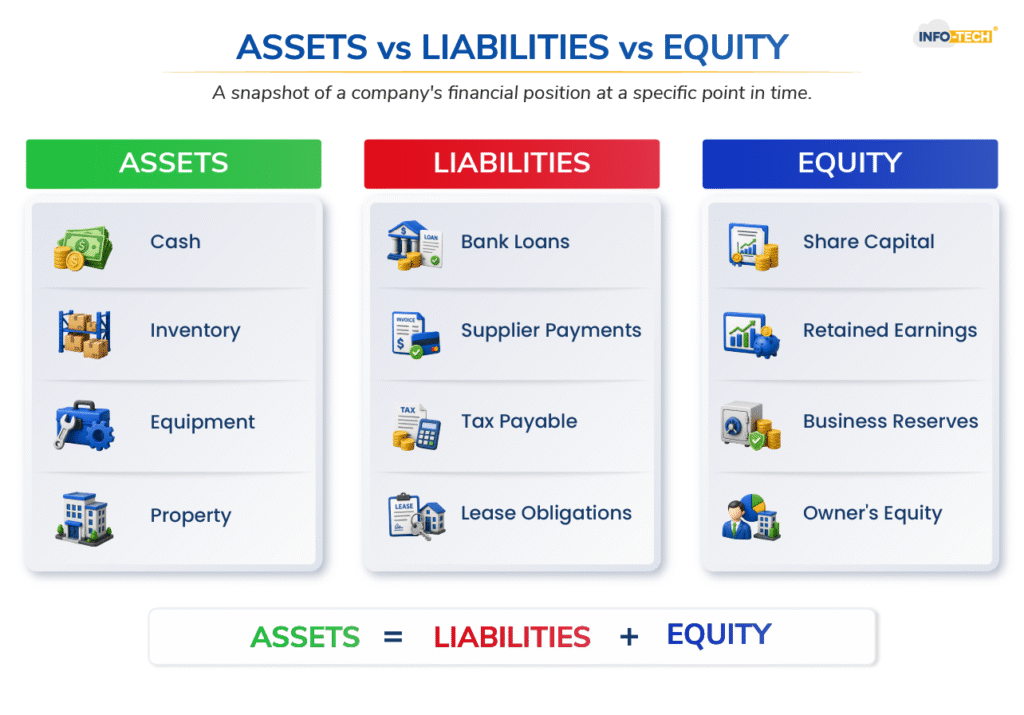
What Exactly Appears in a Statement of Financial Position?
At its simplest, the report is built around three categories.
The first is assets.
Assets represent everything the business owns or controls that has financial value. Cash in the bank is an asset. So are inventories, company vehicles, office equipment, machinery, and even money owed by customers.
A retail business, for example, might hold significant inventory. A manufacturing company may own expensive production equipment. A technology company may have fewer physical assets but substantial cash reserves or intellectual property.
The second category is liabilities.
These represent obligations the company must eventually settle.
Almost every business has liabilities of some form. Supplier invoices, bank loans, lease commitments, tax obligations, and unpaid expenses all fall into this category.
Having liabilities is not necessarily a warning sign. In fact, many successful businesses use financing to expand operations, purchase equipment, or invest in growth. The key question is whether those liabilities remain manageable compared to the resources available to the business.
The final section is equity.
This is the portion that belongs to the owners or shareholders after liabilities have been deducted from assets.
A useful way to think about equity is to imagine the company selling all of its assets and settling all of its debts. Whatever remains would represent the owners’ stake in the business.
Over time, healthy businesses generally aim to increase this figure.
Why Is the Statement of Financial Position So Important When Applying for Financing?
Business owners often encounter this report when applying for a loan.
A bank may appreciate strong sales numbers, but lenders usually want something more concrete before approving financing.
They want to know:
- How much cash the company holds
- How much debt already exists
- Whether assets can support future obligations
- How much value the business has accumulated
This is where the Statement of Financial Position becomes critical.
A company generating RM5 million in annual sales may still struggle to obtain financing if liabilities are excessive or cash reserves are weak.
On the other hand, a business with moderate revenue but strong assets and low debt may appear significantly less risky to lenders.
That is why financial institutions often spend considerable time reviewing this report before making lending decisions.