

In this article
- 1. Why Is a Business Quotation Important?
- 2. What Should a Business Quotation Include?
- 3. How Does a Business Quotation Work in Real Business Situations?
- 4. What Is the Difference Between a Quotation, Invoice, Estimate, and Proposal?
- 5. When Should Businesses Issue a Business Quotation?
- 6. What Common Mistakes Do Businesses Make With Quotations?
- 7. How Can Businesses Improve Their Quotation Process?
- 8. Why Do Growing Businesses Need Better Quotation Management?
- 9. Business Quotation FAQs
A lot of business deals do not fail because their product pricing is too high. They fail because the customer is unsure. When a client asks for pricing, the supplier sends a rushed quotation with a total amount, a few vague words, and no clear terms. The customer then compares it with another supplier who explains the scope properly, breaks down the costs, and states when the price expires. Most of the time, the second supplier would feel safer to work with. That is the real power of a business quotation.
A business quotation is a formal document that tells a potential customer what products or services are being offered, how much they will cost, and what conditions apply. It is usually sent before the customer confirms the purchase, signs an agreement, or receives an invoice.
For Malaysian SMEs, especially in service-based industries, a business quotation is not just paperwork. It is often the first serious business document a client studies before deciding whether to proceed.
Why Is a Business Quotation Important?
Many businesses treat quotations as a routine admin task, but customers see them differently.
To a customer, a quotation is something that gives clues about how organized, transparent, and reliable a business is. If the document is messy, unclear, or missing important details, the customer may start wondering whether the service delivery will be in the same manner.
A good business quotation helps to:
- Build trust before the sale
- Explain pricing clearly
- Reduce misunderstandings
- Make the business look professional
- Improve the chance of closing the deal
It also protects the supplier. When the scope, price breakdown, payment terms, and timeline are written clearly, both sides have something to refer to later, in case of such requirement.
Read also: How does Financial Management Help Businesses
What Should a Business Quotation Include?
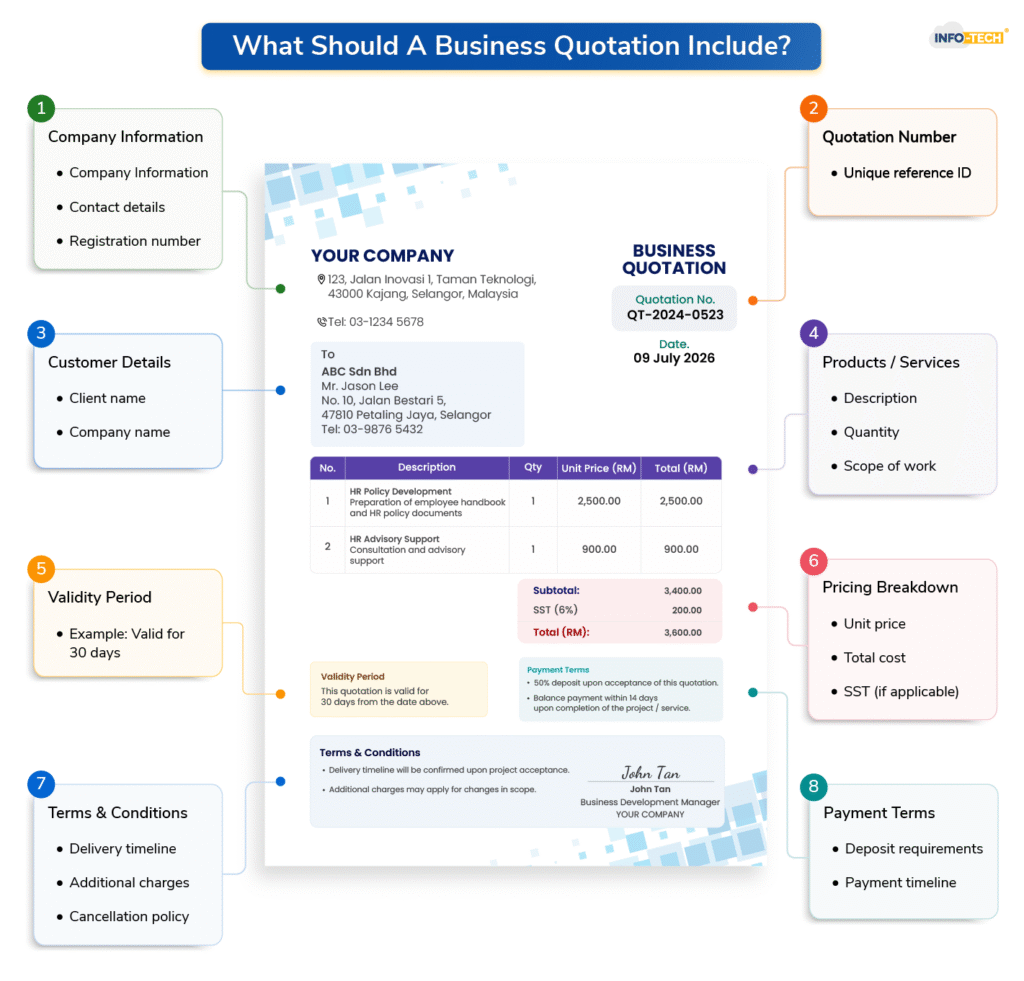
A proper quotation should answer most of the questions a customer would naturally ask the vendor. It does not need to be overly long, but it should be clear enough to avoid any sort of confusion. A professional quotation usually includes:
- Company name, address, contact number, and registration details
- Customer name and company details
- Unique quotation number
- Date of issue
- Product or service description
- Quantity, unit price, and total price
- SST details, if applicable
- Validity period
- Payment terms
- Delivery timeline or service period
- Terms and conditions
The scope of work is especially important. For example, writing “HR services – RM5,000” would be too vague. A better quotation would state whether the price includes HR consultation, employee handbook preparation, payroll setup, policy review, or ongoing advisory support. That level of detail can also prevent uncomfortable conversations later and bring much clarity.
Read also: Why Malaysian Consumers Demand Transparency in E-Invoice
How Does a Business Quotation Work in Real Business Situations?
A business quotation changes depending on the industry.
A payroll outsourcing provider may prepare a quotation based on the number of employees, payroll frequency, statutory requirements, and software support needed. Whereas a construction contractor may quote based on labour, materials, site conditions, and project timeline and marketing agency may include campaign strategy, content creation, ad management, reporting, and revision limits. While a software company may quote based on user licences, setup fees, support packages, and renewal terms, an office equipment supplier may quote for product units, delivery charges, installation, and warranty.
Different industries use different formats, but the purpose is the same: create clarity before work begins.
Read also: Rising Employee Benefits Costs in Malaysia
What Is the Difference Between a Quotation, Invoice, Estimate, and Proposal?
These documents are often confused, but they are not the same and serve different purposes.
| Document | When It Is Used | Purpose |
| Quotation | Before customer confirms | Gives a fixed or agreed price |
| Estimate | Early discussion stage | Gives an approximate cost |
| Proposal | Before major projects | Explains solution, approach, and pricing |
| Invoice | After sale or delivery | Requests payment |
A business quotation is usually more specific than an estimate but is generally less detailed than a full proposal. An invoice comes later, once the sale is confirmed or the work has been completed.
When Should Businesses Issue a Business Quotation?
A quotation should be issued whenever pricing depends on the customer’s requirements.
This is common for:
- HR and payroll services
- Software subscriptions
- Renovation and construction work
- Digital marketing projects
- Consulting services
- Corporate training
- Office equipment supply
- Maintenance services
If the price changes based on scope, quantity, timeline, manpower, or materials, a quotation is usually necessary.
Read also: Supply Chain Management Linking Workforce Planning to Logistics
What Common Mistakes Do Businesses Make With Quotations?
Most quotation problems come from small details being ignored. Common mistakes include:
- No validity date
- Hidden charges
- Wrong calculations
- Unclear scope of work
- Missing SST details
- Outdated pricing
- Poor formatting
- No payment terms
- No approval record
One missing sentence can cause a dispute. For example, if delivery charges are not mentioned, the customer may assume they are included. If revision limits are not stated, a service provider may end up doing extra work without extra payment.
A quotation should never leave things to assumption.
How Can Businesses Improve Their Quotation Process?
As businesses grow, managing quotations through scattered spreadsheets, old templates, and WhatsApp messages becomes risky and confusing. A better process usually starts with standardization.
Businesses can improve quotation management by using approved templates, keeping updated pricing records, numbering quotations properly, setting approval workflows, storing customer details centrally, and reviewing terms before sending anything out.
Digital systems also help reduce manual errors. When pricing, customer records, approvals, and follow-ups are easier to track, the sales and finance teams can work with fewer delays.
Read also: How to Choose the Best POS System in Malaysia
Why Do Growing Businesses Need Better Quotation Management?
When a company is small, the owner may personally check every quotation. That changes as the business grows.
Salespeople start preparing quotes. Finance teams review pricing. Operations teams depend on the quoted scope. Customers request revisions. Management needs visibility. Without a proper process, mistakes become more frequent.
Poor quotation management can affect cash flow, customer trust, employee productivity, and profitability. A business may win a deal but lose money because the quotation was not reviewed properly. This is why quotation management is closely connected to wider business discipline.
The same applies to HR tasks, payroll, attendance, leave, claims, and employee records. As teams grow, manual tracking becomes harder to control. Modern solutions such as Info-Tech’s HRMS software help Malaysian businesses organize workforce administration, payroll processes, leave management, employee information, and daily HR operations in one place.
Though a good quotation may help win the customer, a good internal system helps the business deliver what was promised.
Read also: Importance of Tax Compliance for Malaysian Businesses
Business Quotation FAQs
What is a business quotation?
A business quotation is a document that shows the price, scope, and terms for products or services offered to a potential customer before a sale is confirmed.
How to write a good business quotation?
A good business quotation clearly explains what is being offered, how much it costs, and the terms involved, leaving little room for misunderstanding. It should be professional, transparent, and detailed enough to give the customer confidence in both the pricing and the business behind it.
What is quotation vs invoice?
A quotation is sent before the customer confirms the purchase. An invoice is sent after the sale or service delivery to request payment.
What is the purpose of a quotation?
The purpose of a quotation is to provide a potential customer with a clear breakdown of the products or services offered, their costs, and the terms of the deal before a purchase is confirmed. It helps set expectations, build trust, and reduce misunderstandings between both parties.