

In this article
There are some parts of running a business that naturally get more attention than others. Sales, hiring and customer growth usually sit at the top of the list. Payroll, on the other hand, only tends to become a priority when something goes wrong.
A missed deadline. A wrong deduction. An employee asking why the amount on their payslip has changed.
For many employers, statutory contributions fall into that category. They don’t change every month, but when they do, even a small update can affect every payroll run that follows.
That’s why it’s worth taking a few minutes each year to check whether the contribution rates you’re using are still current.
For 2026, there aren’t any brand-new contribution rates to learn, but employers should continue using the revised PERKESO (SOCSO) contribution schedule that reflects the RM6,000 monthly wage ceiling. If your payroll system hasn’t been updated or you’re still referring to an older contribution table, now is a good time to review it.
Read More: What Is SOCSO?
At a Glance
Before getting into the details, here’s a quick summary.
- The PERKESO wage ceiling remains RM6,000 per month.
- Employees earning above RM6,000 are still subject to the maximum contribution amount.
- Local and eligible foreign employees follow the same contribution schedule.
- Employers must continue making monthly contributions according to the latest PERKESO table.
- Payroll systems should be updated to ensure contributions are calculated correctly.
Does the RM6,000 Wage Ceiling Still Matter?
When PERKESO increased the wage ceiling from RM5,000 to RM6,000, it affected businesses with employees earning above the previous limit. Although the adjustment isn’t new anymore, it remains the basis for payroll calculations in 2026.
Think of the wage ceiling as the highest salary PERKESO uses when working out contributions.
If someone earns RM4,200 a month, contributions are based on RM4,200.
If another employee earns RM5,900, contributions are based on RM5,900.
Once monthly wages go beyond RM6,000, however, the calculation stops there. An employee earning RM6,500 and another earning RM12,000 both attract the same maximum SOCSO contribution because RM6,000 is the current ceiling.
It’s a simple rule, but one that’s easy to overlook if payroll software or internal spreadsheets haven’t been updated.
What About Foreign Employees?
This is one area that has caused plenty of questions over the past few years.
Previously, different rules applied to foreign workers. Today, eligible foreign employees receive broader PERKESO protection and employers generally use the same contribution schedule that applies to Malaysian employees under the relevant schemes.
For businesses with a mixed workforce, this has made payroll administration much more straightforward. HR teams no longer need to switch between separate contribution structures simply because an employee holds a different nationality.
Read More: SOCSO Lindung 24/7: The June 2026 Change Happening In Malaysia
Who Is Responsible for Making Contributions?
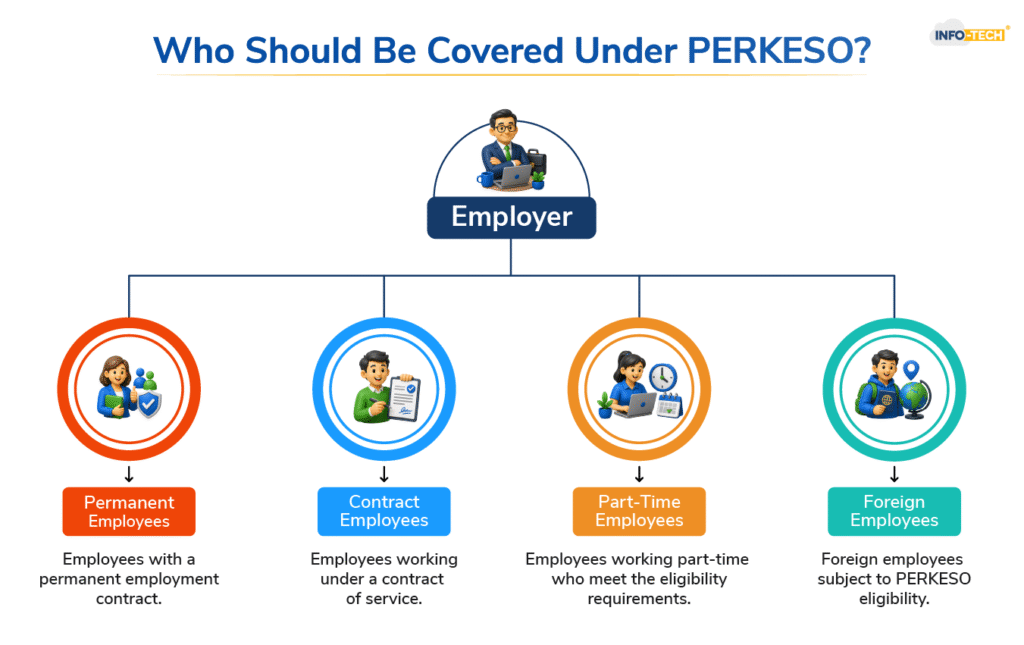
Every employer is responsible for ensuring eligible employees are registered and that contributions are submitted accurately and on time.
That responsibility doesn’t change whether you have five employees or five hundred.
In practice, this means checking that new hires have been added correctly, salary revisions are reflected in payroll, and contribution amounts match the official PERKESO schedule for the relevant wage band.
Leaving payroll until the last minute often increases the chance of mistakes, especially when salary adjustments, bonuses or allowances are involved.
Also Read: SOCSO PERKESO Claim Process Malaysia
PERKESO (SOCSO) Contribution Table 2026
PERKESO publishes an official contribution schedule under the Employees’ Social Security Act 1969 (Act 4).
The table contains different wage bands, with contribution amounts increasing alongside monthly wages until the RM6,000 ceiling is reached.
There are two contribution categories.
First Category
This applies to employees covered under both the Employment Injury Scheme and the Invalidity Scheme. Contributions are shared between the employer and employee.
Second Category
This covers only the Employment Injury Scheme. Under this category, contributions are paid entirely by the employer.
Here are a few examples taken from the official contribution schedule.
| Monthly Wage | Employer | Employee | Total |
| Up to RM30 | RM0.40 | RM0.10 | RM0.50 |
| RM500 – RM600 | RM9.65 | RM2.75 | RM12.40 |
| RM1,000 – RM1,100 | RM18.35 | RM5.25 | RM23.60 |
| RM2,500 – RM2,600 | RM44.65 | RM12.75 | RM57.40 |
| RM4,000 – RM4,100 | RM70.85 | RM20.25 | RM91.10 |
| RM5,900 – RM6,000 | RM104.15 | RM29.75 | RM133.90 |
| Above RM6,000 | RM104.15 | RM29.75 | RM133.90 |
For payroll processing, employers should always rely on the latest contribution schedule issued by PERKESO rather than older copies that may still be circulating online.
Check This Out: SOCSO Contribution Calculation
Mistakes That Are Easier to Make Than You Think
Most payroll errors don’t happen because someone doesn’t understand the rules. They usually happen because the information being used is out of date.
A contribution table downloaded two years ago. A spreadsheet that nobody has updated. A salary adjustment that wasn’t reflected before payroll was processed.
These are small oversights, but they can create extra work once employees have already been paid.
It’s also worth remembering that basic salary isn’t always the only figure affecting payroll. Depending on company policies and statutory requirements, overtime, allowances or unpaid leave may also influence the final payroll calculation.
Taking a few minutes to review payroll before submission is often easier than correcting mistakes afterwards.
How To Make Payroll Less Stressful?
Most HR professionals would probably agree that payroll isn’t the part of the job they worry about the most—until something changes. New statutory requirements, revised contribution rates and compliance deadlines all have a habit of arriving when there’s already plenty happening.
Having the right tools makes a noticeable difference.
Instead of checking contribution tables manually every month, many businesses now rely on payroll software that keeps statutory calculations up to date automatically. It reduces repetitive work, helps minimise calculation errors and gives payroll teams greater confidence that deductions have been processed correctly.
Info-Tech Payroll Software is designed with Malaysian statutory requirements in mind, including PERKESO, EPF, EIS and PCB calculations. Because it also connects with attendance, leave and claims, payroll information flows through a single system instead of being pieced together from multiple spreadsheets.
At the end of the day, compliance is important—but so is having enough time to focus on everything else that HR teams are expected to do. A payroll process that runs smoothly every month makes that a little easier.