
In this article
What Is Return on Investment (ROI)?
A few years ago, I was having a conversation with the owner of a growing SME in Kuala Lumpur.
Business was doing well. Revenue had increased. The company had hired more people, upgraded its systems, and spent heavily on marketing.
On paper, everything looked positive.
Then I asked a simple question.
“Which of those investments gave you the best return?”
The room went quiet.
Not because the answer was confidential.
Because nobody knew.
The company knew exactly how much it had spent. It knew how much money had gone into advertising, software subscriptions, equipment upgrades, and recruitment.
What it couldn’t clearly see was what those investments had given back.
That situation is more common than many business owners realise.
Companies spend money every day. Some investments are necessary. Others are strategic. A few are simply based on instinct. The challenge is not spending money. The challenge is knowing whether the spending actually improves the business.
That’s where ROI comes in.
ROI, short for Return on Investment, is one of the simplest ways to measure whether an investment was worth making in the first place. It helps answer a question that every business owner eventually asks:
“Did we get enough back from what we spent?”
It’s a question that becomes increasingly important as businesses grow.
When you’re running a small operation, a poor decision might cost a few hundred ringgit. As the business expands, those decisions can involve tens of thousands or even hundreds of thousands of ringgit. A wrong investment doesn’t just hurt profits. It can affect cash flow, hiring plans, expansion goals, and future opportunities.
That’s why successful businesses don’t simply track expenses. They track outcomes.
Why Do Businesses Need to Measure ROI?
One of the biggest misconceptions about ROI is that it’s only something accountants care about.
In reality, some of the most important business decisions rely on understanding return on investment.
Take marketing as an example.
Imagine two companies each spend RM10,000 on separate campaigns.
The first campaign generates RM50,000 in new sales.
The second campaign generates RM15,000.
Most business owners can immediately identify which campaign performed better.
Now imagine comparing two software systems.
One costs RM30,000 a year. The other costs RM15,000.
At first glance, the cheaper option appears to be the obvious choice.
But what if the more expensive system saves hundreds of administrative hours every month? What if it eliminates payroll errors, improves reporting accuracy, and reduces compliance risks?
Suddenly, the conversation changes.
The cheapest option isn’t always the most valuable option.
That’s exactly why ROI matters.
It shifts attention away from cost alone and focuses on value.
What Exactly Does ROI Measure?
At its simplest, ROI measures the return generated from an investment compared to the amount spent on that investment.
The result is expressed as a percentage, which makes it easier to compare different opportunities.
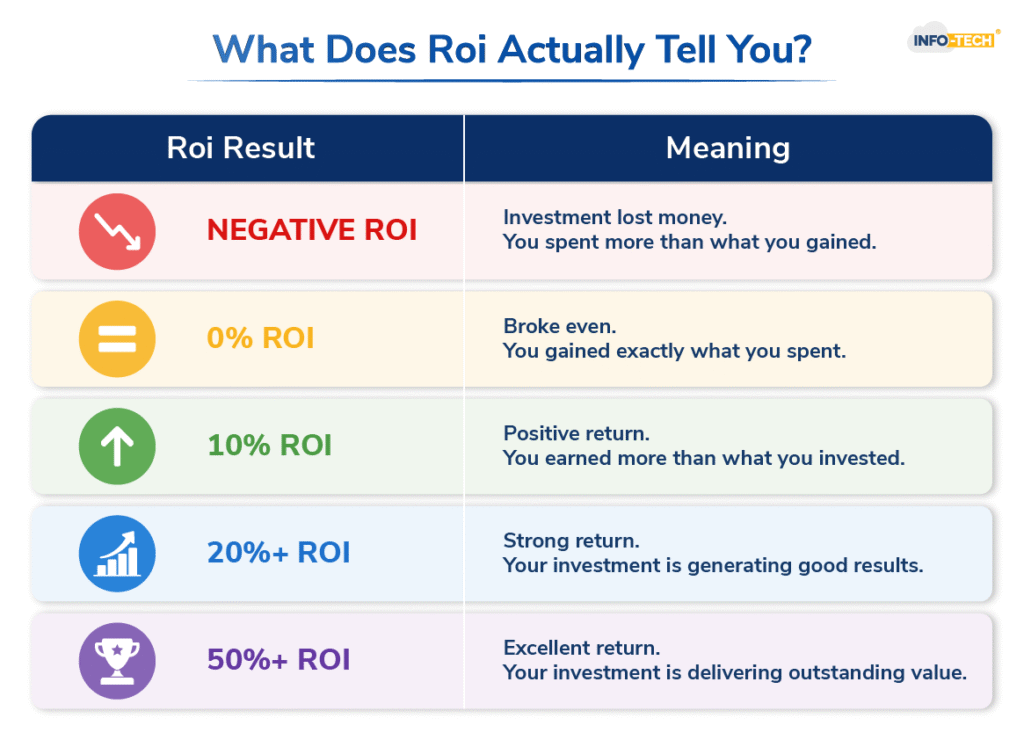
A positive ROI means the investment generated more value than it cost.
A negative ROI means the business spent more than it gained.
Simple enough.
Yet many businesses never calculate it.
They look at sales numbers, bank balances, or overall revenue and assume they have the full picture. The problem is that those numbers don’t always reveal whether a specific investment actually worked.
ROI fills that gap.
It provides a way to evaluate decisions after they’ve been made and, just as importantly, before making similar decisions again.
How Do You Calculate ROI?
The formula itself isn’t complicated.
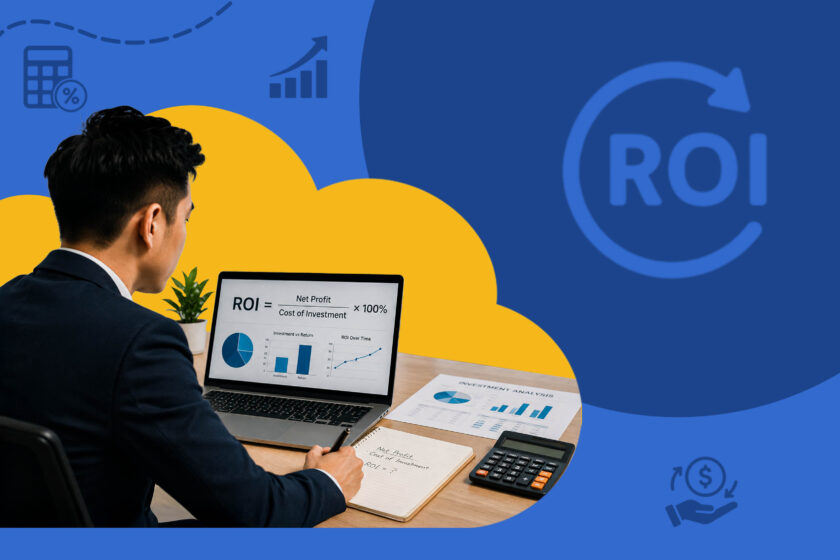
ROI is calculated by taking the net profit generated from an investment, dividing it by the cost of that investment, and multiplying the result by 100.
For example, if a business spends RM20,000 on a marketing campaign and generates RM35,000 in additional revenue, the net gain is RM15,000.
Using the formula:
(Net Profit ÷ Cost of Investment) × 100
The ROI would be 75%.
In practical terms, the business earned RM0.75 in profit for every RM1 invested.
The calculation is straightforward.
The difficult part is often collecting accurate data and identifying all the costs involved.
Many businesses underestimate expenses, overlook hidden costs, or fail to track performance properly. As a result, they end up making decisions based on incomplete information.
And incomplete information usually leads to expensive mistakes.
Why Do Businesses Often Calculate ROI Incorrectly?
There’s another catch that often gets overlooked. ROI doesn’t tell you how long it took to earn that return. A 50% ROI achieved in three months and a 50% ROI achieved over three years look exactly the same when you use the standard formula, even though they’re very different outcomes.
This is where annualized ROI becomes useful. Instead of looking only at the total return, it shows the average return generated each year, making it much easier to compare investments that run over different time periods.
The formula is:
Annualized ROI = [(1 + ROI)<sup>1/n</sup>] − 1
(where n is the number of years the investment was held).
Using the earlier example, if a business spent RM20,000 on a marketing campaign and earned a 75% ROI after three years, the annualized ROI would be about 20.6% per year, rather than 75% every year. Looking at investments this way gives a much fairer comparison and helps businesses avoid choosing an option simply because the headline ROI looks higher.
Here’s something that rarely gets mentioned when people talk about ROI.
Not every successful investment shows an immediate financial return.
Think about employee training.
A company may spend thousands of ringgit developing its staff. There may not be an obvious increase in revenue next month. However, better-trained employees often make fewer mistakes, provide better customer service, and stay with the company longer.
Those benefits matter.
The same can be said for brand building, customer experience improvements, or upgrading internal systems.
The return may not appear overnight, but that doesn’t mean it isn’t there.
This is why experienced business owners rarely look at ROI in isolation.
They use it as a guide rather than a verdict.
Solutions such as Info-Tech Accounting Software help businesses gain better visibility into their financial performance by bringing critical data into one place.
Because in business, spending money is easy. Knowing what that money is actually achieving is where the real advantage lies.
ROI Frequently Asked Questions
What is ROI in simple terms?
How do you calculate ROI?
ROI is calculated using the formula:
ROI = (Net Profit ÷ Cost of Investment) × 100
For example, if an investment costs RM10,000 and generates RM15,000 in returns, the net profit is RM5,000. The ROI would be 50%.
What is considered a good ROI for a business?
Why is ROI important for business decision-making?
ROI helps businesses compare different investment opportunities and identify which ones create the most value. Whether evaluating marketing campaigns, software purchases, equipment upgrades, or hiring decisions, ROI provides a clearer picture of how effectively money is being used.