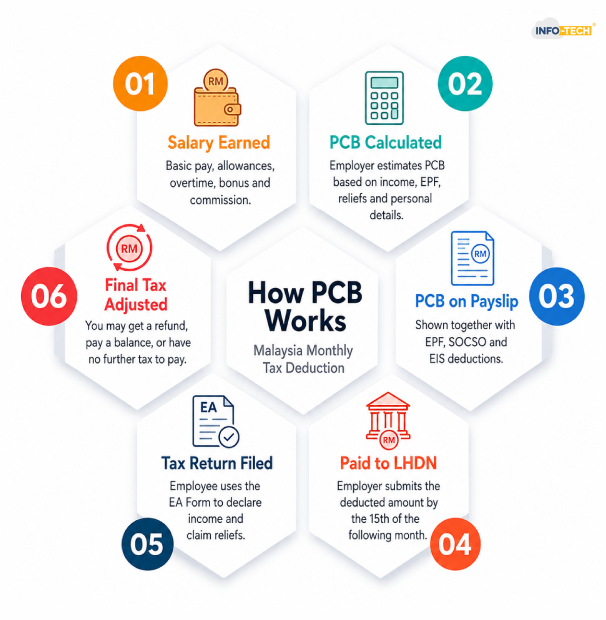
Seeing “PCB” on your payslip can be confusing, especially when EPF, SOCSO and EIS have already been deducted from your salary. PCB is not an additional charge from your employer. It is part of your personal income tax, collected gradually throughout the year. Your employer calculates the amount, deducts it from your monthly salary and submits it to Lembaga Hasil Dalam Negeri Malaysia, commonly known as LHDN or HASiL.
Here is what employees and employers in Malaysia should know about it.
What is PCB in Malaysia?
PCB stands for Potongan Cukai Bulanan, which directly means Monthly Tax Deduction or MTD in English.It is a system used to collect income tax directly from an employee’s monthly salary. Instead of paying the entire year’s tax in one large amount, eligible employees pay it in smaller deductions throughout the year.HASiL describes it as a mechanism through which employers deduct part of an employee’s monthly remuneration for income tax purposes.PCB is different from other payslip deductions:
EPF is for retirement savings.
SOCSO provides social security protection.
EIS supports eligible employees who lose their jobs.
PCB is an advance payment towards personal income tax.
PCB spreads your estimated income tax across the year. Without monthly deductions, you might need to pay a much larger amount when submitting your annual income tax return. Regular deductions make the payment more manageable and help reduce the risk of an unexpected tax bill.Your employer deducts the amount before paying your net salary. This is why your take-home pay is lower than the gross salary shown in your employment contract. The deduction also helps HASiL collect employment income tax during the year rather than waiting until employees submit their returns.
PCB normally applies when an employee earns enough taxable employment income to have an income tax liability. However, there is no single monthly salary at which every employee automatically starts paying it. Two people earning the same salary may have different deductions because the calculation can be affected by:
HASiL states that a single individual generally needs a Tax Identification Number when annual employment income exceeds RM34,001 after EPF deductions. The threshold shown for a married individual with an unemployed spouse is RM46,001. These are TIN registration guidelines rather than one fixed PCB salary limit.The safest way to check an expected deduction is to use the official HASiL PCB calculator rather than relying on a general salary estimate.
PCB is not always calculated by simply working out your annual tax and dividing it by 12. Employers use HASiL’s PCB calculation rules, an approved computerised payroll calculation or the electronic schedule. HASiL publishes updated calculation specifications for payroll systems, including the 2026 specifications.The calculation generally considers:
Your current monthly remuneration
Income received earlier in the year
EPF contributions and other permitted deductions
Applicable tax reliefs and rebates
PCB already deducted during previous months
Additional remuneration such as bonuses or commissions
Because Malaysia uses progressive individual income tax rates, the tax rate increases as chargeable income rises. A bonus or salary increase may therefore cause a higher PCB deduction in that particular month.Employees can check an estimated amount through HASiL’s official PCB calculator.
PCB is mainly connected to income received through employment. It may cover more than just your basic salary. Income that can affect the calculation includes:
Monthly wages or salary
Overtime payments
Fixed and variable allowances
Bonuses and incentives
Sales commissions
Director’s fees
Gratuities
Benefits provided by the employer
Certain accommodation benefits
Tax paid by an employer on behalf of an employee
An employee with a steady monthly salary may see a similar deduction each month. Someone receiving irregular commissions, overtime or a year-end bonus may see the PCB amount change.Freelance income, rental income and income from a separate business are not normally known to your employer. These still need to be declared when you submit your annual tax return.
PCB is generally an advance payment towards your income tax, not automatically the final amount you owe. After the year ends, your actual tax is calculated using your total income, allowable reliefs, deductions, rebates and PCB already paid.There are three possible outcomes:
You paid the correct amount: No further payment or refund is required.
You paid too much: You may receive a tax refund after your return is processed.
You paid too little: You will need to pay the remaining balance.
An underpayment may happen when you receive income that was not fully included in the monthly calculation. An overpayment may happen when you qualify for reliefs that were not considered by your employer. HASiL also allows PCB to be treated as final tax in certain qualifying cases. Employees who are unsure whether this applies to them should check their position through MyTax or with HASiL.
Having PCB deducted does not always remove the need to file an annual income tax return. A resident employee without business income generally uses Form BE or e-BE. The employer provides an EA Form showing the employee’s annual remuneration and total PCB deductions, which helps the employee complete the return. Filing allows you to:
Declare your full annual income
Include income from other sources
Claim eligible tax reliefs and rebates
Confirm the amount of PCB already deducted
Pay any remaining tax
Request a refund when too much tax was deducted
HASiL states that the standard deadline for Form BE was 30 April 2026, while the online e-BE deadline is generally 15 May. Online dates may change, so taxpayers should check the filing programme announced for the relevant year. Supporting documents do not normally have to be attached to the return, but records such as the EA Form, insurance receipts, donation receipts and other relief documents should be kept for seven years.
What Should You Do If Your PCB Looks Wrong?
Start by checking your payslip, salary details and personal information with your HR or payroll team. A difference does not always mean the payroll calculation is wrong. Your PCB may change after receiving a bonus, commission, salary adjustment or another type of additional remuneration.You may need to provide one of the following forms:
Form TP1: Used to inform an employer about eligible deductions and rebates that may be included in the current PCB calculation.
Form TP3: Used when joining a new employer after working elsewhere during the same calendar year. It provides information about income and PCB from the previous employer.
HASiL publishes the latest TP1 and TP3 forms together with its PCB calculation specifications.You can also compare the deduction with the official PCB calculator. When the difference cannot be explained, ask the payroll team to review the employee data and calculation method.
Employers are responsible for calculating PCB accurately, deducting it from employees’ salaries and submitting the amount to HASiL. The PCB collected for a month must be remitted on or before the 15th day of the following month. Employers can submit information using approved services such as e-PCB, e-Data PCB or e-CP39. A payroll software can make this process easier by keeping employee information in one place, applying the latest PCB calculation rules and including salary changes, bonuses, EPF contributions and previous deductions. It can also produce clearer payslips and payroll reports, making the process easier for employees to understand their deductions and for employers to maintain accurate records. PCB may look like just another deduction reducing your take-home pay, but it is a crucial way of paying personal income tax gradually. Checking your payslip regularly and keeping your tax information updated can help prevent unexpected differences when it is time to file your annual return.
PCB Frequently Asked Questions
What is PCB in Malaysia?
PCB (Potongan Cukai Bulanan) means Monthly Tax Deduction. It is the amount deducted from the salary of the employee each month, as an advance for their annual tax.
What is the minimum salary to pay PCB in Malaysia?
There is no fixed minimum salary to pay PCB in Malaysia. It depends on the employee’s marital status, children, EPF contributions and tax reliefs.
What is a PCB used for?
PCB is used as an estimated advance tax payment done to LHDN/HASiL.
Is PCB the same as income tax?
No. PCB is the monthly payment method for income tax but is not the income tax itself.