

In this article
- 1. What exactly does an EPF calculator do?
- 2. Why do businesses rely on one?
- 3. What information do you need?
- 4. Why does salary make a difference?
- 5. Does age change the calculation?
- 6. What about foreign employees?
- 7. Can it handle more than standard payroll?
- 8. Where does the contribution go?
- 9. Who uses an EPF calculator?
- 10. Is it still worth calculating EPF manually?
- 11. EPF Calculator FAQs
There comes a point where almost every employer asks the same question.
“Are these EPF figures correct?”
It might be after hiring a new employee. It might be during payroll. Or maybe someone notices that the deduction on a payslip looks different from last month.
EPF calculations aren’t difficult once you know the rules. The problem is that the rules aren’t always identical for everyone. Salary matters. Age matters. Nationality matters. Even the employer’s contribution can change depending on monthly wages.
That’s why most payroll teams don’t sit down with a calculator anymore. They use an EPF calculator instead.
A perfect EPF calculator takes the information you enter, applies the correct contribution rates, and produces the figures in seconds. No checking tables. No mental maths. No wondering whether you’ve used the right percentage.
What exactly does an EPF calculator do?
At its simplest, it answers one question.
How much should both the employer and employee contribute to EPF this month?
Instead of calculating everything yourself, you enter a few details and let the calculator do the work.
Most calculators will show:
- Employee contribution
- Employer contribution
- Total EPF payable
- Applicable contribution rate
Some also break down how much goes into each EPF account, giving employees a clearer picture of where their retirement savings are going.
It’s a small tool, but one that saves a surprising amount of time when payroll comes around every month.
Why do businesses rely on one?
Payroll isn’t just about paying salaries.
Every month, there are statutory deductions to calculate, records to update, and deadlines to meet. When payroll involves ten employees, the work is manageable. When it involves fifty or five hundred, every manual calculation becomes another opportunity for mistakes.
That’s why calculators have become part of the normal payroll process.
They help businesses work faster, but more importantly, they help them work consistently.
Many payroll teams use an EPF calculator before finalising payroll simply as a way to double-check the numbers.
What information do you need?
Not much.
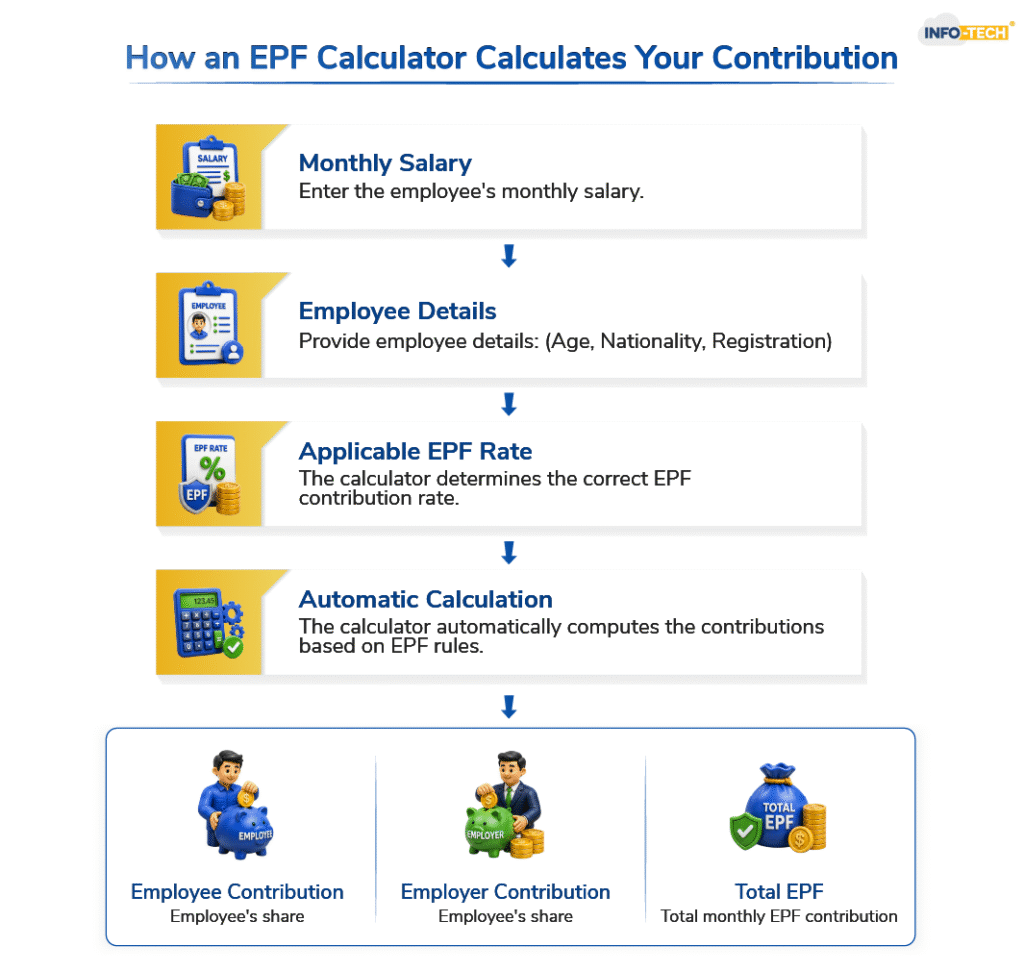
In most cases, you’ll only need four pieces of information.
- Monthly salary
- Employee’s age
- Nationality
- EPF registration category, if applicable
Once those details are entered, the calculator determines which contribution rates apply and performs the calculation automatically.
The process usually takes less than a minute.
Why does salary make a difference?
People often assume EPF uses one fixed percentage for everyone.
That’s only partly true.
Employees generally contribute 11% of their monthly wages if they’re below the age of 60.
The employer’s contribution, however, isn’t always identical. For employees earning up to RM5,000 a month, employers generally contribute 13%. Above that salary level, the contribution is generally 12%.
An EPF calculator checks the salary first before deciding which employer rate should be applied.
Without a calculator, payroll staff would need to keep referring back to contribution schedules.
Does age change the calculation?
Yes.
Once an employee reaches a certain age, different EPF contribution rates apply.
For employees below 60 years old, the standard rates are normally used.
Employees between 60 and 75 years old follow a different contribution structure under EPF rules.
It’s an easy detail to overlook if calculations are being done manually, which is one reason payroll teams prefer using a calculator.
What about foreign employees?
This is another area where confusion sometimes happens.
Malaysian citizens and permanent residents generally follow the standard EPF contribution framework.
Foreign employees may have different contribution requirements depending on the latest EPF regulations.
Rather than remembering which rules apply to each employee, the calculator adjusts the calculation after the correct nationality is selected.
For companies with both local and foreign workers, that can remove a lot of uncertainty during payroll.
Can it handle more than standard payroll?
Usually, yes.
Modern EPF calculators aren’t limited to straightforward salary calculations.
Many also support situations involving:
- Joint share contribution rates
- Disability contribution rates
- i-Saraan voluntary contributions
- Other special EPF categories
That means payroll staff don’t have to switch between different references when unusual situations arise.
Where does the contribution go?
Not every ringgit goes into the same account.
EPF divides contributions into different savings accounts.
Under the current structure, contributions are generally allocated as follows:
- 70% to Account 1
- 30% to Account 2
Account 1 is intended mainly for retirement savings.
Account 2 can be used for approved purposes before retirement, such as buying a home, education expenses, or certain medical needs, subject to EPF’s withdrawal rules.
Some calculators even display this split automatically, making it easier for employees to understand their savings.
Who uses an EPF calculator?
Almost anyone involved in payroll.
Business owners use it when estimating employment costs.
HR teams use it while preparing monthly payroll.
Finance departments use it to verify contribution figures.
Employees use it to check whether the deduction shown on their payslip looks reasonable.
Although everyone uses it for slightly different reasons, they’re all looking for the same thing—accurate calculations.
Is it still worth calculating EPF manually?
There’s nothing stopping you.
The formulas aren’t especially complicated.
But payroll isn’t done once. It’s repeated every month. Employees receive salary adjustments. New staff join. Others resign. Some turn 60. Others may have different contribution requirements.
The more variables there are, the easier it becomes to overlook something.
Using a calculator doesn’t replace payroll knowledge. It simply removes repetitive calculations, allowing payroll teams to focus on reviewing information instead of working everything out from scratch.
Final thoughts
A reliable Malaysia EPF calculator won’t replace payroll software, but it does make everyday calculations much easier.
Whether you’re checking your own payslip or preparing payroll for an entire workforce, having the correct contribution figures within seconds is far more practical than calculating everything manually.
For businesses that process payroll every month, an integrated payroll system goes a step further by calculating EPF automatically alongside salaries, statutory deductions, and payslips. It reduces repetitive work, improves consistency, and helps payroll teams stay focused on reviewing the numbers instead of calculating them manually.
EPF Calculator FAQs
How do I calculate my EPF contribution in Malaysia?
You can calculate your EPF contribution by entering your monthly salary, age, nationality, and EPF registration details into an EPF calculator. The calculator automatically applies the correct employer and employee contribution rates based on current KWSP guidelines.
What is the current EPF contribution rate in Malaysia?
For most employees below 60 years old, the employee contribution is generally 11% of monthly wages. Employer contributions are typically 13% for employees earning up to RM5,000 per month and 12% for those earning above RM5,000, subject to the latest EPF regulations.
Does age affect EPF contribution rates?
Yes. EPF contribution rates change once an employee reaches certain age groups. Employees aged 60 to 75 generally have different contribution rates from employees below 60, and an EPF calculator automatically applies the appropriate rate.
Can foreign workers contribute to EPF in Malaysia?
Yes. Foreign workers may contribute to EPF depending on the applicable EPF regulations and their employment status. Contribution requirements can differ from those for Malaysian citizens and permanent residents, so it’s important to check the latest KWSP guidelines.