

In this article
- 1. Why Does Tax Compliance Feel More Complicated?
- 2. What Are the Key Tax Obligations For Tax Compliance?
- 3. What Are The Important Tax-Related Timelines?
- 4. What Happens If You Do Not Comply to Tax
- 5. What Kind of Records Should a Business Keep?
- 6. What Should You Know About CP58?
- 7. What Are the Common Mistakes Businesses Make?
- 8. How Can Businesses Handle Tax Audits Better?
- 9. Why Is Tax Compliance No Longer Just an Accounting Task?
- 10. How Info-Tech Malaysia Supports Tax Compliance?
- 11. Final Note
- 12. Tax Compliance FAQs
If you run a business in Malaysia, tax compliance is one of those things you can’t afford to ignore. It’s not just about submitting a form once a year and moving on. It’s an ongoing responsibility that sits quietly in the background of your operations.
At its core, tax compliance simply means following the rules set by LHDN. That includes registering your business correctly, filing your taxes on time, paying what’s due, and keeping proper records in case anything gets questioned later.
Most businesses don’t struggle with understanding this, but they struggle with keeping up consistently.
Why Does Tax Compliance Feel More Complicated?
A lot of business owners will tell you the same thing: tax used to feel simpler. That’s now changed. Over the years, a few things have made compliance more demanding:
- Rules and guidelines don’t stay the same for long
- More filings and submissions are now done digitally
- Authorities are stricter when it comes to enforcement
- Systems across agencies are starting to “talk” to each other
- There’s less tolerance for inconsistencies
Because of all this, tax compliance has shifted from being a yearly task to something that needs attention throughout the year.
What Are the Key Tax Obligations For Tax Compliance?
It helps to keep things simple here. There are a few core things every business needs to get right.
Filing your tax return
Companies are required to submit their income tax return (Form e-C). This needs to be done within 7 months after the end of your financial year.
Submitting documents through MITRS
Starting from YA 2025, certain documents 9ones specified under Section 82B of the act) need to be submitted electronically. These must be provided within 30 days after your tax return deadline.
Declaring your estimated tax (CP204)
Before your financial year begins, you’re expected to estimate how much tax your business will pay. New businesses are given a bit of time, they can submit this within 3 months of starting.
Revising your estimate
If your numbers change, you’re allowed to revise your estimate during specific months (usually the 6th, 9th, or 11th month).
Paying in instalments
Once your estimate is submitted, tax is usually paid monthly in instalments. 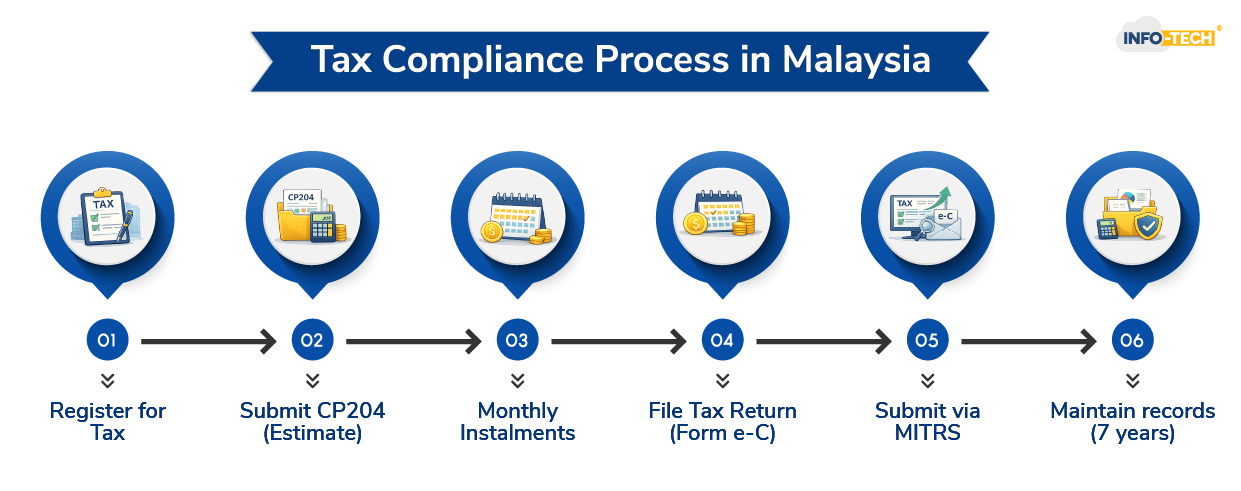
What Are The Important Tax-Related Timelines?
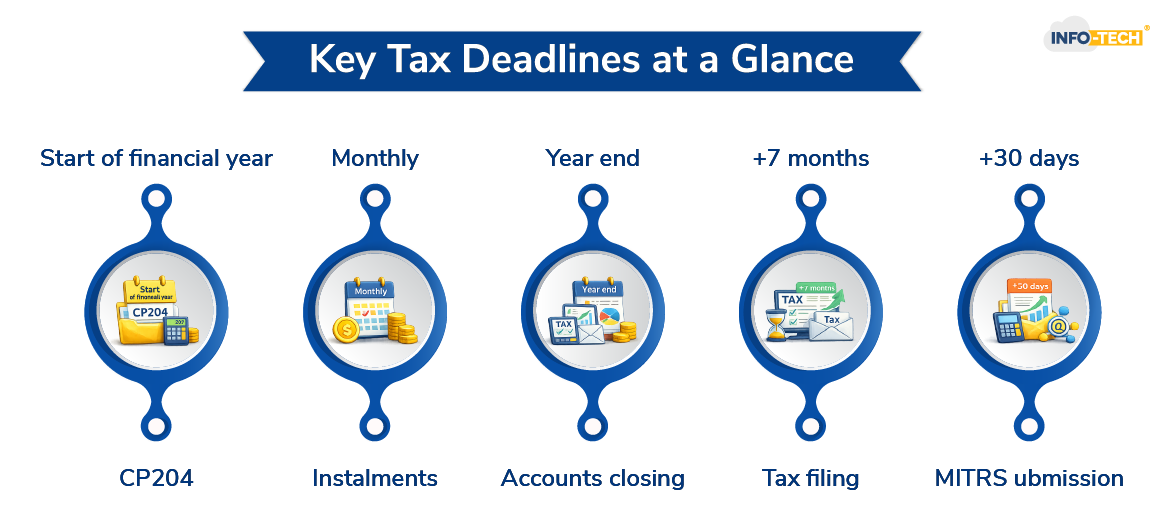
| Requirement | Timeline |
| Tax return filing | Within 7 months after financial year end |
| CP204 submission | Before start of financial year |
| Instalment payments | Monthly |
| MITRS submission | Within 30 days after filing |
| Record keeping | At least 7 years |
What Happens If You Do Not Comply to Tax?
This is where things can escalate quickly. Even small delays or errors can lead to:
- Penalties for late submission
- Additional tax charges
- Fines ranging from RM200 to RM20,000
- In more serious cases, legal consequences
- Penalties that can go up to three times the tax amount
There’s also a 10% penalty if no tax estimate is submitted when required. It’s not just about paying more; it’s the time and stress that comes with fixing the issue later.
What Kind of Records Should a Business Keep?
This is one area where many businesses fall short; not intentionally, but because things get messy over time. To stay on the safe side, you should have:
Core records:
- Cashbook
- Sales and purchase ledgers
- General ledger
Supporting Documents:
- Invoices
- Bank statements
- Receipts
- Payroll details
A few things worth remembering:
- These records need to be kept for at least 7 years
- Digital storage is fine, as long as it’s accessible
- If requested, you should be able to produce them without delay
If records are incomplete, it can create problems during audits, even if your numbers are correct.
Things To Know About CP58
Yes, and this one often gets missed. If your business pays agents, dealers, or distributors, you’re required to issue Form CP58 to them. This needs to be done by 31 March of the following year.
Skipping this step can lead to penalties, so it’s something worth building into your yearly routine.
What Are the Common Mistakes Businesses Make?
Even businesses that try to stay compliant run into similar issues. Some patterns show up again and again:
- Deadlines slipping through the cracks
- Errors in tax calculations
- Missing or incomplete documents
- Different departments working with inconsistent data
Most of the time, it’s not a lack of effort, but a lack of proper systems.
How Can Businesses Handle Tax Audits Better?
Audits are becoming more data-driven, so being prepared makes a big difference. A few practical habits can help:
- Keep everything organised from the start
- Make sure your tax filings match your financial statements
- Double-check calculations before submission
- Fix small issues early instead of letting them build up
- Respond promptly if LHDN reaches out
When things are in order, audits tend to be much smoother.
Why Is Tax Compliance No Longer Just an Accounting Task?
In many companies today, tax compliance is no longer handled only by the finance team. Management plays an important role too. They’re expected to:
- Keep an eye on compliance risks
- Ensure proper processes are in place
- Avoid penalties that could affect the business
- Stay aware of regulatory changes
It’s become part of how a business is managed, not just how accounts are handled.
How Info-Tech Malaysia Supports Tax Compliance?
For many businesses, the biggest challenge isn’t understanding tax rules; it’s managing everything consistently. That’s where having the right tools helps.
Info-Tech Malaysia offers cloud-based systems that take a lot of the manual work out of compliance. Here’s how we make things easier:
- Automatically calculates statutory deductions
- Keeps employee tax records accurate
- Reduces manual errors
- Tracks financial data in real time
- Helps maintain clean, structured records
- Makes tax reporting more straightforward
- Supports Malaysia’s digital tax requirements
- Keeps transaction records organised
- Reduces duplication and manual entry
Cloud-based systems
- Access data anytime, from anywhere
- Makes collaboration easier across teams
- Keeps records stored securely for years
Automation overall
- Less manual work
- Fewer missed deadlines
- Better accuracy across the board
Instead of constantly chasing numbers and paperwork, businesses can rely on systems that keep things running in the background.
Final Note
Tax compliance isn’t something businesses can treat casually anymore. It requires consistency, attention, and the right setup behind the scenes. Once you get the structure right, though, it becomes far more manageable and a lot less stressful in the long run.
Tax Compliance FAQs
What are the tax compliance essentials?
Tax compliance in Malaysia mainly involves registering your business with LHDN, filing tax returns on time, paying accurate taxes through estimates and instalments, and keeping proper records for at least seven years. Businesses must also meet reporting requirements like MITRS and CP58 while staying on top of deadlines. Staying organised and consistent is key to avoiding penalties and managing compliance smoothly.
What happens if you are not tax compliant?
If a business is not tax compliant in Malaysia, it can face both financial and legal consequences. This usually starts with penalties for late filing or incorrect submissions, along with additional tax charges and interest. In more serious cases, businesses may be fined between RM200 and RM20,000, and repeated offences can even lead to imprisonment. There’s also the risk of penalties up to three times the unpaid tax amount. Beyond that, non-compliance can trigger audits, disrupt operations, and damage the company’s reputation, making it harder to build trust with authorities and stakeholders.
What is the purpose of tax compliance?
The purpose of tax compliance is to ensure that businesses meet their legal obligations while contributing fairly to the country’s economy. By reporting income accurately, paying the correct amount of tax, and following regulations, businesses help fund public services like infrastructure, healthcare, and education. At the same time, staying compliant protects the business itself, reducing the risk of penalties, audits, and legal issues, while keeping financial records clear and reliable for better decision-making.
What is the most important aspect of tax compliance?
The most important aspect of tax compliance is accuracy. Everything from filing, payments, to reporting depends on getting the numbers right. Even if you submit on time, mistakes in calculations, incorrect claims, or inconsistent records can lead to penalties, audits, and unnecessary complications. Accurate records, clear documentation, and correct tax computations form the foundation of proper compliance.