

In this article
-
- 1. What Is Bookkeeping?
- 2. Why Business Owners Usually Ignore Bookkeeping Initially?
- 3. What Does A Bookkeeper Actually Do?
- 4. Bookkeeping vs Accounting: Why People Confuse The Two
- 5. Why Good Bookkeeping Matters More Than Most SMEs Realise?
- 6. What Is The Quiet Damage Poor Bookkeeping Causes?
- 7. Why More Malaysian SMEs Are Moving Toward Digital Bookkeeping?
- 8. Good Bookkeeping Is Also a Legal Requirement
- 9. Bookkeeping Frequently Asked Questions
What Is Bookkeeping?
Most people don’t open a business thinking, “I can’t wait to organise receipts.”
Usually, the excitement is somewhere else. Maybe it’s finally opening that café after years of planning. Maybe it’s
turning a side hustle into a proper business. Maybe it’s the freedom of working for yourself instead of somebody else.
Then the business starts growing.
Money starts coming in from different places. Payments go out almost daily. Suppliers need settling. Customers delay
invoices. Staff salaries become fixed monthly commitments. And before long, the business owner realises something
slightly uncomfortable:
There’s money moving everywhere, but nobody has a completely clear picture of it anymore.
That’s normally the point where it suddenly becomes important.
In simple terms, bookkeeping is the process of recording and organising all the money-related activity inside a
business. Every sale, every expense, every invoice, every payroll payment, every receipt — all of it gets tracked
properly so the business owner understands what’s happening financially.
Sounds straightforward enough.
But ask almost any accountant or finance consultant and they’ll tell you the same thing: poor bookkeeping quietly
destroys businesses.
Not overnight. Slowly.
Why Business Owners Usually Ignore Bookkeeping Initially?
To be fair, most SMEs don’t ignore bookkeeping because they’re careless.
They ignore it because they’re busy surviving.
A small business owner in Malaysia usually handles ten different responsibilities at once. One minute they’re replying
customers, the next they’re handling supplier issues, solving staff problems, checking inventory, or trying to close
sales before the month ends.
Bookkeeping gets pushed aside because it doesn’t feel urgent compared to everything else happening daily.
At first, it doesn’t seem like a big problem.
Maybe there are only a few transactions every week. Maybe the owner still remembers which customers haven’t paid yet.
Maybe receipts are still sitting neatly inside a folder somewhere.
Then business grows.
And suddenly things get messy.
Expenses start appearing from every direction. Bank transactions increase. Some customers pay late. Others partially
pay. Payroll becomes more complicated. SST records need organising. Tax deadlines appear faster than expected.
This is where many SMEs start losing visibility over their finances.
One common mistake is assuming that if sales are strong, the business must be healthy financially.
That assumption has caused problems for countless businesses.
A company can generate good monthly revenue while still struggling badly with cash flow because expenses are too high or
payments are arriving too slowly.
Without bookkeeping, these warning signs are easy to miss until the pressure becomes serious.
What Does A Bookkeeper Actually Do?
People sometimes think bookkeeping is just entering numbers into software all day.
There’s more to it than that.
A professional keeps the financial side of the business organised enough that the owner can actually understand what’s
happening.
They record sales, update expenses, track invoices, organise receipts, reconcile bank statements, maintain payroll
records, and make sure financial information stays accurate instead of becoming chaotic.
In many Malaysian SMEs, it is handled internally by whoever happens to be available.
Sometimes it’s the owner. Sometimes admin staff. Sometimes even family members helping with the business.
That may work during the early stages.
But once operations become busier, mistakes usually start appearing.
An unpaid invoice gets forgotten.
A supplier payment is missed.
Payroll numbers become inconsistent.
Receipts disappear during tax season.
None of these issues feel catastrophic individually. But together, they slowly create financial confusion inside the
business.
That’s usually when owners realise bookkeeping isn’t just paperwork anymore.
It’s operational survival.
Bookkeeping vs Accounting: Why People Confuse The Two
This confuses a lot of business owners, especially newer entrepreneurs.
People often use bookkeeping and accounting as if they mean exactly the same thing.
They’re connected, but they’re not identical.
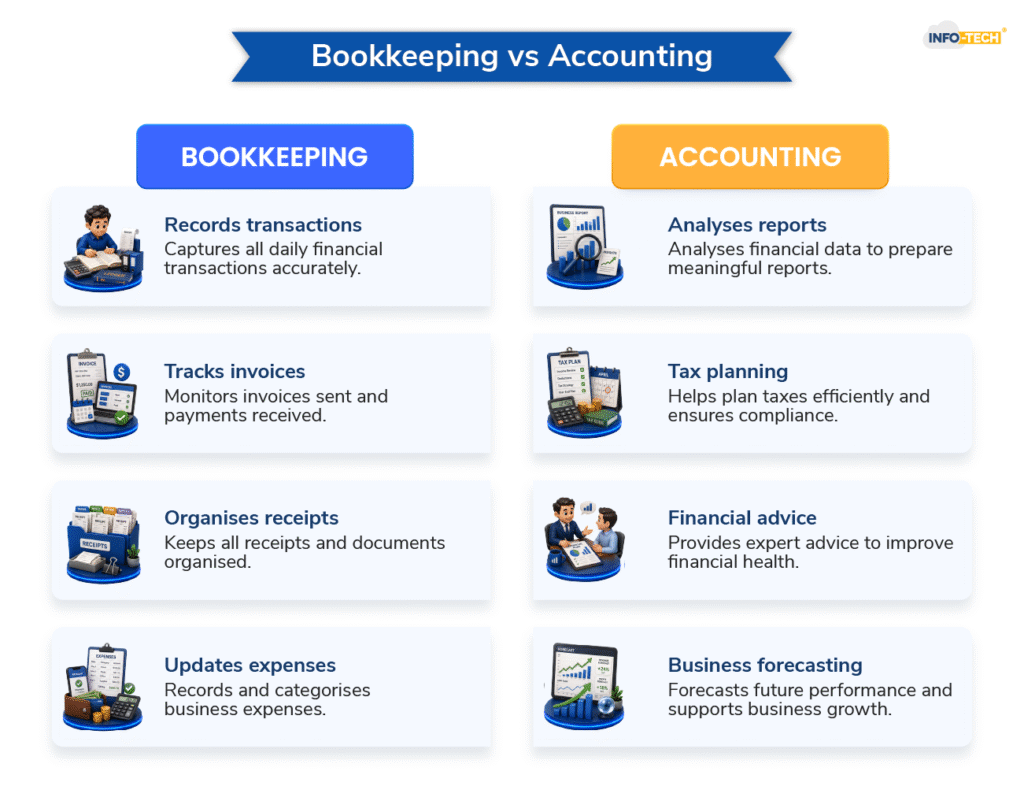
Bookkeeping focuses on recording financial activity.
It’s the day-to-day process of tracking money coming in and going out. Expenses get recorded. Invoices get updated.
Transactions get organised properly.
Accounting happens afterwards.
An accountant takes those financial records and turns them into something useful. They analyse business performance,
prepare reports, review profitability, handle tax planning, and advise on financial decisions.
A simple way to think about it is this:
To keep the records clean.
Accounting explains what the records are saying.
Without proper bookkeeping, accounting becomes unreliable because the information itself is incomplete or inaccurate.
That’s why businesses with messy bookkeeping often struggle during audits, tax filing, or financial reviews.
Why Good Bookkeeping Matters More Than Most SMEs Realise?
Many businesses don’t collapse because sales disappear completely.
They collapse because financial problems quietly build up in the background for too long.
This happens more often than people think.
A restaurant may look busy every evening but still struggle because operating costs increased steadily over the past
year.
An online seller may generate strong revenue but lose money through excessive advertising costs and delivery fees.
A startup may focus heavily on growth while ignoring unpaid customer invoices sitting there for months.
Without bookkeeping, these problems are hard to spot early.
That’s the dangerous part.
Business owners often realise there’s a financial problem only after cash flow becomes tight enough to affect
operations.
Good bookkeeping gives visibility.
It helps owners understand:
- Whether the business is actually profitable
- Which expenses are increasing
- Which customers still owe money
- Whether cash flow is healthy
- Whether payroll and taxes are accurate
Without that visibility, important decisions become guesses instead of informed business decisions.
What Is The Quiet Damage Poor Bookkeeping Causes?
Most bookkeeping problems don’t start dramatically.
Usually, it’s small things.
A missing receipt here.
An expense forgotten there.
An unpaid invoice nobody followed up on.
Then slowly, the financial picture becomes blurry.
One of the biggest issues SMEs face is cash flow confusion.
A business may record RM100,000 in sales but still struggle to pay suppliers because customers haven’t settled invoices
yet.
Revenue and available cash are not the same thing.
That misunderstanding catches many businesses off guard.
Poor bookkeeping also creates stress during tax season.
Suddenly business owners are searching for missing receipts, checking old transactions manually, or trying to remember
why certain expenses happened months ago.
And in Malaysia, proper financial records matter even more because businesses are expected to maintain organised
documentation involving SST, payroll, EPF, SOCSO, PCB deductions, and tax reporting.
When records are incomplete, even simple compliance tasks become unnecessarily stressful.
Why More Malaysian SMEs Are Moving Toward Digital Bookkeeping?
Bookkeeping today looks very different compared to ten years ago.
Many businesses are slowly moving away from paper-heavy systems and manual spreadsheets because they simply become too
difficult to manage once operations expand.
Cloud-based bookkeeping software now helps SMEs automate invoices, digitise receipts, track payroll, and monitor cash
flow much more efficiently.
This shift is becoming increasingly important as Malaysia moves further toward digital tax systems and e-Invoicing
implementation.
Businesses that modernise earlier usually find it easier to stay organised as they grow.
The businesses still relying entirely on manual tracking often struggle once transaction volume increases.
Good Bookkeeping Is Also a Legal Requirement
Bookkeeping isn’t just about staying organised or making tax season easier. In Malaysia, keeping proper financial records is also a legal responsibility.
Under Section 245 of the Companies Act 2016, companies must keep accounting records for at least seven years, with transactions generally recorded within 60 days. Similarly, Section 82 of the Income Tax Act 1967 requires taxpayers, including sole proprietors, to retain their tax records for seven years. SST-registered businesses are subject to the same seven-year record-keeping requirement under the Sales Tax Act 2018 and Service Tax Act 2018.
In other words, documents like invoices, receipts, payroll records, bank statements, and tax-related records shouldn’t be discarded once the financial year ends. Keeping them organised helps your business stay compliant and makes audits or tax reviews much less stressful.
Source:
- Companies Commission of Malaysia (SSM)
- Inland Revenue Board of Malaysia (LHDN)
- Royal Malaysian Customs Department (SST)
Final Thoughts
Bookkeeping is rarely the exciting side of business.
Nobody posts about perfectly organised receipts on social media.
But behind most financially stable businesses is a proper bookkeeping system quietly keeping everything under control.
Many SMEs only realise they have these problems once cash flow becomes stressful or tax deadlines start approaching.
At Info-Tech, we help Malaysian businesses improve payroll, HR, and financial management through practical software and business solutions designed for growing SMEs.
Whether your business needs payroll software, accounting software, HRMS, or financial management support, having the right systems in place can help businesses stay organised, compliant, and financially clearer as they grow.
Bookkeeping Frequently Asked Questions
What is bookkeeping in simple terms?
transactions inside a business, including sales, expenses, invoices, payroll, and payments.
Why is bookkeeping important for SMEs?
taxes properly, and maintain organised financial records.
What is the difference between bookkeeping and accounting?
focuses on analysing financial information and preparing reports.
Can bookkeeping help during tax filing?
filing and compliance reporting much easier.