

In this article
- 1. What is the Meaning of NLP?
- 2. Why is Natural Language Processing Important?
- 3. How NLP Works?
- 4. What are the Main Techniques in NLP?
- 5. What is the Difference Between NLP, NLU and NLG?
- 6. What are Some Examples of NLPs?
- 7. What are the Industries that Benefit out of NLP?
- 8. What are the Benefits of Natural Language Processing?
- 9. How NLP Supports Modern Businesses?
- 10. NLP Frequently Asked Questions
Think about the last time you searched for something on Google, asked chatbot a question, used voice-to-text option in your mobile phone or translated something online. You would have probably used a simple human language and not any special commands or programming language to do the same. And the technology manages to understand enough your request and provides benefitting responses.
Have you ever wondered what facilitates this? It is the ability of Natural Language Processing or NLP.
As Artificial Intelligence became a part of everyday business activity and personal technology, the role of NLP becomes significant. Behind many tools that people use for searching information, automate support and work with written information, there is NLP.
What is the Meaning of NLP?
Why is Natural Language Processing Important?
- When you ask a question, NLP understands and tries to answer the question.
- When you submit a document, NLP analyses and gives the important information.
- When a customer feedback is submitted, it says whether the feedback is positive, negative or neutral.
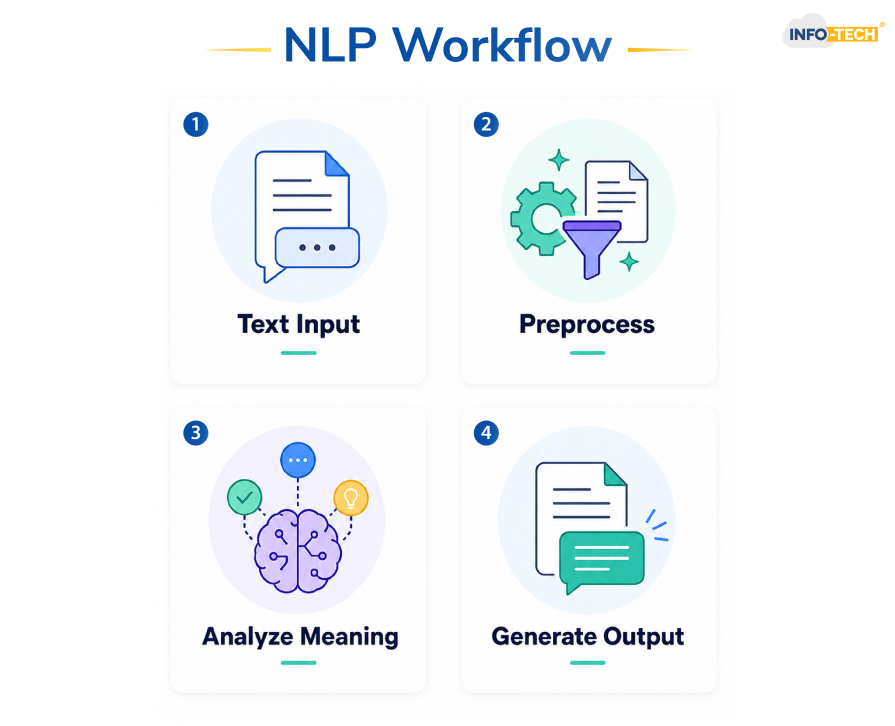
How NLP Works?
- Text collection (Data collection)
- Processing and cleaning the text data (Data processing)
- Breaking sentences into smaller parts (Language analysis)
- Understanding the meaning (Machine Learning)
What are the Main Techniques in NLP?
Tokenisation:
Tokenisation is the process of breaking down the sentences into smaller parts like the words and phrases. It is to make the process easier and help the system analyse each part better. It is usually the first stage of NLP.Sentiment Analysis:
It identifies whether a piece of sentence expresses positive, negative or neutral opinion. It is used by businesses to analyse employee feedback, reviews and surveys.Text Classification:
It is used to segregate texts into pre-defined categories. For an example, a customer support message can be classified into product enquiry, delivery details, complaint or general enquiry.Name Entity Recognition:
Nama entity recognition is used to identify several information within texts including people’s name, location, organisation, dates and products.Machine Translation:
Machine translation is used to translate information from one language to another. Modern translating platforms translates not just words but also sentences and contexts proving more natural translations. Businesses operating in multilingual markets can hugely benefit out of this.Text Summarization:
NLP can give a summarized context out of lengthier documents, articles and reports. This can save a lot of time while businesses deal with lengthy documents.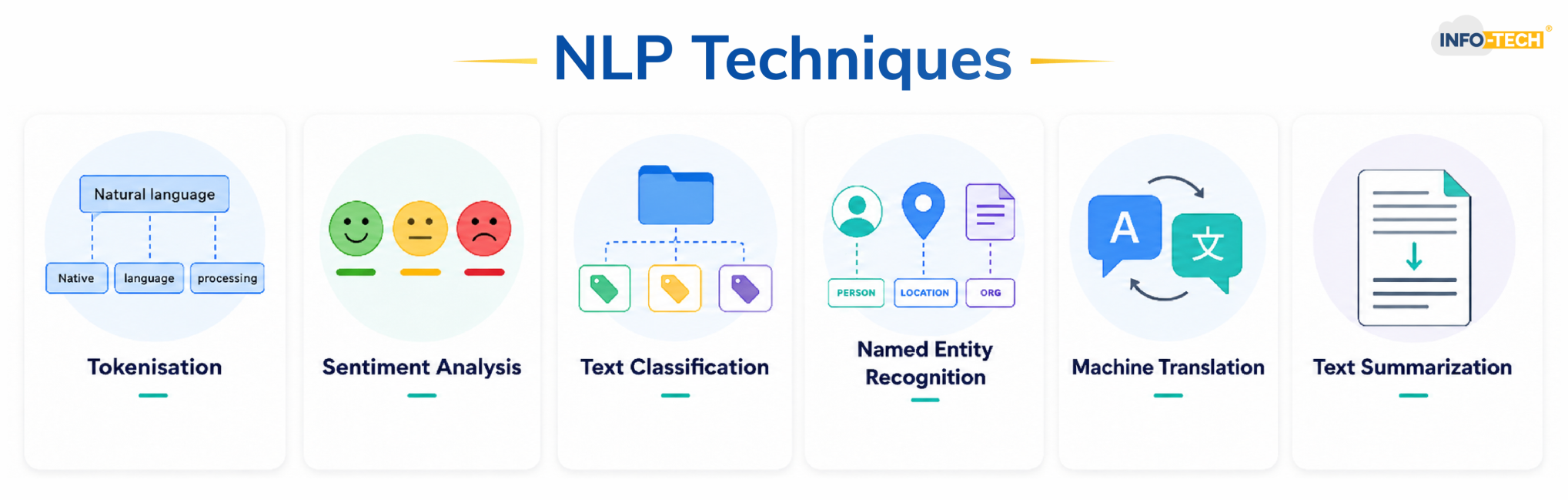
What is the Difference Between NLP, NLU and NLG?
- NLP – Natural Language Processing – A broader category that helps computers process and work with human language.
- NLU – Natural Language Understanding – It helps systems understand the meaning, context and the intent.
- NLG – Natural Language Generation – It helps systems to generate useful responses that are in readable language for human.
What are Some Examples of NLPs?
What are the Industries that Benefit out of NLP?
Some of the industries that have NLP application:
What are the Benefits of Natural Language Processing?
- NLP understands the human language better and this makes the use of technology much easier.
- The sentiment analysis in NLP helps businesses understand the concerns and preferences of the customers.
- NLP provides answers to the questions though they are asked using a simple language. This improves the access to information.
- Chatbots and automated responses make businesses answer the queries so fast.
How NLP Supports Modern Businesses?
For Malaysian businesses that look for digital transformation, the technology like NLP shows how AI can be used even in ordinary companies rather than other technologies which can be applied only in technology related companies.
Read Also: Modern Business Activities
Do You Want to Digitalise your Business Processes?
Info-Tech’s HRMS and CRM systems bring potential processes into digital platforms, making the administrative works and operations perform efficiently. Explore Info-Tech’s software and discover how everyday business activities can become easier.
NLP Frequently Asked Questions
Wha is NLP in AI?
NLP is a part of AI that focuses mainly on communication and language. It allows AI to communicate with people using simple human-language instead of computer languages.
What are the two components of NLP?
Natural Language Understanding (NLU) and Natural Language Generation (NLG) are the two components of NLP.
What are two examples of NLP?
A customer service Chatbot and voice assistants are the two examples pf NLP.
What is NLP used for?
NLP is used to make the computers understand, analyse and respond to human requests in a human understanding language.