
In this article
- 1. What is IoT?
- 2. What is the Meaning of IoT?
- 3. How Does IoT Work?
- 4. What are the Main Components of IoT?
- 5. What are the Key Features of IoT?
- 6. What are the Benefits of IoT?
- 7. What are the Real-time Challenges?
- 8. What is the Future of IoT?
- 9. What is the Role of Digital Advancements in Smarter Businesses?
- 10. IoT Frequently Asked Questions
Think of an air conditioner that can automatically regulate its temperate, a smart watch that gives you the steps count and heartbeat rate, a sensory device that gives an alert when a machinery becomes too hot in a factory, or a camera that can be accessed from anywhere through your mobile.
The serving purpose of all these devices are different. But one common thing in all of these devices is that they do collect data from the devices, communicate them with the systems with internet connectivity and does not require manual effort at any point.
So, this is a basic idea behind Internet of Things (IoT). But what are its benefits, features, how do they help businesses in real world situations are some of the questions that remain unanswered. This guide acts as a tool to answer all such questions in simple terms.
What is IoT?
IoT stands for Internet of Things. It is a network of connected devices that can collect, share and communicate data with the help of internet connection. This is sometimes automated and does not require any human effort. Smart watches that count the steps, appliances that automatically switches off when its job done are some better examples for this.
What is the Meaning of IoT?
The meaning of IoT can be understood better when its main idea has been divided into three,
Things:
The things in IoT mean the physical objects like the sensor, vehicles, machines, camera, appliances and watches
Internet:
The data must be communicated with other systems life the software or cloud platforms. Internet connection becomes crucial to serve this purpose.
Data:
The raw information collected by these devices are not so useful. Whereas they can be combined with analytics and help making better and informed decisions.
So, IoT makes the devices capable of providing information that can help in taking required actions with internet connection.
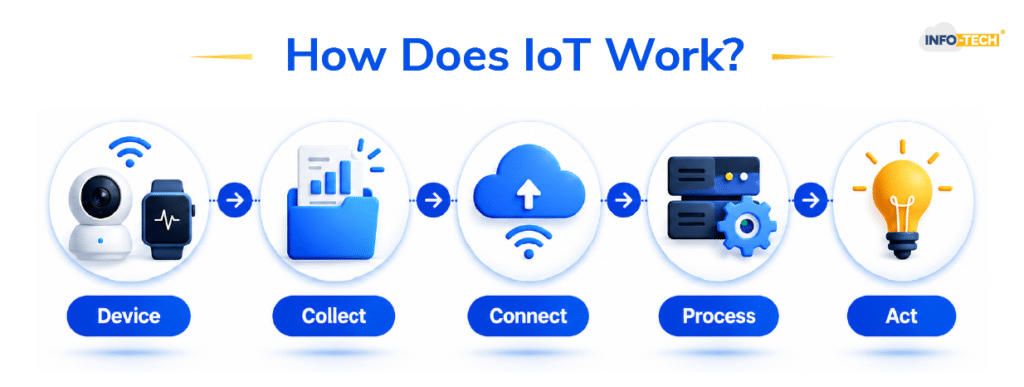
How Does IoT Work?
The process behind IoT is quite simple,
Device → Collect Data → Connect → process data → Act
Devices Collect Information:
The IoT devices have sensors installed and they collect information from the surroundings based on the purpose of the device. They may collect information like the temperature, attendance, humidity, pressure and speed.
Internet Connect:
Once the information is collected, they are sent through internet. Based on the IoT application the data may transfer through different technologies like Wi-Fi and Bluetooth.
Data Processing:
The collected data is sent to a software, a cloud platform or any other system where it can be processed. It determines whether any action is required or not.
Action:
The final step is to act with the information. If the processed information requires the device to act, it will do so.
For example, if the temperature turns out to be extremely heat, the system will process the data and sends an alert or notification to the team. In advanced environments, the systems can take actions automatically.
What are the Main Components of IoT?
It is important to note that the IoT systems can vary from one to the other. However, there are some common components for all IoT systems.
Sensors and Devices:
Sensors are installed in the IoT systems, and they are responsible for collecting information from the environment. The information may vary from speed, location and pressure to machine performance based on the purpose of the device.
Connectivity:
The collected information must travel from the devices to other systems like the software, cloud platform or other connected devices. So, the communication with other systems is enabled with internet connection.
Data Processing:
The raw data by itself may not do the needful. IoT platforms process the data and help in taking required actions.
User Interface:
People need a simple way to view the information to take required actions. A mobile application, dashboard or a notification screen are some of the ways to present information to the users in an easy way.
Read Also: Why Businesses Should Use Mobile Applications | Infotech
What are the Key Features of IoT?
Real-time Data Collection:
IoT can collect data continuously. It gives recent information about what is happening.
Automation:
IoT systems can work automatically for pre-defined situations. For an example, in a smart room, the lights can turn off automatically when the sensors detect that there is no one available in the room.
Remote Monitoring:
IoT does not require humans to be always available in the location to monitor the devices. They can be accessed from anywhere. This would largely help companies with warehouses, number of branches and field employees.
Data Sharing:
The data collected from physical devices can be shared to other systems. This can help in reports preparation and better decision making.
Informed Decision-Making:
The data collected from devices can be combined with analytics providing way to take informed decisions.
What are the Benefits of IoT?
The IoT devices can be accessed from anywhere.
Smart devices like camera, sensors and alarms can easily detect the issues and prevent them with alerts.
Smart devices at home make everyday life hassle-free and better.
Businesses can make informed decisions with useful information collected from these devices.
IoT supports smart agriculture and water management using the available resources, providing environmental benefits.
Businesses can receive information frequently rather than waiting long for the reports. So, they may not miss to take required actions.
Monitoring related tasks are automated, reducing manual efforts. So, their time can be utilized to do tasks that really requires human judgement.
What are the Real-time Challenges?
Although IoT has number of benefits, it is important to note that it has its own challenges as well.
Security becomes an important concern with IoT. Every connected device must be secured well to protect the important data. Usage of authentication factors like verification codes, passwords and regular software updates can secure the data.
IoT devices collect a large amount of data. So, it becomes important for the users to be aware of what type of data is being shared, why it is needed, whom the data are being share to and how long the data will retain.
Businesses may use hundreds and thousands of devices, and some of them go no longer functioning. So, it becomes important to monitor them regularly.
What is the Future of IoT?
The IoT will become more advanced in the upcoming days. Its usage will prominently increase homes, healthcare, agriculture and other industries. The AI advancements will make IoT perform even better and smarter. The user experience with IoT is going to be great in the future.
Smart home options will become quite common in the future to make daily life easier.
Communication becomes an inevitable part in Io. With 5G, the communication between systems becomes even more reliable.
The privacy and security become more important in the future as multiple devices will be connected.
What is the Role of Digital Advancements in Smarter Businesses?
In this growing business world, information becomes very much important. Devices, employees and software can generate more information. But they are not going to serve the purpose unless the information can be organised. Businesses should have the capability to use the information to make better actions. The real time data is more important for smarter businesses and that can be easily extracted with the digital advancements. Businesses become more adaptable to changes and can compete better.
IoT Frequently Asked Questions
What is an IOT device?
An IoT device refers to any physical object with a sensor that has a unique identifier. Its primary goal is to communicate with devices and users in real time.
What are five examples of IoT devices?
The smart watch, fitness tracker, security camera, smart washing machine and smart lighting system are the examples of IoT devices.
Is CCTV an IoT device?
Yes, the modern CCTV cameras that come with internet connectivity are IoT devices.
What are the requirements for IoT?
A physical hardware, internet connectivity, cloud platform and strict protocols are the requirements for IoT.