

In this article
- 1. What Is Passive Income?
- 2. What Is the Difference Between Passive Income And Active Income?
- 3. Why Passive Income Is Popular Today?
- 4. What Are the Best Passive Income Ideas?
- 5. What Are the Risks With Passive Income?
- 6. How Is Technology Changing Passive Income Opportunities?
- 7. Conclusion
- 8. Passive Income FAQs
A lot of Malaysians have started looking for extra income over the past few years. Some are trying to manage rising living costs. Others want more financial security because depending on one salary no longer feels enough. Even people with stable jobs are quietly building side income streams now.
That is where the question usually comes in: what is passive income?
The term gets thrown around everywhere online. TikTok videos make it sound effortless. YouTube thumbnails promise “money while you sleep.” But once you look beyond the hype, passive income is actually much more practical and much more realistic than internet culture makes it seem.
For most people in Malaysia, passive income is not about becoming rich overnight. It is about creating another layer of financial support slowly, whether that means covering monthly bills, reducing stress, saving for retirement, or simply having backup income during uncertain times.
What Is Passive Income?
Passive income is money that continues to come in without needing constant day-to-day work after the initial setup.
That does not mean “zero effort.” Usually, there is work involved at the beginning. Sometimes a lot of work. For example:
- A landlord buys and manages a rental property before earning rental income
- A content creator spends months building an audience before ads generate income
- An investor builds a dividend portfolio over time
- A freelancer creates a digital product that keeps selling repeatedly
The key difference is: eventually, the income becomes less tied to daily working hours.
That is why passive income feels attractive. Your earnings are no longer completely dependent on clocking in every single day.
What Is the Difference Between Passive Income And Active Income?
Most Malaysians are already familiar with active income even if they do not call it that.
Active income is the money you earn directly from your work:
- Salary
- Freelance projects
- Overtime pay
- Commission-based jobs
- Hourly work
Once you stop working, the income usually stops too. But passive income works differently. The idea is to build something that continues generating returns with lower ongoing involvement.
| Active Income | Passive Income |
| Requires continuous work | Can continue over time |
| Time-for-money model | Asset or system-based |
| Monthly salary | Rental income |
| Freelance payment | Dividend income |
| Immediate earnings | Slower but scalable |
Most people build passive income alongside active income first. Very few people jump straight into passive income full-time successfully.
Why Passive Income Is Popular Today?
Ten or fifteen years ago, one stable income may have felt enough for many households. Things feel different now. Daily expenses have gone up noticeably:
- Groceries
- Fuel
- Property prices
- Education costs
- Insurance
- Medical bills
At the same time, many younger Malaysians are also thinking more seriously about long-term financial stability. There is greater awareness now around emergency savings, retirement planning, and income diversification.
The pandemic also changed how people think about money. Many realised how risky it can be to rely entirely on one source of income.
That is why passive income Malaysia searches have increased so much recently. People are not just chasing luxury anymore. A lot are simply trying to create breathing room financially.
Is Passive Income Really “Money While You Sleep”?
Sometimes yes, but mostly no. The phrase sounds catchy, but it skips an important part of the story.
A YouTuber earning ad revenue today may have spent three years uploading videos before seeing meaningful income. Someone earning dividends may have invested consistently for a decade. Passive income usually involves one of these:
- upfront effort
- upfront capital
- long-term patience
- systems and automation
- consistent maintenance
There are very few truly effortless income streams. Understanding this early helps people avoid scams and unrealistic expectations.
What Are the Best Passive Income Ideas?
The best passive income idea depends heavily on your situation, income level, skills, and risk tolerance.
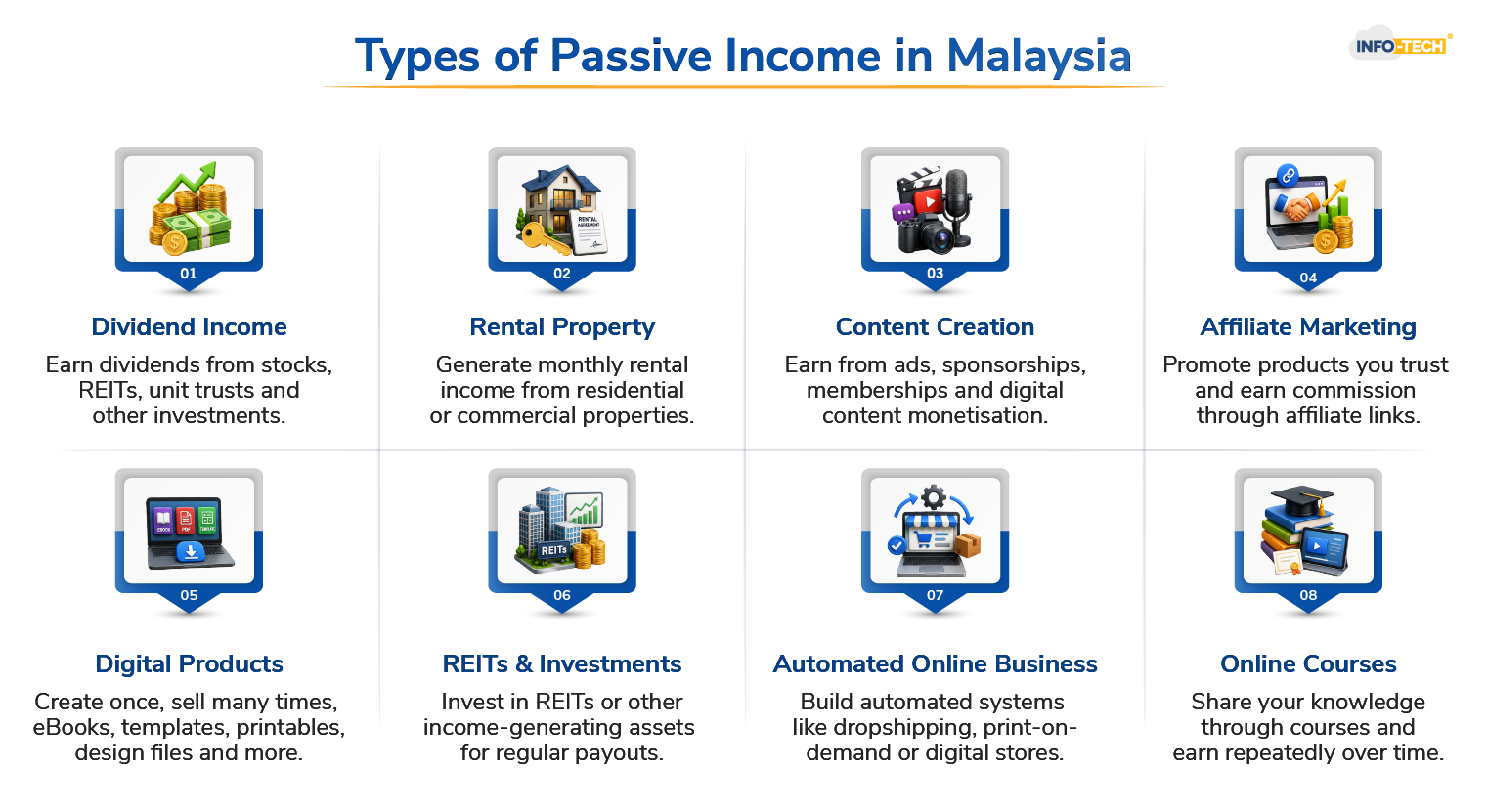
Someone with savings may lean toward investing. Someone creative may prefer digital products or content creation. Still, there are several common approaches Malaysians are exploring today.
Can Dividend Investing Generate Passive Income?
Dividend investing remains one of the more traditional passive income methods in Malaysia.
When you invest in dividend-paying companies, you receive payouts from company profits based on your share ownership. Some Malaysians build dividend income through:
- Bursa Malaysia stocks
- REITs
- unit trusts
- ETFs
- ASM (Amanah Saham Malaysia)
- ASB investments (Bumiputera-only)
One reason dividend investing appeals to working adults is because it does not necessarily require running a business or creating content online.
But it is important to stay realistic. Dividend returns grow slowly unless significant capital is involved. Markets also fluctuate, and dividends are never guaranteed. Still, over time, dividend income can become a meaningful secondary income stream.
Can Rental Property Become a Passive Income Stream?
Property has long been associated with wealth building in Malaysia.
Many people still see rental property as one of the more reliable forms of investment income. Rental income may come from:
- apartments
- landed homes
- commercial units
- student accommodation
- short-term stays
But people often underestimate the responsibilities involved.
Property ownership comes with:
- maintenance costs
- loan repayments
- renovations
- vacant periods
- tenant management
So while rental income can become semi-passive eventually, it is rarely hands-off in the beginning. That said, many Malaysians still prefer property because it combines recurring income with long-term asset appreciation.
Can You Earn Passive Income From Digital Products?
This has become increasingly common over the last few years.
Digital products are attractive because they can be created once and sold repeatedly online. Examples include:
- e-books
- templates
- online courses
- design assets
- printable planners
- educational resources
A Malaysian graphic designer, for instance, might create Canva templates for small businesses and continue earning from them long after the initial work is done. The same applies to fitness trainers, teachers, consultants, and even HR professionals.
Knowledge itself has now become monetisable.
Is Content Creation a Real Passive Income Opportunity?
It can be, although it usually takes time.
A lot of people think content creators make easy money. In reality, most spend years building audiences before earning consistent returns. Income may come from:
- ad revenue
- affiliate partnerships
- sponsorships
- memberships
- product sales
The advantage is that older content can continue generating traffic and income later.
A blog post written today might still bring visitors two years from now. The same goes for YouTube videos or searchable TikTok content. That is where the passive element slowly develops.
How Does Affiliate Marketing Work?
Affiliate marketing is basically earning commissions by recommending products or services.
For example, a Malaysian finance blogger might review accounting software or investment apps and include affiliate links. If readers sign up through those links, commissions are earned. Affiliate income works best when:
- audiences trust your recommendations
- content is genuinely useful
- the niche is specific
People can usually tell when someone is pushing products purely for money. Trust matters a lot here.
Can Employees Earn Passive Income While Working Full-Time?
Definitely, and this is generally how most people start.
Not everyone wants to quit their job and become an entrepreneur overnight. In fact, keeping stable active income while slowly building side income is often the safer route.
Many employees begin with:
- dividend investing
- affiliate blogging
- selling digital templates
- content creation
- renting unused property space
- small online businesses
The goal is usually not instant freedom. It is gradual financial improvement. Even an additional RM500 to RM1,000 monthly can make a noticeable difference for many households.
What Passive Income Options Work for Freelancers and SME Owners?
Freelancers often run into the same problem eventually: income stops when work stops. That is why many experienced freelancers slowly move toward scalable income streams.
For example:
- a designer may sell templates
- a consultant may launch paid resources
- a photographer may license stock images
- a trainer may build online courses
SME owners sometimes automate parts of their businesses too:
- subscription models
- recurring services
- digital storefronts
- automated online sales
Technology has made this far more accessible than before.
What Are the Risks With Passive Income?
This part rarely gets discussed enough online. Passive income still carries risks. Some common ones include:
- investment losses
- scams
- unstable income
- overspending on “business opportunities”
- burnout from trying too many side hustles
- unrealistic expectations
There is also the issue of time. Many people underestimate how long sustainable passive income takes to build.
Most successful income streams grow slowly before compounding later.
What Mistakes Do People Commonly Make With Passive Income?
One major mistake is trying to copy trends blindly. Someone sees a TikTok video about dropshipping, then suddenly switches to crypto, then affiliate marketing, then YouTube automation; all within a few months. Nothing gets enough time to grow properly.
Another mistake is expecting fast money. The reality is boring sometimes. Many passive income streams involve repetitive work upfront before results become visible.
Consistency matters more than chasing every new trend.
How Is Technology Changing Passive Income Opportunities?
Technology has completely changed how additional income works today.
A person in Malaysia can now:
- sell products globally
- automate customer emails
- run online businesses remotely
- create subscription services
- monetise expertise digitally
Automation tools, AI systems, cloud software, and digital payment platforms have lowered the barrier significantly. Even small businesses now rely heavily on technology to reduce manual work and improve efficiency.
That shift is not only changing businesses, it is changing personal income opportunities too.
Why Is Long-Term Financial Planning Important?
Passive income should support financial stability, not replace financial discipline. Additional income helps, but good money habits still matter:
- budgeting
- emergency savings
- debt management
- long-term investing
- controlled spending
Without financial planning, even strong income can disappear quickly. The healthiest approach is usually combining:
- stable active income
- gradual passive income growth
- consistent financial management
That combination creates flexibility over time.
What Does the Future of Income Look Like in Malaysia?
More Malaysians are starting to build multiple income streams instead of relying on one source entirely.
Some freelance after office hours. Others invest, sell online, create content, or monetise professional skills digitally. This trend will likely continue because the economy itself is changing.
Passive income may not solve every financial problem overnight, but it can provide something many people are really looking for today: stability and options.
Conclusion
Understanding passive income is less about chasing internet trends and more about learning how money, assets, skills, and systems can work together over time.
For Malaysians, additional income streams are becoming part of practical financial planning rather than just a side hobby. Whether it comes from investments, digital products, rental income, or online businesses, passive income is really about building something sustainable little by little.
The same idea applies to businesses too. Companies that improve efficiency, organise operations properly, and reduce unnecessary manual work usually place themselves in a stronger financial position long-term.
That is one reason many growing businesses now rely on digital HRMS and payroll systems to manage employee records, payroll processing, attendance tracking, and workforce operations more smoothly. Better organisation does not just save time; it helps businesses stay productive, scalable, and financially healthier over time.
Read Also: Income Tax(IT) Filing Guide Malaysia 2026
Passive Income FAQs
What is an example of passive income?
An example of passive income is earning rental income from a property you own or receiving dividends from stocks you have invested in.
How can I make RM1000 a month passive income?
You can make RM1,000 a month in passive income by gradually building income streams like dividend investments, rental property, affiliate marketing, digital products, or online content. Most people achieve it by combining multiple small income sources and reinvesting earnings consistently over time.
How do beginners start passive income?
Beginners usually start passive income by choosing one simple method, such as dividend investing, creating digital products, affiliate marketing, or renting out unused assets. The best approach is to start small, stay consistent, and slowly build income streams alongside a stable primary income.
How to earn passive income in Malaysia?
You can earn passive income in Malaysia through dividend investments, rental properties, affiliate marketing, digital products, content creation, or automated online businesses. Most people start small while keeping their full-time job, then slowly grow multiple income streams over time.