

In this article
- 1. What is Medical Leave in Malaysia?
- 2. How Is Medical Leave Different From Annual Leave?
- 3. What Does Malaysian Law Say About Medical Leave?
- 4. Who Is Entitled to Medical Leave in Malaysia?
- 5. Are Probation Employees Entitled to Medical Leave?
- 6. What Rules Apply to Medical Certificates (MC)?
- 7. Can Employers Reject a Medical Certificate?
- 8. What Happens When Employees Frequently Take Medical Leave?
- 9. How Should HR Handle Long-Term Illness?
- 10. Medical Leave FAQs
Nobody really pays much attention to medical leave until something goes wrong.
An employee disappears for two days and sends an MC afterwards. A manager complains that one staff member is “always sick”. Payroll deducts salary by mistake because HR did not update the leave record in time. Another employee insists their hospitalisation leave balance is separate, while the company says it is already exhausted.
These are not unusual situations in Malaysian workplaces. In fact, they happen more often than many companies admit.
Medical leave sounds straightforward when you read the Employment Act. But once you deal with actual employees, different managers, operational pressure, and payroll deadlines, things become less black and white. HR teams are expected to protect the company, stay compliant, and still handle employees fairly at the same time.
What is Medical Leave in Malaysia?
Medical leave refers to paid leave given to employees who are unable to work because they are unwell.
In Malaysia, this entitlement exists under the Employment Act 1955. Employees who are medically certified unfit for work by a registered medical practitioner are generally entitled to paid medical leave according to their years of service.
In practical terms, this leave can cover many situations:
- Fever or flu
- Food poisoning
- Migraines
- Minor injuries
- Surgery recovery
- Hospital treatment
- Pregnancy-related medical conditions
Some employees only use this leave once or twice a year. Others may need it more frequently because of chronic illness or ongoing treatment.
One thing HR professionals learn quite quickly is that no two cases are exactly alike. A three-day MC for dengue is simple enough to process. A staff member repeatedly taking one-day medical leave before weekends is a different discussion altogether.
Read also: Rules and Eligibility for Maternity Leave (2026) in Malaysia
How Is Medical Leave Different From Annual Leave?
Employees sometimes assume all leave works the same way, but both the leaves serve completely different purposes.
Annual leave is for rest, travel, personal matters, or family plans. Medical leave exists because the employee is not medically fit to perform work duties.
For example, if an employee catches influenza during a planned holiday and provides a proper MC, those sick days should not simply be treated as annual leave automatically. HR needs to look at both the company policy and legal obligations carefully.
| Type of Leave | Purpose | Requires MC? |
| Annual Leave | Personal time or holidays | No |
| Medical Leave | Illness or recovery | Yes |
Smaller companies sometimes blur the line between both. Employees may be told to “just use annual leave” when they are sick. While this may seem harmless internally, it can create dissatisfaction and compliance issues later if employees feel their rights are being ignored.
Read also: Annual Leave Entitlement for Employees in Malaysia
What Does Malaysian Law Say About Medical Leave?
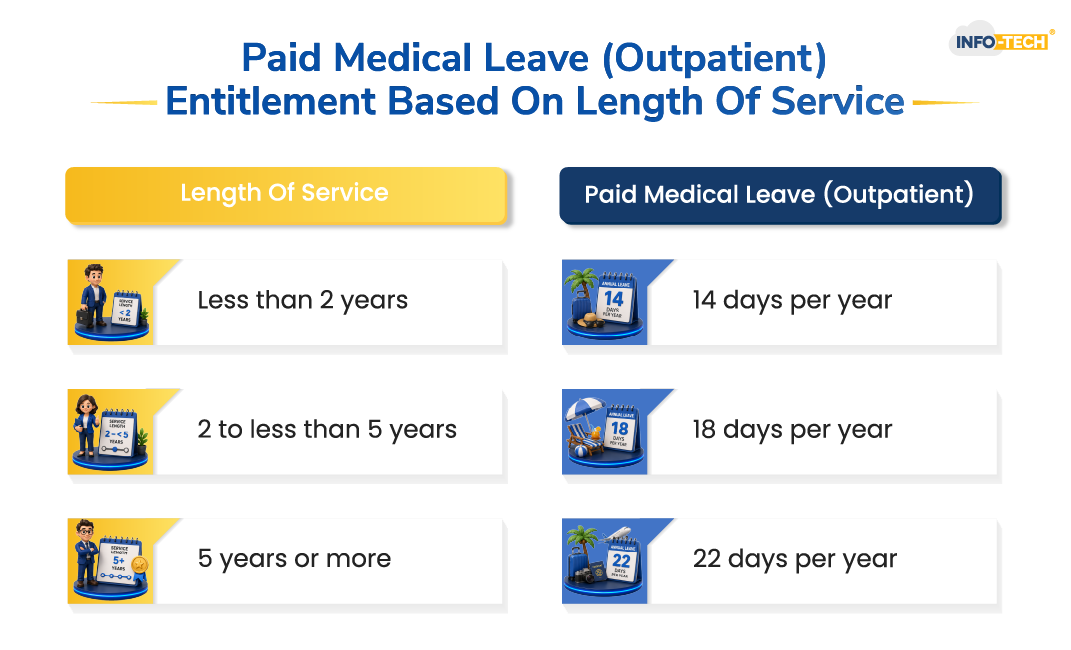
Medical leave entitlement is mainly governed under Section 60F of the Employment Act 1955. The entitlement depends on how long the employee has worked for the company.
Outpatient Medical Leave Entitlement
| Length of Service | Paid Medical Leave |
| Less than 2 years | 14 days |
| 2 to less than 5 years | 18 days |
| More than 5 years | 22 days |
These are minimum statutory entitlements. Employers can always offer better benefits if they choose to.
Some multinational companies, for example, provide more generous sick leave because they view employee wellbeing as part of retention strategy rather than just legal compliance.
Hospitalisation Leave
Apart from ordinary medical leave, employees may also receive Hospitalisation Leave of up to 60 days annually if certified necessary by a doctor.
Hospitalisation leave should not simply be lumped together with ordinary outpatient sick leave. HR and payroll teams need to track these separately to avoid disputes over balances and salary calculations later on.
Read also: Hospitalization Leave in Malaysia: Employee & Employer Guide
Who Is Entitled to Medical Leave in Malaysia?
Most employees working under a contract of service are entitled to medical leave protection.
This includes:
- Full-time employees
- Office staff
- Operational employees
- Junior executives
- Probation employees
The misunderstanding usually comes from older practices where entitlement depended heavily on salary thresholds. Since amendments to the Employment Act, the scope has widened significantly.
That said, HR should still ensure employment contracts and internal policies are properly aligned with legal requirements. Sometimes the issue is not the law itself, but outdated employee handbooks that were never revised.
Read also: Unpaid Leave in Malaysia: Rules, Salary Deduction & Legal Guide
Are Probation Employees Entitled to Medical Leave?
Yes, they are. This is still one of the most misunderstood areas in Malaysian HR management. Some managers assume probation employees cannot take paid medical leave because they are “not confirmed yet”. That is incorrect.
A probation employee is still considered an employee under the law. If they are genuinely sick, obtain a proper MC, and follow the reporting procedure, they are entitled to medical leave.
Of course, excessive absence during probation may still affect overall suitability for the role. But that is a separate performance discussion. HR should avoid mixing attendance concerns with legal leave entitlement.
Read also: Is Compassionate Leave Paid or Unpaid in Malaysia? (2026 Guide)
What Rules Apply to Medical Certificates (MC)?
A medical certificate is usually required before medical leave can be treated as paid sick leave. Employees are also expected to notify the employer within the required timeframe, commonly within 48 hours.
In reality, most HR problems involving MCs are not caused by the illness itself. The issue is usually poor communication.
An employee informs only their supervisor but not HR. Another submits the MC after payroll has already closed. Someone else sends a blurry photo without follow-up documentation. These operational gaps create unnecessary friction.
This is why companies need clear internal procedures, including:
- Who employees must notify
- When the MC should be submitted
- Whether digital copies are accepted first
- How late submissions are handled
- Which department keeps the records
Without a proper process, HR ends up spending too much time chasing documents instead of managing workforce issues properly.
Can Employers Reject a Medical Certificate?
Generally, employers should not reject a valid MC simply because they are suspicious. At the same time, HR is not expected to ignore obvious warning signs either. There are situations where verification may be reasonable, especially if:
- The MC appears altered
- The clinic cannot confirm issuing it
- There is an obvious attendance pattern
- The employee’s explanation keeps changing
- Social media activity strongly contradicts the illness claim
Still, HR should avoid reacting emotionally. Accusing an employee too early can damage trust and expose the company to unnecessary disputes.
The better approach is always to investigate quietly, document properly, and allow the employee to explain before taking any disciplinary action.
Should Companies Only Accept Panel Clinic MCs?
Many Malaysian employers encourage or require staff to use panel clinics. From the company’s perspective, it helps standardise records and manage medical costs.
But strict enforcement does not always work smoothly in real life.
An employee may fall sick late at night, while travelling, or in an emergency situation where the nearest panel clinic is unavailable. If HR rejects every non-panel MC without considering circumstances, the policy may end up feeling unreasonable rather than practical.
Most companies manage this better by allowing exceptions where justified while still encouraging panel clinic usage whenever possible. Employees usually cooperate more when policies feel fair instead of overly controlling.
What Happens When Employees Frequently Take Medical Leave?
This is where medical leave management becomes sensitive. Frequent MC usage naturally raises concern, especially when workload is affected or team members start complaining. But HR also needs to avoid assuming every repeated absence is fake.
Sometimes there are genuine medical issues behind the pattern. Sometimes it may involve stress, burnout, family problems, or untreated health conditions.
Instead of immediately escalating matters, experienced HR teams usually start with observation first. They look for patterns:
- Is leave frequently taken before public holidays?
- Are MCs consistently from unrelated clinics?
- Is productivity affected?
- Have managers documented concerns properly?
A private discussion often works better than confrontation. Employees are sometimes more willing to explain personal situations when they do not feel accused from the start. If abuse is eventually proven, then disciplinary action can follow according to company procedure.
How Should HR Handle Long-Term Illness?
Long-term illness cases are difficult for everyone involved. The employee may be dealing with serious health concerns, while the employer is trying to manage workload, staffing pressure, and operational continuity.
In these situations, rushing toward termination is usually a mistake. A more reasonable approach is to first explore whether adjustments can be made temporarily, such as:
- Flexible working arrangements
- Reduced workload
- Alternative duties
- Remote work options
- Extended unpaid leave
Medical reports and proper documentation become very important here. HR should maintain communication with the employee while ensuring decisions are handled fairly and consistently.
If the employee is eventually unable to continue working permanently, the company must ensure the process is properly documented to reduce the risk of disputes later.
Read also: Paternity Leave in Malaysia: Rules and Eligibility
Why Has Medical Leave Become More Sensitive After COVID-19?
Workplace attitudes changed significantly after COVID-19. Before the pandemic, some employees still came to work despite being visibly sick because they feared looking uncommitted. Employers often tolerated that culture too.
Now, both sides are more cautious. Employees are more aware of mental health, recovery time, and infection risks. Employers also understand that one sick employee attending work can affect an entire department.
As a result, medical leave is no longer treated purely as an attendance issue. It has become part of a wider discussion about employee wellbeing, workplace expectations, and responsible management practices.
What Problems Do HR Teams Face When Managing Medical Leave Manually?
Manual leave management creates more problems than many companies realise. At first, spreadsheets and WhatsApp approvals may seem manageable. But once employee numbers increase, things start slipping through the cracks. MCs go missing. Leave balances become outdated. Payroll deductions happen incorrectly. Managers approve leave without checking entitlement.
Eventually, HR spends more time correcting records than managing employees. This becomes even more difficult for businesses with multiple branches, hybrid staff arrangements, or high employee turnover. Without centralised records, even basic questions like “Has this MC already been submitted?” can turn into unnecessary back-and-forth conversations.
Why Do Accurate Medical Leave Records Matter?
Accurate records protect both the company and the employee. For HR, proper documentation helps with:
- Payroll processing
- Leave tracking
- Compliance checks
- Attendance monitoring
- Internal investigations
- Labour dispute management
It also helps management identify larger workforce issues. For example, unusually high medical leave in one department may indicate excessive workload, poor supervision, burnout, or even workplace safety concerns.
Without reliable data, these patterns are easy to miss. Good records are not just for filing purposes. They help companies make better operational decisions overall.
How Can HR Balance Compliance and Productivity?
This is probably the hardest part of leave management. Companies need employees to be present and productive. Employees need enough time to recover properly when they are sick.
Trying to solve this through extremely strict policies usually backfires. Overly loose policies create different problems. Most companies operate better somewhere in the middle.
Employees should clearly understand:
- How to apply for medical leave
- When to submit MCs
- Who to notify
- What happens in suspicious cases
Managers also need guidance. Many workplace conflicts happen because supervisors respond emotionally instead of following proper HR procedure.
Consistency matters more than harshness. When employees feel policies are fair and applied equally, medical leave issues tend to become easier to manage overall.
Conclusion
Medical leave management involves far more than approving MCs and updating leave balances.
For HR teams in Malaysia, it affects payroll accuracy, compliance, employee trust, operational planning, and workplace culture all at once. As businesses grow, manual processes become harder to control. Missing records, delayed approvals, payroll mistakes, and inconsistent handling can create unnecessary stress for both HR and employees.
This is where a proper HR Software, Payroll Software or Leave Management Software becomes useful. Instead of relying on scattered spreadsheets and manual tracking, HR teams can centralise medical leave records, monitor entitlements more accurately, coordinate payroll updates, and maintain clearer employee documentation in one place.
You can also check our Accounting Software for managing E-invoicing, tax, bank reconciliation, inventory, fixed assets, budgeting, and tedious financial reports in one secure cloud platform.
More importantly, it helps HR spend less time fixing admin problems and more time managing people properly.
Read also: Annual Leave Malaysia 2026: Rules, Forecasts & HR Practices
Medical Leave FAQs
How many days of medical leave are employees entitled to in Malaysia?
Employees are entitled to 14, 18, or 22 days of paid medical leave per year, depending on their length of service with the employer.
Can I be terminated while on sick leave?
Yes, employees in Malaysia can be terminated while on sick leave, but not simply for taking legitimate medical leave with a valid MC.
Is an MC required for one day medical leave?
Yes, an MC is usually required even for one day of paid medical leave.
Can probation employees take medical leave?
Yes. Probation employees are still employees, so they are entitled to medical leave if they meet the proper requirements.