
In this article
- 1. What Exactly Is SOCSO Lindung 24/7?
- 2. Why This Policy Feels Different From Previous SOCSO Updates?
- 3. How Is It Rectifying Blurry Modern Work Life?
- 4. Why Payroll Teams Should Not Underestimate This Change?
- 5. Are Employees Over 60 and Foreign Workers Are Also Included?
- 6. Why This Matters Beyond Compliance?
- 7. Final Thoughts
- 8. SOCSO Lindung 24/7 FAQ
Most Malaysians have always understood SOCSO in a very simple way.
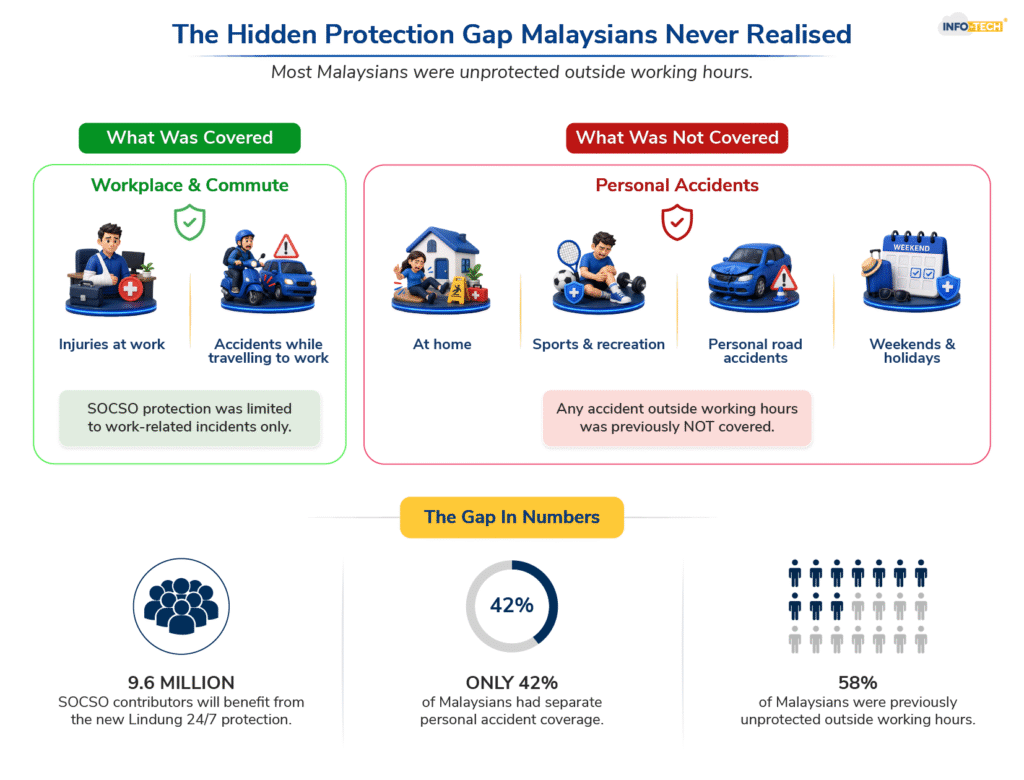
If you get injured at work, there’s protection. If the accident happens while travelling to work, there’s usually protection too. Outside that? You’re mostly on your own.
That’s why the upcoming SOCSO Lindung 24/7 rollout in June 2026 feels like a much bigger shift than many people realise.
For the first time, PERKESO protection is moving beyond office walls and factory floors. Employees may now receive protection for certain non-work-related accidents happening outside working hours within Malaysia.
And honestly, this change reflects the reality of how Malaysians work today.
Because work no longer ends neatly at 5PM.
People answer Slack messages during dinner. Managers send WhatsApp instructions late at night. Employees work from home, cafés, airports, and co-working spaces. Some are technically “off duty” but still mentally connected to work the entire evening.
The old idea of separating “working life” and “personal life” has slowly faded.
SOCSO seems to be adapting to that reality now.
What Exactly Is SOCSO Lindung 24/7?
The new scheme is linked to the Skim Kemalangan Bukan Bencana Kerja (SKBBK). In simple terms, it extends protection to accidents that are not directly related to work.
That includes situations many employees previously assumed were never covered.
For example:
- Falling down stairs at home
- Personal road accidents during weekends
- Injuries during sports or recreational activities
- Burns or household accidents
- Non-work-related incidents during public holidays
Under the older system, these situations generally fell outside SOCSO’s scope.
That’s changing.
And for employees who do not have personal accident insurance or takaful coverage, this matters more than people think.
Medical costs are not getting cheaper in Malaysia. Neither is living on reduced income after a serious injury.
Why This Policy Feels Different From Previous SOCSO Updates
Most statutory updates usually affect employers quietly in the background.
A new contribution rate.
A revised filing format.
A portal update nobody enjoys dealing with.
But this one is different because employees will actually feel it.
There will likely be new deductions appearing on payslips. Employees will ask questions. HR teams will need answers.
And many employers are still not fully prepared for those conversations.
Some employees may even misunderstand the policy completely and assume they are now covered for “everything, everywhere.”
They’re not.
The protection still comes with limits. Accidents outside Malaysia, for example, are generally excluded.
But perception matters.
Once workers hear “24/7 protection,” expectations naturally become bigger.
Read Also: What Is SOCSO?
Rectifying Blurry Modern Work Life
A lot of this policy change comes down to one uncomfortable truth.
Modern work culture has become messy.
Ten years ago, it was easier to define what counted as “work.”
Today?
Not so much.
Take remote work as an example.
If someone injures themselves while working from home, where exactly is the workplace? The dining table? The home office? The kitchen during lunch break?
Or imagine an employee attending a company dinner after office hours and getting into an accident on the way back.
Is that work-related?
Personal?
Somewhere in between?
These situations are becoming more common, not less.
And while SOCSO Lindung 24/7 mainly focuses on non-work accidents, the existence of the scheme itself shows that Malaysia’s social protection system is trying to catch up with how people actually live and work now.
Why Payroll Teams Should Not Underestimate This Change
From the outside, the additional deduction may look small.
But payroll teams already know small statutory changes can create surprisingly big operational problems.
According to the available information, the additional contribution for the new protection scheme is expected to be borne by employees through salary deductions.
That means employers still need to handle:
- Accurate calculations
- Correct payslip display
- Updated payroll formatting
- Proper submissions through PERKESO systems
And this is where some SMEs may struggle.
A lot of businesses in Malaysia are still heavily dependent on spreadsheets or outdated payroll processes. That usually works fine — until a new compliance requirement appears.
Then suddenly:
- deductions are wrong
- submissions fail
- employees complain
- HR scrambles to fix everything at month-end
It happens more often than companies admit publicly.
Read Also: Common Payroll Compliance Pitfalls Malaysian Businesses Face
Are Employees Over 60 and Foreign Workers Are Also Included?
Yes.
One detail many businesses overlooked initially is the expanded eligibility scope.
Employees over 60 are expected to fall under the updated deduction structure as well.
Foreign workers may also qualify, provided their permits and documentation remain valid.
That means employers managing foreign worker compliance need to pay even closer attention moving forward.
Because once statutory requirements expand, documentation mistakes become more risky too.
Read Also: EPF for Foreign Workers in Malaysia
Why This Matters Beyond Compliance
This policy is not just about deductions or claims.
It says something bigger about Malaysia’s workforce.
Employees today are far more aware of financial protection, medical costs, and workplace security than previous generations. After years of economic uncertainty, rising living costs, and pandemic-driven changes to work culture, people pay more attention to safety nets now.
And honestly, many younger employees already expect employers to understand these concerns better.
That pressure is growing.
Final Thoughts
SOCSO Lindung 24/7 is probably going to be remembered as one of Malaysia’s more significant employee protection changes in recent years.
Not because it completely transforms the system overnight.
But because it quietly changes the idea of when protection starts — and when it ends.
For employers, this is not something to review at the last minute when payroll processing begins.
With constant updates involving SOCSO, EPF, payroll reporting, and employment regulations, many Malaysian businesses are realising that compliance can no longer be handled casually.
Practical HR and payroll software training helps teams stay updated before mistakes happen — especially when new statutory requirements like SOCSO Lindung 24/7 begin taking effect.