
Employee data management used to be relatively simple. HR departments mainly handled a few files containing employee details, payroll information, and attendance records. But today, the situation is very different. Modern organisations deal with large volumes of employee information, from recruitment documents and payroll data to performance reviews, training records, compliance reports, and internal communications.
As companies grow, the amount of employee-related data grows with them. Managing this information manually can quickly become overwhelming. HR teams often spend hours searching through documents, updating records, or trying to locate specific employee information across multiple systems. Over time, this not only slows down HR operations but also increases the chances of mistakes or missing data.
This is where Natural Language Processing (NLP) is starting to make a real difference. NLP is a branch of artificial intelligence(AI) that allows software to understand and process human language. When applied to HR systems, it helps organisations manage employee information more intelligently by analysing documents, extracting useful data, and organising information automatically.
Instead of relying heavily on manual processes, HR teams can use NLP-powered systems to handle large volumes of employee data more efficiently. The result is better data accuracy, less administrative workload, and clearer insights into the workforce. In this article, we will explore how NLP improves employee data management and why it is becoming an increasingly important technology in modern HR systems.
What Is Natural Language Processing (NLP)?
Natural Language Processing, commonly referred to as NLP, is a technology that enables computers to understand and interpret human language. It allows systems to read, analyse, and extract meaning from text in a way that goes beyond simple keyword matching.
Traditional software systems typically rely on structured data — information that is neatly organised into fields such as employee name, department, or salary. However, a large portion of HR information does not exist in such a structured format. Instead, it appears in emails, reports, feedback forms, and written documents.
NLP helps bridge this gap by allowing systems to interpret unstructured text data such as:
- Emails
- HR reports
- Employee feedback
- Job descriptions
- Performance reviews
- Chat messages
- HR support tickets
- Policy documents
Using advanced language processing techniques, NLP systems can recognise patterns, identify key information, and convert written text into structured data that HR platforms can understand and use.
In practical terms, this means HR teams can work with employee data more efficiently, without having to manually process every document or piece of information.
Why Employee Data Management Is Challenging for HR Teams?
Managing employee data is one of the most important responsibilities of any HR department. However, many organisations still struggle with fragmented systems, manual processes, and large volumes of documentation.
Over time, these challenges make it increasingly difficult for HR teams to maintain accurate and well-organised records.
What Are The Challenges With Employee Data Management?
|
Challenge |
Description |
|
Fragmented Data Sources |
Employee information is often spread across HR software, payroll systems, spreadsheets, and email records. |
|
Manual Data Entry |
HR teams frequently need to update employee information manually, which increases the risk of human error. |
|
Large Volumes of Documents |
Contracts, leave forms, policy acknowledgements, and training records create a growing archive of documents. |
|
Unstructured Text Data |
Many important HR records exist as written text, which makes them harder to search and analyse. |
|
Compliance Complexity |
Organisations must ensure employee records comply with labour laws, payroll regulations, and statutory reporting requirements. |
When HR teams rely heavily on manual data handling, simple tasks such as locating employee records or reviewing feedback can take far longer than they should.
Natural Language Processing helps address these issues by enabling systems to interpret and organise employee information automatically.
How Is Automated Data Extracted From HR Documents?
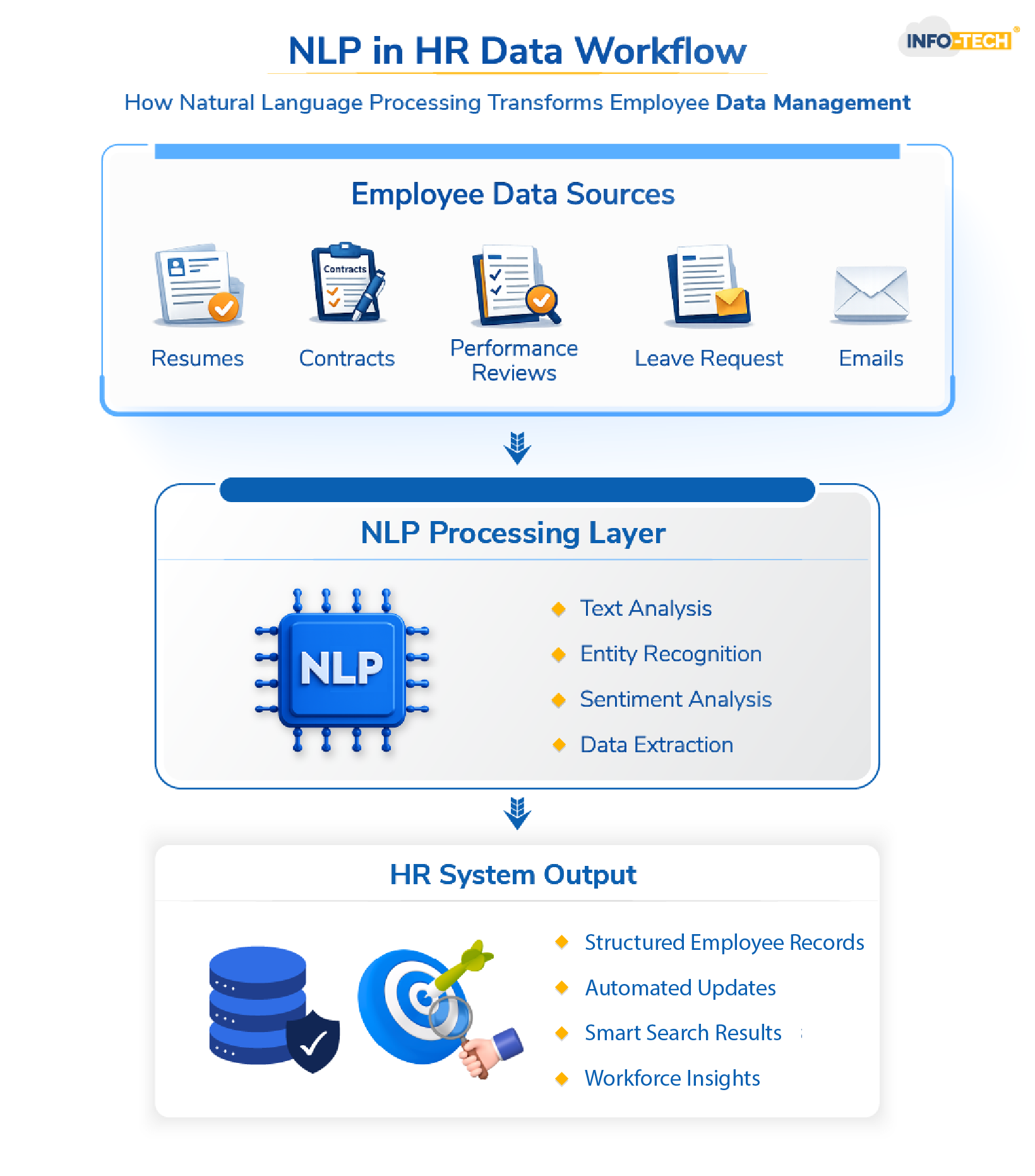
HR departments handle a wide range of documents on a daily basis. These include resumes, employment contracts, leave applications, training certificates, and performance reviews. Traditionally, HR staff would need to read through each document and manually enter relevant details into their systems.
With NLP technology, much of this work can now be automated.
NLP systems are capable of analysing documents and extracting key employee information automatically. This might include details such as job titles, employment dates, certifications, or salary information.
Instead of manually transferring information from documents into databases, the system identifies and captures these details on its own.
What Is An Example of NLP Data Extraction?
|
Document Type |
Information Extracted by NLP |
|
Resume |
Skills, experience, education |
|
Employment Contract |
Position title, salary, start date |
|
Leave Application |
Leave type, duration, approval status |
|
Performance Review |
Key performance indicators, feedback comments |
This type of automation helps HR teams maintain accurate records while significantly reducing the time spent on manual data entry.
How To Intelligently Search Employee Record?
Searching for employee information can sometimes feel like looking for a needle in a haystack, especially when records are stored across multiple platforms or archived in documents.
NLP introduces a more intuitive way to search employee data by enabling natural language search.
Instead of using complicated filters or manually reviewing documents, HR professionals can simply type queries such as:
- “Employees who completed cybersecurity training”
- “Staff with leadership certification”
- “Employees eligible for promotion this year”
- “Team members with excellent performance ratings”
The system interprets the meaning of the request and retrieves relevant records almost instantly.
This makes it much easier for HR teams to locate employee information quickly, especially in organisations with large workforces.
How Can Employee Data Classification Be Improved?
Another important advantage of NLP is its ability to organise and classify employee data automatically.
Employee records often exist in different formats and locations. Without proper categorisation, important information can easily become difficult to find.
By automatically sorting and organising employee data, HR systems become far easier to navigate and maintain.
How Can Employee Feedback Analysis Be Improved?
Employee feedback is incredibly valuable for understanding workplace culture and employee experience. However, feedback is usually written in open-ended text, which makes it difficult to analyse using traditional methods.
NLP makes it possible to analyse written feedback using sentiment analysis.
This technology can evaluate the tone of written comments and determine whether they express positive, neutral, or negative sentiments.
By identifying patterns in employee sentiment, organisations can better understand employee concerns and make improvements where necessary.
How Can Better Compliance and HR Documentation Management Be Done?
Compliance is a critical aspect of employee data management. Organisations must maintain accurate records to meet employment regulations, tax requirements, and statutory reporting obligations.
NLP technology can assist by reviewing HR documents and identifying important compliance-related information, making it easier for organisations to maintain reliable employee records and reduce compliance risks.
How Can Administrative Workload for HR Teams Be Reduced?
One of the biggest benefits of NLP is its ability to automate routine HR tasks.
Many HR professionals spend a large portion of their day on administrative activities such as updating records, searching documents, or reviewing employee information.
With NLP-powered systems handling many of these tasks automatically, HR teams can spend less time on administrative work and more time on strategic activities like talent development and workforce planning.
Conclusion
Managing employee data has become increasingly complex as organisations deal with larger workforces and growing volumes of information.
Traditional manual processes are no longer sufficient for handling this level of complexity efficiently.
Natural Language Processing(NLP) offers a powerful solution by enabling HRMS software to understand and process human language within employee records, documents, and communications.
By automating document processing, improving search capabilities, analysing feedback, and supporting compliance management, NLP helps organisations manage employee data more effectively.
As HR technology continues to evolve, organisations that adopt NLP-driven systems will be better equipped to manage their workforce information and make more informed decisions.
NLP Frequently Asked Questions
What is NLP in HR systems?
Natural Language Processing (NLP) in HR systems refers to the use of artificial intelligence technologies that allow software to understand and analyse human language in HR documents, employee records, feedback, and communications.
How does NLP help manage employee data?
NLP helps manage employee data by automatically extracting information from documents, organising employee records, improving search functionality, and analysing employee feedback.
Can NLP improve HR compliance management?
Yes. NLP can help organisations organise HR documentation, detect missing information in employee records, and support compliance monitoring by analysing employment documents and statutory data.
Is NLP used in HR software today?
Yes. Many modern HR systems use NLP technologies for applications such as resume parsing, HR chatbots, sentiment analysis, and intelligent document processing.