

In this article
- 1. What is a Payslip?
- 2. What Should a Payslip Include in Malaysia?
- 3. What Deductions Appear on a Malaysian Payslip?
- 4. What Does a Payslip Look Like?
- 5. Is a Payslip Mandatory in Malaysia?
- 6. What Are the Types of Payslips?
- 7. Is a Payslip the Same as a Salary Slip or Pay Stub?
- 8. How Do Employers Prepare Payslips?
- 9. Payslip Frequently Asked Questions
Payday comes, the money lands in your account, and the number is never quite what you expected. Where did the rest go? That is exactly what a payslip is there to answer.
If you run a business or handle HR in Malaysia, the payslip is also one of your legal duties. Here is what it is, what goes on it, and how to get it right every month.
What is a Payslip?
Think of it as a receipt for your work. For employees, it is proof of income. For employers, it is proof of payment.
You will need your payslip more often than you think:
- Applying for a home loan, car loan or credit card (banks usually ask for the last three months)
- Renting a house or room
- Filing your income tax with LHDN
- Checking that your EPF, SOCSO and tax deductions are correct
- Settling a salary dispute with your employer
What Should a Payslip Include in Malaysia?
There is no single official payslip template, but a proper Malaysian one usually covers these:
- Company details: name and address
- Employee details: name, employee number, IC or passport number, job title, plus EPF, SOCSO and income tax numbers
- Pay period and payment date
- Earnings: basic salary, allowances, overtime, commission, bonus and claim reimbursements
- Deductions: EPF, SOCSO, EIS and PCB, plus anything the employee agreed to, like a staff loan repayment
- Employer contributions: the company’s share of EPF, SOCSO and EIS
- Gross pay and net pay
- Leave balance, if leave is tracked through payroll
Also check: Payroll Calculation Malaysia: Guide for Employers & Employees
What Deductions Appear on a Malaysian Payslip?
Four statutory items show up on almost every payslip. Here are the rates for Malaysian employees below 60:
| Deduction | What it is for | Employee share | Employer share | Wage limit |
| EPF (KWSP) | Retirement savings | 11% | 13% (wages up to RM5,000), 12% (above RM5,000) | No cap |
| SOCSO (PERKESO) | Work injury and invalidity cover | About 0.5% | About 1.75% | RM6,000 |
| EIS (SIP) | Support if you lose your job | About 0.2% | About 0.2% | RM6,000 |
| PCB / MTD (LHDN) | Monthly income tax | Depends on salary and reliefs | None | Not applicable |
SOCSO and EIS are worked out using the official contribution tables, so the actual figures are slightly rounded. All four must be paid to the agencies by the 15th of the following month. A few things that often catch people out:
- Overtime is not subject to EPF, so it raises gross pay but not the EPF deduction.
- Employees aged 60 and above have different rates. EIS stops, and SOCSO covers only the Employment Injury Scheme.
- Foreign workers now contribute to EPF too, at 2% each from employee and employer, starting with October 2025 wages.
- HRDF levy is paid by the employer alone, so it never comes out of the employee’s pay.
Read also: SOCSO Lindung 24/7: The June 2026 Change
What Does a Payslip Look Like?
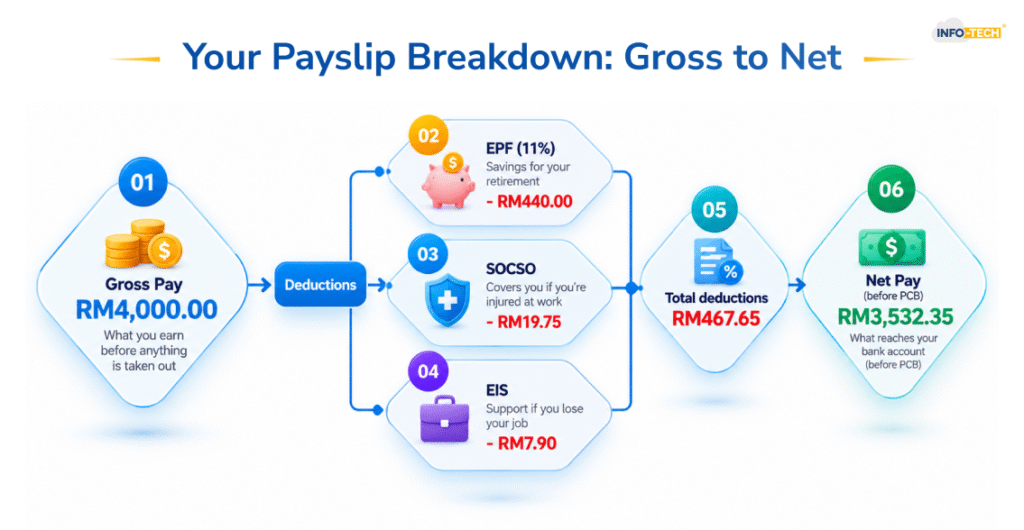
ABC Trading Sdn Bhd · Payslip for October 2026 · Paid on 31 October 2026
Employee: Aina binti Rahman · Emp. No: 0123 · Executive
| Earnings | RM | Deductions | RM |
| Basic salary | 4,000.00 | EPF (11%) | 440.00 |
| SOCSO | 19.75 | ||
| EIS | 7.90 | ||
| PCB | Based on reliefs | ||
| Gross pay | 4,000.00 | Total deductions (before PCB) | 467.65 |
| Net pay (before PCB) | 3,532.35 |
Employer contributions: EPF RM520.00 (13%), SOCSO RM69.05, EIS RM7.90
The gap between gross pay and net pay is simply the deductions. Gross is what Aina earned. Net is what reaches her bank account. Her employer’s contributions do not come out of her pay at all; they are an extra cost to the company, shown so she can see what is going into her EPF and SOCSO.
PCB is left open here because it depends on each person’s tax reliefs, like marital status and number of children. Payroll software or PCB calculator works it out for you.
Similar reads: Free Payslip Template
Is a Payslip Mandatory in Malaysia?
A few related rules worth knowing:
- Wage period: it cannot be longer than one month.
- When to pay: salary must be paid within 7 days after the wage period ends. The payslip should reach the employee by that same day.
- Overtime, rest day and public holiday pay: due by the last day of the next wage period.
- Minimum wage: RM1,700 a month. Your payslips are often the first thing checked to prove you meet it.
If you are in Sabah or Sarawak, wage matters fall under the Sabah Labour Ordinance and the Sarawak Labour Ordinance instead, which have similar requirements.
Employers who skip payslips or pay late can be fined, and employees can lodge a complaint with the Labour Department (JTKSM, or JTK Sabah and JTK Sarawak).
How long should employers keep payslips?
Keep wage records for at least 6 years, as required under the Employment Act. Since tax records must be kept for 7 years under the Income Tax Act 1967, many companies simply keep all payroll records for 7 years to be safe.
What Are the Types of Payslips?
Most employees only ever see the monthly one, but HR teams in Malaysia typically issue three kinds:
| Type | When it is issued |
| Normal payslip | Every wage period, for regular salary |
| Adjustment payslip | To fix an earlier mistake, like an underpayment or overpayment |
| Supplementary payslip | For extra pay after the normal slip is out, such as a bonus, commission or late overtime |
Check out: EPF for Foreign Workers Malaysia: Are You Calculating It Right?
Is a Payslip the Same as a Salary Slip or Pay Stub?
The one that is different is a paycheck. That is the payment itself, while the payslip is the record explaining how that amount was worked out.
How Do Employers Prepare Payslips?
Whether you have 5 staff or 500, the monthly routine looks roughly like this:
- Collect the month’s data. Attendance, overtime hours, approved leave, claims and any salary changes. A time attendance software or mobile attendance app saves you from chasing timesheets.
- Work out gross pay. Add basic salary, allowances, overtime, commission and reimbursements. Unpaid leave gets deducted here, which is why a proper leave management software helps.
- Calculate statutory deductions. Apply EPF, SOCSO, EIS and PCB using the latest official tables.
- Build the payslip. Fill in earnings, deductions, employer contributions and net pay. Double check names, IC numbers and the pay period.
- Issue it on time and file a copy. Send it on or before payday, then keep it with your payroll records.
Short on time or HR headcount? Our payroll outsourcing services can take the whole monthly cycle off your hands, payslips included.