

In this article
- 1. What is the EPF Contribution Rate in 2026?
- 2. What Changes When an Employee Turns 60?
- 3. How Does EPF Work for Permanent Residents and Foreign Workers?
- 4. Which Payments Count as Wages For EPF?
- 5. Should You Use the Percentage or the Third Schedule?
- 6. When is EPF Due and What Happens If You Pay Late?
- 7. Can You Contribute More Than the Minimum?
- 8. How is Each Contribution Split Across the Three Accounts?
- 9. What Does EPF Dividend History Look Like?
- 10. What Payroll Mistakes Catch Employers Out Most Often?
- 11. EPF Contribution Rate FAQs
Most Malaysian employees still pay 11% of their wages into EPF in 2026, and employers add 12% or 13% on top. The headline rates haven’t changed, but some of the rules around them have. Foreign workers now contribute, and the Third Schedule still decides the exact amount for most salaries.
This guide covers the rates for each type of employee, what counts as wages, deadlines and penalties, and how contributions grow once they reach an employee’s account.
What is the EPF Contribution Rate in 2026?
The rate depends on three things: the employee’s age, their citizenship or residency status, and whether their monthly wages sit above or below RM5,000. These are the current rates under the Third Schedule of the EPF Act 1991.
| Employee category | Monthly wages | Employee share | Employer share | Total |
| Malaysian or PR, below 60 | RM5,000 and below | 11% | 13% | 24% |
| Malaysian or PR, below 60 | Above RM5,000 | 11% | 12% | 23% |
| Malaysian, 60 and above | Any amount | 0% | 4% | 4% |
| PR, 60 and above | RM5,000 and below | 5.5% | 6.5% | 12% |
| PR, 60 and above | Above RM5,000 | 5.5% | 6% | 11.5% |
| Non-Malaysian employee | Any amount | 2% | 2% | 4% |
The employer’s share is a separate cost on top of salary. It can never be deducted from the employees’ wages.
Also check: What is EPF? A Guide for Employees and Employers
What Changes When an Employee Turns 60?
For Malaysian citizens, the employee’s share drops to zero and the employer pays a flat 4%, whatever the salary. This structure has been in place since January 2019, when Budget 2019 cut the rates to lift take-home pay for people who keep working past 60.
A few practical points payroll teams often miss:
- The new rate kicks in from the wage month after the employee’s 60th birthday, not the birthday month itself.
- Employees aged 60 and above can still choose to keep contributing their own share voluntarily.
- Mandatory contributions continue up to age 75, so rehired retirees still need EPF processed.
Read also: How EPF Self/Voluntary Contribution Works in Malaysia
How Does EPF Work for Permanent Residents and Foreign Workers?
Foreign workers are the bigger change. EPF used to be optional for most non-Malaysian employees, but it became mandatory from October 2025 wages under a scheme announced in Budget 2025:
- Both employer and employee contribute 2% of monthly wages, for a total of 4%.
- The rate is the same across all ages and wage levels.
- It’s calculated as a straight percentage, not from the Third Schedule’s wage bands, with any sen rounded up to the next ringgit.
- Non-citizens who became EPF members before 1 August 1998 stay on an older schedule, so check each worker’s membership history before setting a rate.
If your payroll hasn’t been updated for foreign staff since mid-2025, start there.
Read in Detail: EPF for Foreign Workers Malaysia: Are You Calculating It Right?
Which Payments Count as Wages For EPF?
EPF isn’t based on basic salary alone or on full gross pay. The EPF Act 1991 defines what counts as wages, and each payslip item needs to be checked against it.
| Subject to EPF | Not subject to EPF |
| Salary and wages | Overtime pay |
| Bonuses | Gratuity |
| Commissions and incentives | Retirement benefits |
| Fixed allowances | Retrenchment, termination or lay-off benefits |
| Salary arrears | Payment in lieu of notice |
| Payment for unused annual or medical leave | Travelling allowance |
| Paid maternity and study leave | Reimbursements for work expenses |
Travel claims often cause errors when reimbursements are mixed in with allowances. Running them through a dedicated claims management software keeps them separate from salary and out of the EPF wage figure.
Also check: EPF Contribution Table Malaysia 2026: Rates & Guide
Should You Use the Percentage or the Third Schedule?
For wages up to RM20,000, use the Third Schedule. It groups wages into bands (RM20 wide for most salaries) and sets a fixed contribution for each band, so the result often differs from multiplying salary by 11% or 13%.
Take a Malaysian employee under 60 earning RM3,250. That salary falls in the RM3,240.01 to RM3,260 band:
| Method | Employee | Employer | Total |
| Straight percentage | RM357.50 | RM422.50 | RM780.00 |
| Third Schedule (correct) | RM359 | RM424 | RM783 |
A RM3 difference seems small, but across 200 staff over 12 months it adds up to an underpayment KWSP can claim back with late charges.
Above RM20,000, the schedule stops and you calculate the percentage directly. On RM21,250, the employee pays RM2,337.50 and the employer RM2,550. The total of RM4,887.50 is then rounded up to RM4,888, since EPF only accepts whole ringgit.
When is EPF Due and What Happens If You Pay Late?
Other deadlines to note:
- Registering as an employer: within 7 days of hiring your first employee. One employee is enough to make you liable.
- Notifying EPF when you stop employing anyone: within 30 days.
- Paying: through i-Akaun (Majikan) and e-Caruman, using FPX or direct debit.
If you pay after the 15th, KWSP can impose a late payment charge on the outstanding amount, and you may also have to cover the dividends the employee lost while the money sat with you.
Persistent non-payment is a criminal matter. Under Section 43(2) of the EPF Act 1991, an employer can face a fine of up to RM10,000, up to three years in prison, or both. Under Section 46, company directors can also be held personally liable for unpaid contributions.
Read also: Employees Provident Fund (EPF) in Malaysia
Can You Contribute More Than the Minimum?
Why employers do it:
- Contributions up to 19% of an employee’s remuneration are tax-deductible for the company.
- A higher employer rate, such as 15% or 16%, helps retain staff.
Why employees do it:
- Mandatory and voluntary EPF contributions qualify for up to RM4,000 in personal tax relief, with a further RM3,000 available under the combined life insurance and voluntary EPF category.
- EPF dividends and withdrawals are tax-exempt.
- Members can add up to RM100,000 a year in voluntary contributions on top of payroll deductions.
Any extra amount should go through i-Topup. Over-deducting by mistake is a payroll error, not a voluntary contribution.
How is Each Contribution Split Across the Three Accounts?
Using the RM783 total from the RM3,250 example above:
| Account | Share | From RM783 | What it’s for |
| Akaun Persaraan | 75% | RM587.25 | Retirement, locked until age 55 |
| Akaun Sejahtera | 15% | RM117.45 | Housing, education, healthcare and other approved needs |
| Akaun Fleksibel | 10% | RM78.30 | Withdraw anytime, minimum RM50 |
All three accounts earn the same dividend rate. However, money taken out of Akaun Fleksibel stops earning dividends from the day it is withdrawn, so frequent withdrawals reduce the year’s dividend.
What Does EPF Dividend History Look Like?
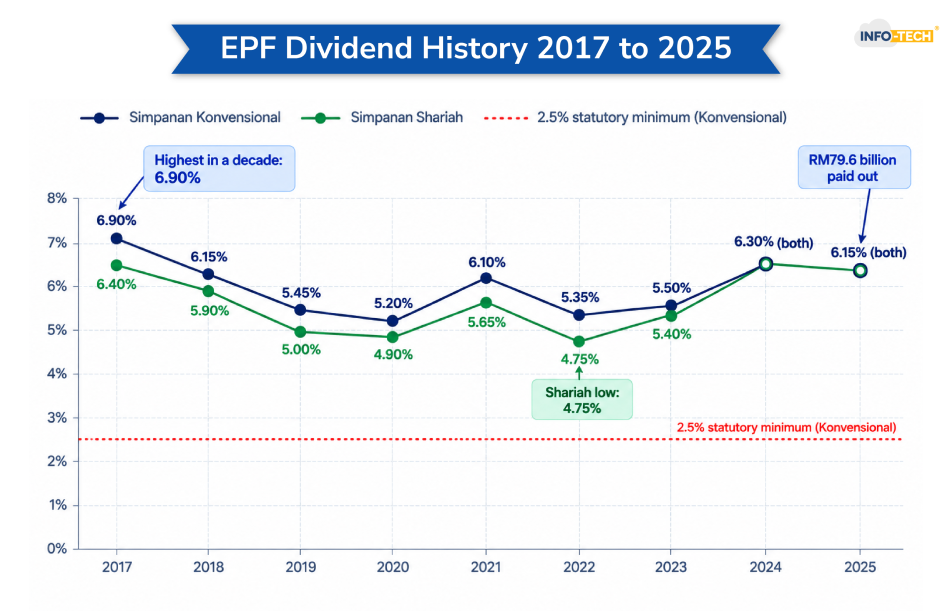
EPF has paid at least 5% on conventional savings every year since 2009. For 2025, EPF declared 6.15% on both conventional and Shariah savings, a total payout of RM79.6 billion.
| Year | Simpanan Konvensional | Simpanan Shariah |
| 2025 | 6.15% | 6.15% |
| 2024 | 6.30% | 6.30% |
| 2023 | 5.50% | 5.40% |
| 2022 | 5.35% | 4.75% |
| 2021 | 6.10% | 5.65% |
| 2020 | 5.20% | 4.90% |
| 2019 | 5.45% | 5.00% |
| 2018 | 6.15% | 5.90% |
| 2017 | 6.90% | 6.40% |
How is the dividend worked out?
EPF doesn’t just multiply your year-end balance by the rate. Each contribution earns only for the months it actually sits in the account. Someone starting 2025 with RM100,000 and adding RM1,000 a month would earn:
- RM6,150 on the opening balance (a full 12 months)
- RM338.25 on the 12 monthly contributions, each earning for fewer months than the last
- RM6,488.25 in total
Also check out: EPF Withdrawal Malaysia 2026: Rules, Age, Types & How to Apply
What Payroll Mistakes Catch Employers Out Most Often?
Most EPF errors are small and repeated every month. They often only show up during an audit or when an employee checks their i-Akaun.
- Multiplying instead of using the schedule. For wages up to RM20,000, the Third Schedule amount is the legal figure.
- Dropping to 12% because of a bonus. If an employee normally earns RM5,000 or less and a bonus pushes that month over the line, the employer rate stays at 13%.
- Missing the age 60 switch. Keeping a 63-year-old on the 11% and 13% rates means both sides overpay every month.
- Ignoring foreign workers. Anyone still treating non-Malaysian staff as exempt is under-contributing from October 2025 wages onward.
- Mixing up overtime and holiday pay. Overtime is excluded, but pay for regular work on a public holiday usually isn’t. Accurate records from time attendance software make the distinction easier to prove.
- Leaving payment to the 14th. The deadline is when funds reach KWSP, not when you hit submit.