
In this article
-
- 1. What is EPF And Who Needs to Contribute?
- 2. What Are the EPF Contribution Rates For 2026?
- 3. Is EPF Mandatory for Foreign Workers Now?
- 4. How Do I Calculate EPF Using the Third Schedule?
- 5. When is the EPF Payment Deadline?
- 6. How Can I Make EPF Payroll Easier to Manage?
- 7. EPF Contribution Table FAQs
If you run payroll in Malaysia, EPF is the one deduction you really can’t afford to get wrong. The rate changes depending on how old your employee is, how much they earn and whether they’re Malaysian, a PR or a foreign worker. And since October 2025, foreign workers are part of the picture too.
Here’s a simple breakdown of the 2026 EPF contribution table and what your HR team needs to do each month.
What is EPF And Who Needs to Contribute?
You need to contribute for:
- Malaysian citizens
- Permanent residents (PR)
- Non-Malaysian employees below 75 with a valid work pass (domestic workers are excluded)
Hiring your first employee? Register your company with EPF within 7 days.
Read also: What is EPF? A Guide for Employees and Employers
What Are the EPF Contribution Rates For 2026?
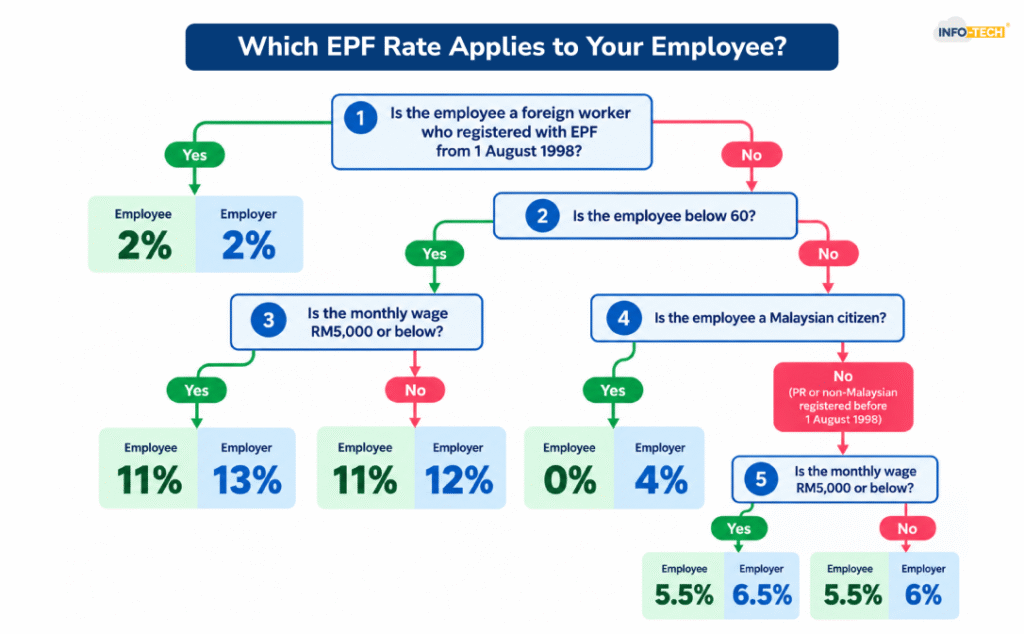
| Employee type | Monthly wage | Below 60 (Employee / Employer) | 60 and above (Employee / Employer) |
| Malaysian citizens | RM5,000 and below | 11% / 13% | 0% / 4% |
| Malaysian citizens | Above RM5,000 | 11% / 12% | 0% / 4% |
| PRs and non-Malaysians registered before 1 August 1998 | RM5,000 and below | 11% / 13% | 5.5% / 6.5% |
| PRs and non-Malaysians registered before 1 August 1998 | Above RM5,000 | 11% / 12% | 5.5% / 6% |
| Non-Malaysians registered from 1 August 1998 | Any amount | 2% / 2% | 2% / 2% |
- Section A for employees below 60
- Section C for PRs and older non-Malaysian members aged 60 and above
- Section E for Malaysians aged 60 and above
- Section F for foreign workers
Read also: EPF Employer Contribution in Malaysia
Is EPF Mandatory for Foreign Workers Now?
The rule covers non-Malaysian employees below 75 who hold a valid work pass, except domestic workers. Foreign workers can generally withdraw their savings when they leave Malaysia for good, as long as they show proof that their employment has ended. Here’s what HR should sort out:
- Register every eligible foreign employee with EPF
- Add the deduction to your payroll setup
- Update employment contracts to reflect it
- Let your foreign staff know ahead of time so the deduction doesn’t catch them off guard on their payslip
If you hire foreign workers regularly, an Applicant Tracking System makes it easier to capture work pass details right from the hiring stage, so nobody gets missed when it’s time to register.
Read also: EPF for Foreign Workers Malaysia: Are You Calculating It Right?
How Do I Calculate EPF Using the Third Schedule?
For wages above RM20,000, you apply the percentage to the actual wage and round up to the next ringgit. Either way, EPF is always paid in whole ringgit with no cents. Here’s an example for a Malaysian employee below 60 earning RM2,950. That salary falls in the RM2,900.01 to RM3,000 band.
| Straight percentage | Third Schedule amount | |
| Employee share (11%) | RM324.50 | RM330 |
| Employer share (13%) | RM383.50 | RM390 |
| Total | RM708 | RM720 |
Using the straight percentage would leave you short by RM12 that month, which is exactly the kind of gap that shows up later during an audit.
Read also: Malaysia EPF Calculator For Accurate Calculation
When is the EPF Payment Deadline?
- Deduct the employee’s share from their salary
- Add your share as the employer
- Submit and pay through the EPF i-Akaun (Employer) portal
- Keep your contribution records for audits and reconciliation
Read also: Employees Provident Fund (EPF) in Malaysia
How Can I Make EPF Payroll Easier to Manage?
- Automate the calculations. Our Payroll Software works out EPF along with SOCSO, EIS and PCB based on each employee’s age, wage and citizenship, so you’re not looking up the Third Schedule every month.
- Keep employee records clean. Dates of birth, citizenship and work pass details all decide which EPF category applies. Our HRMS Software keeps everything in one place so payroll always pulls the right data.
- Get the wage figure right first. Unpaid leave and absences affect the final wage, which affects EPF. Pairing Time Attendance Software or our Mobile Attendance App with Leave Management Software means payroll runs on accurate numbers.