

In this article
- 1. Who Do the Employment Act Pay Rules Apply To?
- 2. How Do You Calculate an Employee’s Daily and Hourly Rate?
- 3. How Do You Calculate Pay for Rest Days, Public Holidays and Partial Months?
- 4. What is the Minimum Wage, And How Does It Affect Payroll?
- 5. How Do Leave Entitlements and Termination Benefits Affect Payroll?
- 6. What Payroll Deadlines Do Malaysian Employers Need to Meet?
- 7. Should You Run Payroll In-House or Outsource It?
- 8. Payroll Calculation Malaysia FAQs
Most payroll mistakes in Malaysia don’t come from EPF or SOCSO rates. Those are published, and most systems get them right. The trouble usually starts earlier, with the gross pay figure itself: a daily rate worked out the wrong way, public holiday work underpaid, or a mid-month joiner paid for a full month. This guide covers the parts of payroll calculation that sit around the statutory deductions.
That includes how the Employment Act 1955 defines a day’s pay, what rest day and public holiday work should cost, how to handle incomplete months, and the deadlines that catch employers out.
Who Do the Employment Act Pay Rules Apply To?
Since the Employment (Amendment) Act 2022 took effect on 1 January 2023, the Employment Act covers every employee in Peninsular Malaysia and Labuan, whatever they earn. Sabah and Sarawak have their own labour ordinances.
What’s the catch? Some of the money provisions only apply to employees earning RM4,000 a month or less, plus manual workers and a few other groups regardless of pay. For this group, the law sets minimums for:
- Overtime pay
- Pay for work on rest days
- Pay for work on public holidays
- Termination and lay-off benefits
Read more: Employment Act 1955 – Summary
How Do You Calculate an Employee’s Daily and Hourly Rate?
For monthly-paid staff, the Employment Act uses a fixed divisor of 26, no matter how many days are in the month. The result is called the ordinary rate of pay (ORP), and almost every other calculation in this guide builds on it.
- Daily rate (ORP) = Monthly salary ÷ 26
- Hourly rate = ORP ÷ Normal working hours per day
- Daily rate: RM3,640 ÷ 26 = RM140
- Hourly rate: RM140 ÷ 8 = RM17.50 (contracted hours may differ)
Check out: Overtime Calculation Malaysia Rules & Eligibility
How Do You Calculate Pay for Rest Days, Public Holidays and Partial Months?
Rest days and public holidays
When a monthly-paid employee works their normal hours on a day off, they’re owed extra pay on top of their salary. At a RM140 daily rate:
| Situation | What the law requires | Extra pay at RM140/day |
| Rest day, up to half the normal hours | Half a day’s wages | RM70 |
| Rest day, more than half up to full hours | One day’s wages | RM140 |
| Public holiday, normal hours | Two days’ wages | RM280 |
Partial months
When someone joins or leaves mid-month, the 26-day divisor no longer applies. Pay is prorated by the calendar days in that month: Partial month pay = (Monthly salary ÷ Days in the month) × Days employed An employee on RM3,640 who starts on 11 September (a 30-day month) is employed for 20 days: RM3,640 ÷ 30 × 20 = RM2,426.67.Unpaid leave
The Act doesn’t set one formula for unpaid leave. Most employers deduct one day’s ORP for each unpaid day, while some use calendar days instead. Whichever you choose, put it in the contract and apply it consistently. Pulling approved leave from Leave Management Software and days worked from Time Attendance Software keeps these deductions accurate without manual checks.Also read: Payroll Calculation Formula Malaysia 2026 | EPF, SOCSO & PCB
What is the Minimum Wage, And How Does It Affect Payroll?
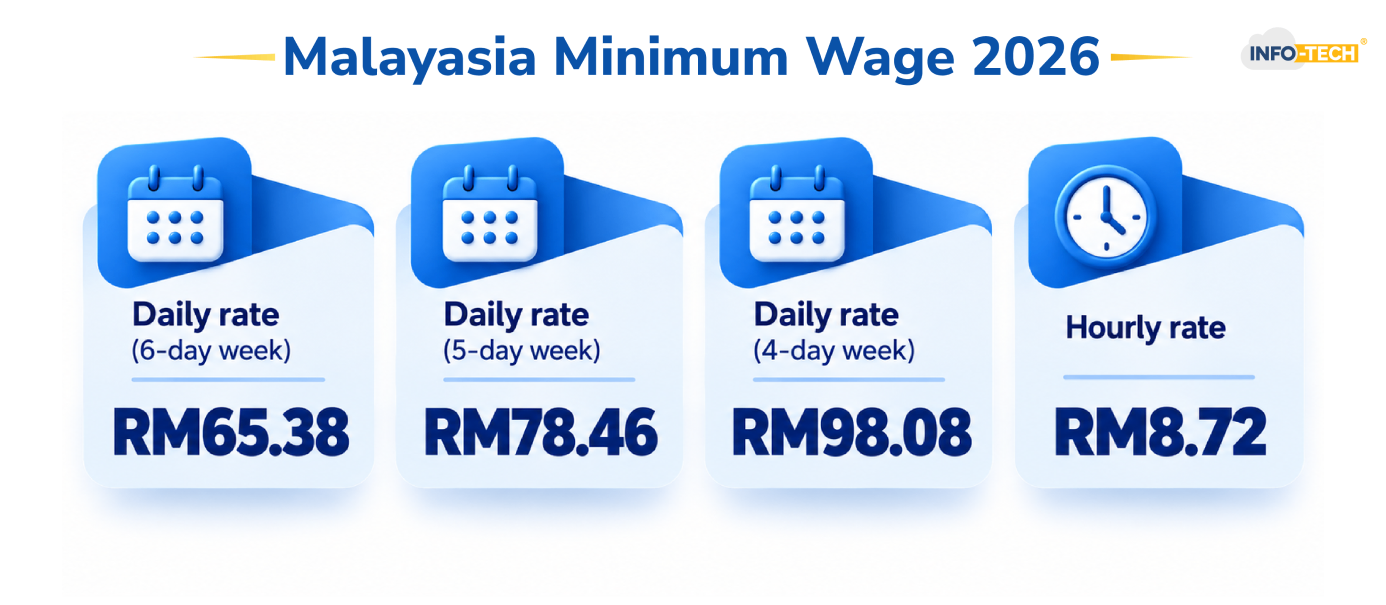
The national minimum wage is RM1,700 a month under the Minimum Wages Order 2024. It took effect on 1 February 2025, and employers with fewer than five staff had until 1 August 2025 to comply. That’s a 13.3% jump from the previous RM1,500. For staff paid daily or hourly, the Order sets equivalent rates:
| Pay basis | Minimum rate |
| Monthly | RM1,700 |
| Daily, 6-day week | RM65.38 |
| Daily, 5-day week | RM78.46 |
| Daily, 4-day week | RM98.08 |
| Hourly | RM8.72 |
Read also: Average Salary in Malaysia (2026): Latest Pay Guide & Insights
How Do Leave Entitlements and Termination Benefits Affect Payroll?
Paid leave is built into the monthly salary, but entitlements grow with length of service, so payroll needs to track each person’s tenure.
| Length of service | Annual leave | Sick leave (no hospitalisation) |
| Less than 2 years | 8 days | 14 days |
| 2 to 5 years | 12 days | 18 days |
| More than 5 years | 16 days | 22 days |
On top of this, employees get up to 60 days of hospitalisation leave a year (sick leave counts towards it), 98 days of maternity leave and 7 days of paternity leave. Termination benefits are paid when an employer ends the contract, for example through redundancy. They apply to employees with at least 12 months of continuous service and are based on the ORP:
- Under 2 years of service: 10 days’ wages per year
- 2 to 5 years: 15 days’ wages per year
- Over 5 years: 20 days’ wages per year
So an employee with 4 years of service and a RM140 daily rate is owed at least 4 × 15 × RM140 = RM8,400. Incomplete years are prorated to the nearest month.
Similar reads: Payroll Calculation Formula
What Payroll Deadlines Do Malaysian Employers Need to Meet?
| What | Deadline |
| Salary payment | Within 7 days after the end of the wage period |
| Overtime, rest day and public holiday pay | By the last day of the next wage period |
| EPF contributions (KWSP i-Akaun) | 15th of the following month |
| SOCSO and EIS contributions (PERKESO ASSIST) | 15th of the following month |
| Monthly tax deduction (LHDN e-PCB) | 15th of the following month |
| Form EA to each employee | 28 February |
| Form E to LHDN | 31 March |
Also check: Malaysian Salary Management Checklist to Avoid Fines & Audits
Should You Run Payroll In-House or Outsource It?
| In-house | Outsourced | |
| Control | Full control over pay rules and timing | Less hands-on, managed through reports |
| Compliance | Your team tracks every rule change | Provider handles updates and filings |
| Effort | Needs trained staff and good software | Frees up HR for other work |
| Works best for | Companies with an established HR team | SMEs and new market entrants |
Get the daily rate right, apply the correct multipliers and keep an eye on the 15th, and most payroll headaches never show up.
Payroll Calculation Malaysia FAQs
Is salary calculated 26 days or 30 days in Malaysia?
Payroll calculation is done on 26 days basis, for a full-time time monthly-paid employee.
What is the formula for calculating payroll?
Net pay = (Basic salary + Allowances + Overtime + Other payments − Unpaid leave) − (Employee EPF + SOCSO + EIS + PCB + Other deductions).
How is overtime calculated in Malaysia in 2026?
Overtime pay = (Monthly salary ÷ 26 ÷ Normal daily hours) × Multiplier × Overtime hours. The multiplier is 1.5× on normal working days, 2× on rest days and 3× on public holidays, and these rates are mandatory for employees earning RM4,000 a month or less.
What are the four basic steps for payroll calculation?
Calculate gross pay, subtract the statutory deductions (EPF, SOCSO, EIS, PCB) to get net pay, then pay employees and remit contributions by the 15th of the following month.