

In this article
- 1. What is Net Salary in Malaysia?
- 2. What Deductions Come Out of Your Salary?
- 3. How to Calculate Net Salary Step by Step?
- 4. How Much is Your Take-Home Pay on RM5,000?
- 5. Do Employer Contributions Reduce Your Take-Home Pay?
- 6. Are Overtime, Bonus and Allowances Subject to EPF, SOCSO And EIS?
- 7. Why is Your Net Salary Different Every Month?
- 8. What are Common Mistakes in Salary Calculation?
- 9. How Can Employers Make Salary Calculation Easier?
- 10. Salary Calculation FAQs
Your offer letter says RM5,000. Your bank account says something closer to RM4,300. Where did the rest go? If you’ve ever had that moment on payday, you’re not alone. In Malaysia, a chunk of every salary goes to EPF, SOCSO, EIS and income tax before it reaches you. None of it is a mystery once you see how each one works, and that’s what this guide is for. Whether you’re an employee checking your payslip or an HR person tired of calculating salary every month, you’ll find the numbers here.
What is Net Salary in Malaysia?
The formula is simple:
Net Salary = Gross Salary − (EPF + SOCSO + EIS + PCB + Other Deductions)
When you compare job offers, gross salary tells you the headline. Net salary is what you should build your budget around.
What Deductions Come Out of Your Salary?
| Deduction | What it’s for | Employee share (typical) |
| EPF (KWSP) | Retirement savings | 11% of wages |
| SOCSO (PERKESO) | Injury and invalidity protection | About 0.5%, based on wage bracket |
| EIS (SIP) | Support if you lose your job | About 0.2%, based on wage bracket |
| PCB (MTD) | Monthly income tax to LHDN | Depends on income and reliefs |
EPF
If you’re a Malaysian under 60, you contribute 11% of your monthly wages. Your employer adds 13% if you earn RM5,000 or less, and 12% if you earn more. Once you turn 60, your own share drops to 0% and the employer pays a reduced rate. Foreign workers also contribute now, at 2% each from the employee and employer. You can choose to contribute more than 11% if you want to boost your savings.SOCSO
SOCSO isn’t a flat percentage. It follows a wage bracket schedule, so someone earning RM3,480 and someone earning RM3,420 pay the same amount. The wage ceiling is RM6,000, which means the most an employee pays is RM29.75 a month. Employees aged 60 and above usually move to a category where only the employer contributes.EIS
EIS also uses wage brackets with the same RM6,000 ceiling, working out to roughly 0.2% of wages. The maximum employee deduction is RM11.90. It covers employees aged 18 to 60, and your employer matches your share.PCB
PCB is your income tax paid bit by bit every month, so you don’t get a big bill at year end. Two people on the same salary can have very different PCB because it depends on:- Your marital status and whether your spouse works
- Number of children
- Tax reliefs you’ve declared to your employer (insurance, medical, education and so on)
- Whether you’re a tax resident. Non-residents are taxed at a flat 30%
- Zakat paid through salary deduction, which reduces your PCB ringgit for ringgit
Check out: What is PCB in Malaysia?
Other deductions
Depending on your company, your payslip may also show staff loan repayments, salary advances, unpaid leave, or charges for parking and meals. These should be agreed in writing and shown clearly on the payslip.
Read also: Payslip: Meaning, Format & Example
How to Calculate Net Salary Step by Step?
- Add up your gross pay: Basic salary plus fixed allowances, commission and overtime for the month.
- Work out EPF: Multiply your EPF wages by 11%. Overtime isn’t included here (more on that below).
- Look up SOCSO and EIS: Find your wage bracket in the PERKESO contribution table. Don’t just multiply by a percentage, because the schedule rounds by bracket.
- Estimate PCB: Use LHDN’s formula or a PCB calculator with your marital status, children and reliefs.
- Subtract any other deductions: Loans, advances, unpaid leave and so on.
- What’s left is your net salary.
Also read: Payroll Calculation Malaysia: Guide for Employers & Employees
How Much is Your Take-Home Pay on RM5,000?
| Item | Amount (RM) |
| Gross salary | 5,000.00 |
| EPF (11%) | − 550.00 |
| SOCSO | − 24.75 |
| EIS | − 9.90 |
| PCB (estimate) | − 108.00 |
| Net salary | about 4,307.35 |
For a lower earner, say RM2,500, the picture is simpler. EPF is RM275, SOCSO RM12.25, EIS RM4.90, and PCB is usually nil. Net pay comes to about RM2,207.85.
Do Employer Contributions Reduce Your Take-Home Pay?
No. Your employer’s share of EPF, SOCSO and EIS is paid on top of your salary, not taken from it. You’ll often see both on your payslip, which is where the confusion starts.
For employers, though, it’s a real cost. Using Aina’s RM5,000 salary:
- Employer EPF (13%): RM650.00
- Employer SOCSO: RM86.65
- Employer EIS: RM9.90
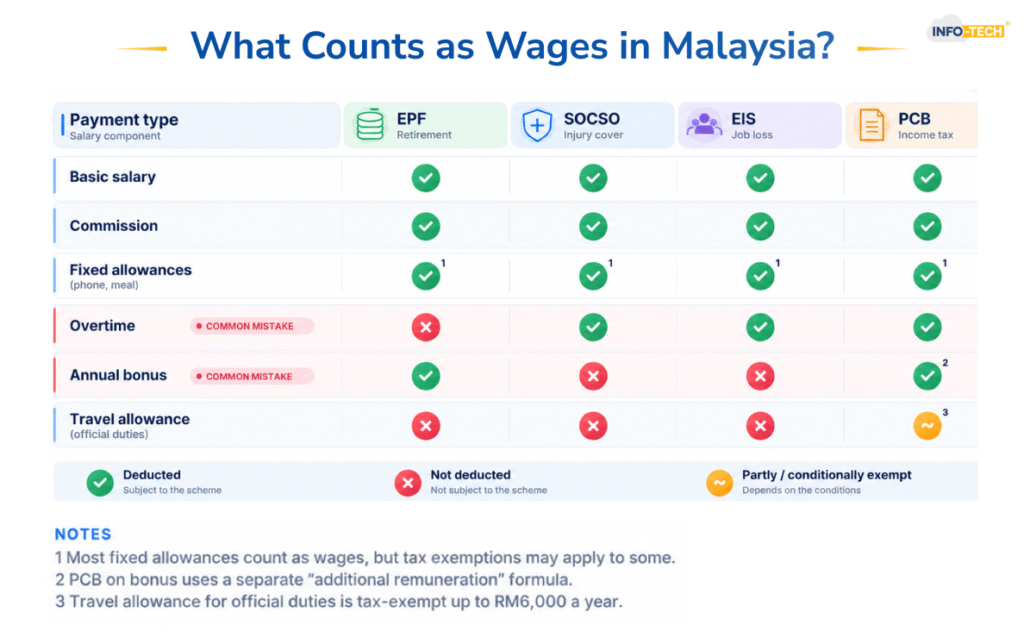
Are Overtime, Bonus and Allowances Subject to EPF, SOCSO And EIS?
Not always, and this is where a lot of payslip errors come from. Each scheme defines “wages” a bit differently.
| Payment | EPF | SOCSO | EIS | PCB |
| Basic salary | Yes | Yes | Yes | Yes |
| Commission | Yes | Yes | Yes | Yes |
| Fixed allowances (phone, meal, etc.) | Usually yes | Usually yes | Usually yes | Taxable unless exempt |
| Overtime | No | Yes | Yes | Yes |
| Annual bonus | Yes | No | No | Yes, calculated separately |
| Travel allowance for official duties | No | No | No | Exempt up to RM6,000 a year |
Check out: EPF Contribution Rate Malaysia 2026: Complete Guide
Why is Your Net Salary Different Every Month?
Even with a fixed basic salary, a few things can move the number:
- Overtime: Under the Employment Act 1955, eligible employees (generally those earning RM4,000 or less) get at least 1.5 times their hourly rate on normal days, 2 times on rest days and 3 times on public holidays. The hourly rate is your monthly salary ÷ 26 ÷ normal daily hours. So on RM2,600 and an 8-hour day, that’s RM12.50 an hour and RM18.75 per overtime hour.
- Unpaid leave: Each unpaid day is deducted from your pay, usually at monthly salary ÷ 26 or ÷ calendar days, depending on company policy.
- Bonus and commission: Higher gross pay means higher EPF and often higher PCB that month.
- Changes in reliefs: If you update your TP1 or TP3 forms, or get married mid-year, your PCB shifts.
- Claims: Reimbursements for mileage or medical bills can be added to your payslip, usually without deductions.
What are Common Mistakes in Salary Calculation?
A few we see again and again:
- Budgeting on gross pay: RM5,000 on paper is closer to RM4,300 in hand. Plan with the smaller number.
- Using a flat percentage for SOCSO and EIS: They’re bracket based. A simple 0.5% or 0.2% gets you close but not exact.
- Charging EPF on overtime: Overtime is excluded from EPF wages.
- Forgetting the age switch: Contribution rates change once an employee turns 60, and payroll often misses the month it happens.
- Ignoring tax residency: Non-residents pay a flat 30% and can’t claim personal reliefs.
- Using outdated tables: EPF, PERKESO and LHDN update their rules from time to time. Last year’s spreadsheet can quietly get things wrong.
Also check: Malaysian Salary Management Checklist to Avoid Fines & Audits
How Can Employers Make Salary Calculation Easier?
A Payroll Software handles the heavy lifting. It applies the latest EPF, SOCSO, EIS and PCB rates automatically, generates payslips and EA forms, and prepares statutory submission files. When it’s part of a full HRMS Software, attendance, leave and claims flow straight into payroll, so nobody has to retype numbers. Staff can also clock in on the go with a Mobile Attendance App.