

In this article
- 1. How Do You Actually Claim Your SOCSO Benefits?
- 2. What Is A SOCSO Claim?
- 3. Who Can Make A SOCSO Claim?
- 4. What Should You Do Immediately After A Workplace Accident?
- 5. How Does The SOCSO Claim Process Work?
- 6. What Documents Are Usually Needed?
- 7. How Long Does A SOCSO Claim Usually Take?
- 8. Can You Make A SOCSO Claim For A Commuting Accident?
- 9. What Happens If You Can’t Return To Work Immediately?
- 10. Why Are Some SOCSO Claims Delayed?
- 11. What Role Does The Employer Play In The SOCSO Claim Process?
- 12. Final Thoughts
- 13. SOCSO Claim FAQs
Most employees never think about making a SOCSO claim until something unexpected happens.
A workplace accident. A road accident while travelling for work. An illness caused by years of exposure to hazardous conditions.
When situations like these occur, the immediate priority is getting medical treatment. But once the dust settles, another question quickly follows.
How Do You Actually Claim Your SOCSO Benefits?
Many employees assume the process is complicated because it involves employers, hospitals, doctors, and PERKESO. In reality, the procedure is quite manageable when you understand what needs to happen and when.
Whether you’re making your first claim or simply want to understand your rights, this guide explains how the SOCSO claim process in Malaysia works, what documents you’ll need, and what to expect after submitting your application.
Read More: What Is SOCSO
What Is A SOCSO Claim?
A SOCSO claim is a request for benefits provided under Malaysia’s Social Security Organisation (SOCSO), also known as PERKESO.
Its purpose is simple. When employees suffer an employment-related injury, develop an occupational disease, become permanently disabled, or are unable to continue working because of a qualifying condition, SOCSO provides financial and medical support to help them through that period.
Many people associate PERKESO solely with workplace accidents, but its protection extends further than that.
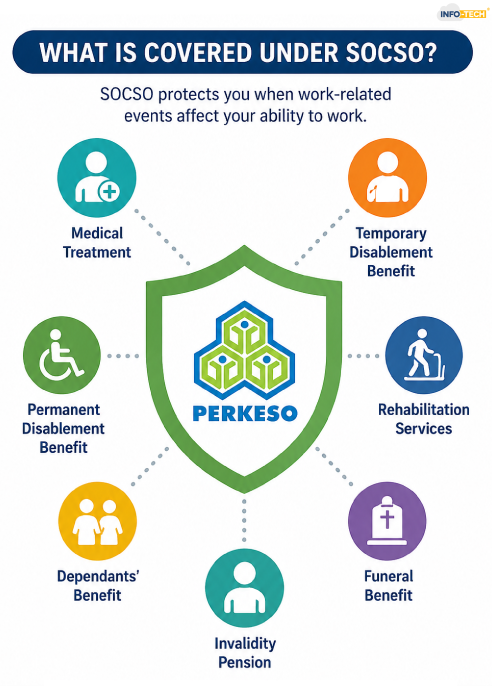
Depending on the circumstances, eligible contributors may receive medical treatment, income replacement while recovering, rehabilitation services, permanent disability compensation, invalidity benefits, or financial assistance for their dependants.
Exactly what a person receives depends on the type of claim being made and the outcome of PERKESO’s assessment.
Who Can Make A SOCSO Claim?
One of the biggest misconceptions is that every accident automatically qualifies for compensation.
In reality, eligibility depends on several factors, including whether the employee is covered under SOCSO, whether contributions have been made, and whether the incident falls within PERKESO’s coverage.
For example, someone injured while carrying out work duties may qualify under the Employment Injury Scheme. Likewise, an employee involved in an accident while travelling directly between home and work could also be eligible under certain conditions.
Occupational diseases follow a slightly different process because these illnesses often develop gradually rather than resulting from a single incident. Hearing loss, respiratory illnesses and certain work-related medical conditions may all require additional medical assessment before benefits are approved.
Although each situation is unique, the objective remains the same—to provide financial support when an employee’s ability to work has been affected by circumstances covered under the law.
What Should You Do Immediately After A Workplace Accident?
When an accident happens, paperwork should never be the first concern.
The priority is always getting medical treatment.
Even injuries that appear relatively minor should be examined by a medical professional as soon as possible. What seems like a simple sprain could later turn out to be something more serious, and delaying treatment may complicate both your recovery and your SOCSO claim.
Once you’ve received medical attention, your employer should be informed without unnecessary delay.
Some employees wait until they return to work before reporting what happened, believing there’s no rush if they’ve already visited a clinic. In practice, early reporting helps everyone involved. Employers have responsibilities of their own, including notifying PERKESO and preparing the required documentation, so informing them promptly allows the process to begin sooner.
It’s equally important to keep every document related to the incident. Medical certificates, consultation notes, hospital discharge summaries and diagnostic reports often become essential when PERKESO reviews a claim. Losing these records can create unnecessary delays later.
How Does The SOCSO Claim Process Work?
Although every case is different, most SOCSO claims follow a fairly predictable path.
The process usually begins once the incident has been reported to the employer and employers must report an accident to SOCSO within 48 hours, using Form 21 (via the ASSIST Portal).
Depending on the type of accident or illness, the employer prepares the necessary forms and submits the relevant information to PERKESO together with supporting documents.
At the same time, medical professionals assess the employee’s condition and prepare reports describing the injury, diagnosis, treatment plan and expected recovery period.
PERKESO then reviews both the employment records and the medical evidence before determining whether the claim satisfies the requirements of the relevant scheme.
If additional clarification is needed, further documents or medical assessments may be requested before a final decision is made.
While many people expect an immediate outcome, claims are assessed individually. Straightforward cases with complete documentation naturally move faster than complex claims involving permanent disabilities or occupational diseases.
What Documents Are Usually Needed?
The exact paperwork depends on the nature of the claim, but one thing remains consistent—complete documentation helps the process move more smoothly.
Most employees will be asked to provide identification documents together with medical records relating to their treatment. Depending on the circumstances, PERKESO may also require accident reports prepared by the employer, police reports for commuting accidents, hospital discharge summaries, medical certificates and banking details for benefit payments.
Rather than worrying about collecting everything afterwards, it’s a good habit to keep every document from the beginning. Many delays occur simply because employees struggle to retrieve medical reports weeks or months after treatment.
How Long Does A SOCSO Claim Usually Take?
This is probably the question employees ask most often.
Unfortunately, there isn’t a single answer. Employees/employers generally have up to 12 months from the date of the accident (or onset of symptoms for an occupational disease) to file the actual benefit claim.
- Form 21 (Accident Report, employer-submitted)
- Form 34 (Notice and Benefit Claim), and Form 10/Form 12 depending on benefit type.
Some claims are relatively straightforward. An employee suffers a temporary injury, receives treatment, submits the required documents and the claim progresses without major complications.
Others require considerably more assessment.
Claims involving permanent disability, occupational diseases or long-term rehabilitation often take longer because PERKESO may need specialist medical reports or additional investigations before reaching a decision.
The quality of the submitted documents also plays an important role. Missing information, incomplete forms or inconsistent reports frequently slow down the assessment process.
Although employees cannot control every aspect of the timeline, submitting complete and accurate information from the outset gives the claim the best chance of progressing efficiently.
Can You Make A SOCSO Claim For A Commuting Accident?
Yes—but the circumstances matter.
Many employees are surprised to learn that PERKESO doesn’t only cover accidents that happen inside the workplace.
If you’re injured while travelling directly between your home and workplace, or while travelling for work-related duties, you may still qualify for benefits under the Employment Injury Scheme.
Of course, every claim is assessed individually.
PERKESO will usually examine where the accident occurred, whether the journey was directly connected to employment and whether sufficient evidence has been provided. Police reports, medical records and other supporting documents often become particularly important in these situations.
Read Also: SOCSO Lindung 24/7: The June 2026 Change Happening In Malaysia
What Happens If You Can’t Return To Work Immediately?
Recovery isn’t always quick.
Some employees are fortunate enough to return after a few days. Others may require surgery, physiotherapy or months of rehabilitation before they’re able to resume their normal duties.
Depending on the medical assessment, eligible employees may receive temporary disablement benefits to help replace part of their lost income during recovery.
Where injuries result in permanent impairment, additional assessments determine whether permanent disablement benefits are payable.
PERKESO also provides rehabilitation programmes designed to help injured employees regain independence and, where possible, return to employment. These services can include physical rehabilitation, vocational training and assistive devices depending on individual needs.
Why Are Some SOCSO Claims Delayed?
When employees hear that someone’s claim took months to process, it’s easy to assume PERKESO simply works slowly.
In reality, delays are often caused by incomplete information.
Missing medical reports, inconsistent accident descriptions, delayed reporting and incomplete employer records are among the most common reasons claims require additional review.
Sometimes PERKESO also needs further medical assessments before deciding whether an injury has resulted in permanent disability or whether a particular illness qualifies as an occupational disease.
While not every delay can be avoided, careful preparation certainly helps. Reporting incidents promptly and ensuring every supporting document is submitted together can save considerable time later.
Also Read About: SOCSO Lindung 24/7: The June 2026 Change Happening In Malaysia
What Role Does The Employer Play In The SOCSO Claim Process?
Although employees are the beneficiaries, employers are heavily involved throughout the process.
Beyond reporting workplace accidents, employers are responsible for providing employment records, salary information and contribution details whenever required by PERKESO.
For businesses managing a growing workforce, retrieving this information manually can become surprisingly time-consuming, particularly if records are spread across different systems or maintained on paper.
Many organisations now rely on integrated HR and payroll software to keep employee information organised, making it easier to prepare statutory documentation whenever situations like a SOCSO claim arise. While software doesn’t replace PERKESO’s assessment process, it does simplify the administrative work that supports it.
For broader financial record-keeping, accounting software as well payroll software can also help businesses maintain organised payroll-related transactions, payment records and financial data. Keeping these records in one place can make it easier for employers to retrieve relevant information when handling statutory requirements and other business reporting needs.
Final Thoughts
Nobody expects to need SOCSO.
Yet when an accident or work-related illness interrupts someone’s ability to earn a living, understanding how the SOCSO claim process works becomes incredibly important.
Knowing what to do immediately after an incident, keeping the right documents, informing your employer promptly and following PERKESO’s procedures can make the experience far less stressful.
For employers, good record-keeping is just as important. Having accurate employee information readily available not only supports statutory compliance but also helps employees receive the assistance they’re entitled to without unnecessary delays.
Ultimately, SOCSO exists as a safety net. While nobody hopes to rely on it, understanding how the system works means you’ll be better prepared if the unexpected ever happens.