

In this article
- 1. What Does Sole Proprietorship Actually Mean?
- 2. How Does a Sole Proprietorship Work in Malaysia?
- 3. How Do You Register a Sole Proprietorship With SSM?
- 4. What Taxes Does a Sole Proprietor Pay in Malaysia?
- 5. Why Do Many Malaysians Choose Sole Proprietorship??
- 6. Common Misconceptions About Sole Proprietorship?
- 7. The Reality Most Entrepreneurs Learn Later
- 8. Sole Proprietorship FAQs
A lot of businesses in Malaysia start with one person doing everything.
One person handling customers. The other person replying to WhatsApp messages at midnight, and another person managing invoices, orders, marketing, and sometimes even packing deliveries from the living room floor.
That’s usually where a Sole Proprietorship begins.
Not with a fancy office. Not with investors. Just a person trying to turn a skill, idea, or side income into something real.
And honestly, that’s why Sole Proprietorship remains one of the most common business structures in Malaysia. It’s simple, affordable, and easy to set up. But despite how common it is, many people misunderstand what it actually means — especially the legal and financial side of it.
Some think registering a Sole Proprietorship automatically protects them legally. It doesn’t.
Others assume it’s only for “small businesses.” That’s not entirely true either.
So before registering your business with SSM, it helps to understand what you’re actually signing up for.
What Does Sole Proprietorship Actually Mean?
A Sole Proprietorship is a business owned by one individual.
In Malaysia, it’s commonly registered under Suruhanjaya Syarikat Malaysia (SSM) as an “Enterprise” business.
The key thing many people miss is this:
The business and the owner are legally the same entity.
That means there is no separation between your personal finances and your business liabilities.
If the business earns money, you earn money.
If the business owes money, you owe money personally.
That’s the trade-off behind the simplicity.
How Does a Sole Proprietorship Work in Malaysia?
The structure itself is straightforward.
You register your business name with SSM, operate under that registered enterprise, and report your income as personal income when filing taxes.
Unlike a Sdn Bhd company, there are fewer compliance requirements, less paperwork, and lower startup costs.
This is why many Malaysians choose it for:
- Freelancing businesses
- Online stores
- Food businesses
- Small retail shops
- Home-based businesses
- Consultants and service providers
- Startup side hustles
For example:
A graphic designer earning freelance income through Instagram may register a Sole Proprietorship to issue invoices professionally.
A couple running a small nasi lemak business may begin with a Sole Proprietorship before eventually upgrading to a Sdn Bhd later.
It’s often the “first step” structure for entrepreneurs testing a business idea.
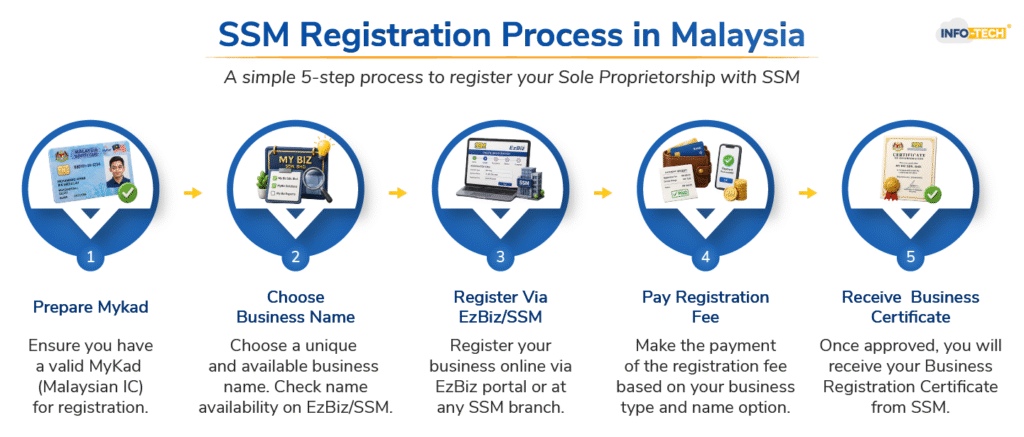
How Do You Register a Sole Proprietorship With SSM?
The registration process in Malaysia is relatively fast compared to many countries.
You can register through:
- SSM counter services
- SSM online platform (EzBiz)
- Licensed business registration agents
Basic Requirements
You generally need:
- MyKad
- Business address
- Business activity description
- Proposed business name
- Registration fee
Business Name Options
|
Type |
Example |
|
Personal Name |
Ahmad Trading |
|
Trade Name |
Urban Brew Cafe |
Using your personal name is cheaper, while custom trade names require approval from SSM.
What Taxes Does a Sole Proprietor Pay in Malaysia?
This is where many new business owners get confused.
A Sole Proprietorship does NOT pay corporate tax like a Sdn Bhd.
Instead, the business income is treated as personal income under your individual tax filing.
That means your tax depends on how much profit you make overall.
Example
If your business earns:
- RM120,000 revenue
- RM50,000 expenses
Your taxable business profit becomes RM70,000.
That amount is added into your personal income tax calculation.
|
Sole proprietors in Malaysia pay personal income tax, not corporate tax. Business profits are reported under the owner’s individual income tax filing. |
Depending on your business, you may also need to handle:
- SST registration
- EPF contributions
- SOCSO
- E-Invoicing requirements
- Payroll tax deductions if hiring employees
This is usually the stage where many small businesses realise business operations become more complicated than expected.
Why Do Many Malaysians Choose Sole Proprietorship?
The biggest reason is simplicity.
You can start quickly without heavy legal requirements or high operating costs.
But there’s also a psychological reason people rarely talk about:
A Sole Proprietorship feels less intimidating.
People feel more comfortable starting small rather than immediately committing to a full company structure.
Main Advantages
- Low Startup Cost
Registering a Sole Proprietorship is significantly cheaper than incorporating a Sdn Bhd.
For many first-time entrepreneurs, that matters.
- Easy Administration
Less paperwork. Fewer reporting obligations.
You don’t need:
- Company secretaries
- Audited financial statements
- Board resolutions
- Complex annual compliance
- Full Control
You make every decision yourself.
There’s no shareholder approval process or partnership disputes.
- Faster Decision-Making
Small businesses move quickly because there are fewer layers involved.
That flexibility can be valuable during early growth stages.
Common Misconceptions About Sole Proprietorship
- “Registering With SSM Protects Me Legally”
No.
SSM registration only makes the business legitimate and compliant. It does not create legal separation between you and your business.
- “Only Small Businesses Use Sole Proprietorship”
Not necessarily.
Some businesses generate substantial revenue while still operating under this structure.
The real question is whether the liability risk still makes sense.
- “It’s Easier Because There’s No Tax”
There is still tax.
You’re simply taxed differently under personal income tax instead of corporate tax.
Sole Proprietorship vs Partnership vs Sdn Bhd
|
Feature |
Sole Proprietorship |
Partnership |
Sdn Bhd |
|
Owners |
1 |
2–20 |
Separate legal entity |
|
Legal Separation |
No |
No |
Yes |
|
Liability |
Unlimited |
Shared unlimited |
Limited liability |
|
Tax Type |
Personal tax |
Personal tax |
Corporate tax |
|
Compliance |
Low |
Medium |
Higher |
|
Startup Cost |
Low |
Low–Medium |
Higher |
|
Best For |
Freelancers & small businesses |
Co-owned businesses |
Growing/scalable businesses |
The Reality Most Entrepreneurs Learn Later
Starting a business is usually easier than managing one consistently.
At first, a Sole Proprietorship feels manageable because everything is small.
Then suddenly:
- Employee leave records pile up
- Payroll calculations become stressful
- Attendance tracking gets messy
- Claims go missing
- Staff records become disorganised
That’s often the stage where business owners realise they need proper systems instead of spreadsheets and WhatsApp messages.
For growing Malaysian businesses, using an HRMS and payroll software can make daily operations far easier to manage — especially once hiring begins. Instead of manually handling payroll, leave management, claims, and employee records, businesses can centralise everything in one system and reduce administrative headaches as the company grows.
And honestly, many entrepreneurs only realise how valuable that becomes after the business starts getting busier.
Sole Proprietorship FAQs
Is Sole Proprietorship the same as Enterprise in Malaysia?
Yes. In Malaysia, Sole Proprietorship businesses are commonly registered as “Enterprise” businesses under SSM.
Can foreigners register a Sole Proprietorship in Malaysia?
Generally, Sole Proprietorship registration is limited to Malaysian citizens and permanent residents.
How much does it cost to register a Sole Proprietorship with SSM?
The cost depends on whether you use a personal name or trade name, but it is generally one of the cheapest business registration options in Malaysia.
Does a Sole Proprietorship need audited accounts?
No. Sole Proprietorship businesses are not legally required to submit audited financial statements like Sdn Bhd companies.