
In this article
HR teams have to deal with a lot of employee information every day. There are salary details, attendance records, leave requests, benefits, personal information and plenty more to manage. When all of this is kept in separate spreadsheets, emails or systems, even a simple update can take more time than it should. That is where an HRIS (Human Resource Information System) comes in. It keeps employee information and common HR processes in one place. Depending on the software’s abilities, this can include payroll, attendance, leave management, benefits, reporting and employee self-service.
What is HRIS?
HRIS stands for Human Resource Information System. In simple terms, it is software businesses use to keep employee information organised and handle day-to-day HR work. An HRIS may contain:
- Personal and contact details
- Job and employment information
- Salary and payroll records
- Leave and attendance
- Employee benefits
- Performance information
- Training records
So instead of checking one spreadsheet for attendance, another for employee details and a different system for payroll, HR can work with the information from one central system.
How Does an HRIS Work?
Most HRIS software starts with an employee database. Other HR functions then use the information stored there. Say an employee applies for leave. They can submit the request through the HRIS, their manager can approve it and the leave balance can be updated.
If it is connected with attendance or payroll, the same information can flow into those areas too. This matters because HR teams don’t have to keep entering the same change in different places. If an employee’s job details or salary changes, for instance, the new information can be recorded in the system and used by the relevant HR processes. Employees may also get their own access. They can check certain information or make requests without having to email HR each time.
What Can an HRIS Do?
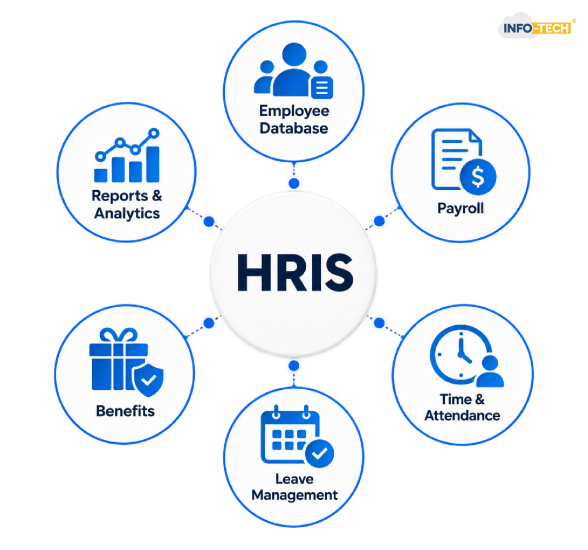
There isn’t one fixed list of features. A smaller system might cover employee records and attendance, while another could include payroll, benefits, reporting and other HR functions. Here are some of the common ones:
| Function | What it is used for |
| Employee database | Keeping employee, job and compensation details |
| Payroll | Managing salary and payroll information |
| Time and attendance | Recording working hours, attendance and absences |
| Leave management | Managing leave requests, approvals and balances |
| Benefits | Keeping track of employee benefits |
| Employee self-service | Giving employees access to selected HR information |
| Reporting | Creating reports from employee and HR data |
Because these functions use much of the same employee information, keeping them connected can make everyday HR work less repetitive.
What Types of HRIS are There?
HRIS software can serve different purposes. Some are built mainly for daily administration, while others are used to support bigger workforce decisions.
Operational HRIS deals with the everyday side of HR, such as employee details, job information and appraisal records.
Tactical HRIS is more useful when HR needs information for decisions around recruitment, compensation, training or how resources are allocated.
Then there is strategic HRIS, which looks further ahead. It can help a company understand its workforce and skills when planning for future needs.
A comprehensive HRIS brings several of these areas together rather than focusing on one. There are also limited-function systems for businesses that only need something specific, such as employee records or timekeeping.
Why do Businesses Use an HRIS?
A lot of the value comes from removing small manual tasks that pile up over time. Imagine an HR team handling leave through email. Someone has to read the request, get approval, update the leave balance and possibly update attendance or payroll as well. An HRIS can connect more of that process. It can also help with:
- Less manual work: Routine HR processes can be handled through the system instead of spreadsheets and emails.
- Fewer data-entry mistakes: Employee information doesn’t have to be repeatedly entered in different places.
- Easier access for employees: Staff can check information or make simple requests themselves.
- Better visibility: HR teams can use stored data to prepare reports and look at workforce trends.
- More consistent records: Employee information is easier to maintain when it isn’t scattered across different files.
- Data security: HRIS platforms can provide controls for accessing sensitive employee information.
The difference tends to become clearer as a company grows. A spreadsheet that works for a small team can quickly become difficult to maintain when there are hundreds of employee records and regular changes to track.
Read also: What CFOs in Malaysia Really Think About HRIS (2026)
How are HRIS, HRMS and HCM Different?
You will often see HRIS, HRMS and HCM used when looking at HR software. The lines between them aren’t always clear, and software companies don’t necessarily use the terms in exactly the same way. Broadly, the difference looks like this:
| Term | Usually refers to |
| HRIS | Employee information and core HR processes |
| HRMS | A wider HR system that may also cover recruitment, performance and talent management |
| HCM | A broader approach to managing people, workforce planning and human capital |
HRIS is generally the more core, data-focused layer. HRMS tends to add more HR management functions around it. HCM is broader again and can include both the technology and the wider practices a business uses to manage its workforce.
How Does an HRIS Make Things Easier for Employees?
Employees don’t necessarily need to go through HR for every small request when self-service is available. They may be able to log in and:
- Request leave
- Check their leave balance
- View benefits
- Access payroll information
- Check their employment details
- Update certain personal information
For employees, this means quicker access to basic information. For HR, it means fewer emails asking for leave balances, employee records or other details that staff can already find themselves. Contact us for a free demo of Info-Tech’s reliable HRMS software.
HRIS Frequently Asked Questions
What does HRIS mean?
HRIS means Human Resource Information System. It is software that helps businesses store employee information and manage HR tasks.
What are the 5 types of HRIS?
The five common types of HRIS are Operational, Tactical, Strategic, Comprehensive, and Limited-Function.
Is HRIS the same as HRMS?
No, while HRIS mainly manages employee information and core HR records, HRMS typically covers a broader range of functions such as payroll, attendance, leave, benefits, recruitment, and performance management.
Why is an HRIS important?
An HRIS is important because it keeps employee data in one place, reduces manual HR work, improves payroll and record accuracy, and helps HR teams manage employees more efficiently.