

In this article
- 1. What is the Employment Act 1955?
- 2. Who Is Covered Under the Employment Act 1955?
- 3. What Leave Entitlements Do Employees Receive Under the Employment Act 1955?
- 4. How Do Working Hours, Overtime and Flexible Work Arrangements Work?
- 5. What Employment Compliance Updates Should Employers Know in 2026?
- 6. How Can Employers Stay Compliant with the Employment Act 1955?
- 7. Employment Act 1955 FAQs
The Employment Act 1955 sets out the basic rules for employees and employers to follow at workplaces in Malaysia. It covers common workplace matters such as salary, working hours, leave, overtime and termination. The Act applies mainly to Peninsular Malaysia and Labuan. Sabah and Sarawak have their own labour laws.
What is the Employment Act 1955?
Some of the biggest changes took effect in 2023, including shorter weekly working hours, longer maternity leave and wider coverage for employees.
Read also: Employment Act vs Employment Rights Act: Differences Explained
Who Is Covered Under the Employment Act 1955?
However, the RM4,000 salary level still matters in a few areas. Employees earning more than RM4,000 a month may not qualify for certain payments, such as overtime, work on rest days and some termination benefits. There are exceptions depending on the type of work the employee does.
What Employment Terms Must Employers Follow?
Employers should make sure employees know the basic terms of their job from the start. This normally includes components such as:- salary
- working hours
- leave
- job duties
- benefits and
- notice period
Clear employment terms can prevent confusion later, especially when it comes to pay, leave or leaving the company.
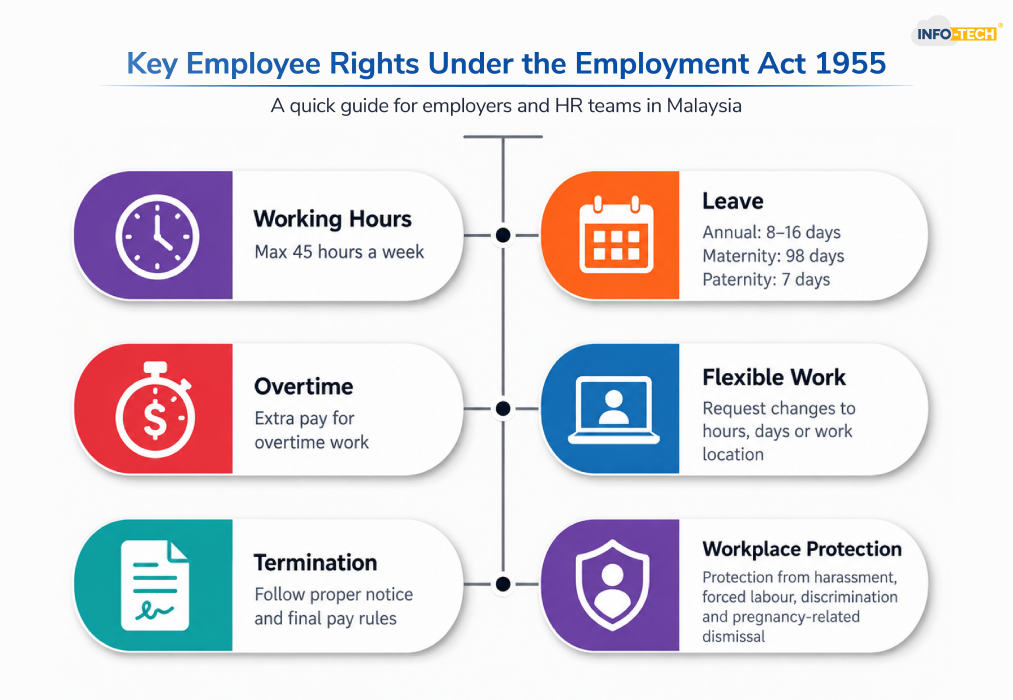
What Leave Entitlements Do Employees Receive Under the Employment Act 1955?
| Leave | Minimum |
| Annual leave | 8, 12 or 16 days based on years worked |
| Sick leave | 14, 18 or 22 days based on years worked |
| Hospitalisation leave | Up to 60 days |
| Maternity leave | 98 days |
| Paternity leave | 7 days |
| Public holidays | 11 paid days |
Read also: Annual Leave Malaysia 2026: Rules, Forecasts & HR Practices
How Do Working Hours, Overtime and Flexible Work Arrangements Work?
Employees who qualify for overtime should be paid extra when they work beyond their normal hours. On a normal working day, overtime usually starts at the rate of 1.5 times the hourly pay
Employees can also ask for changes to their working hours, working days or even work location. The request should be conveyed through writing, and the employer has to reply within 60 days of the request.
Read also: Overtime Calculation Malaysia Rules & Eligibility
What Are the Rules for Termination, Retrenchment and Workplace Protection?
When an employee leaves or is dismissed, the employer should follow the notice period in the employment contract or the period required under the Employment Act.Employees who lose their job because of retrenchment may also receive a payment based on their years of service, if they qualify.
The Act also covers workplace issues such as:
- sexual harassment
- discrimination
- forced labour
- dismissal linked to pregnancy
Employers who break the rules can face fines of up to RM50,000 for some of the offences.
What Employment Compliance Updates Should Employers Know in 2026?
From June 2026, the salary levels for Employment Passes had changed as follows:
- Category I: RM20,000 and above
- Category II: RM10,000 to RM19,999
- Category III: RM5,000 to RM9,999
These updates matter mainly to companies hiring foreign workers or expatriates.
How Can Employers Stay Compliant with the Employment Act?
HR and payroll software can help with the record keeping with salary, leave, attendance and employee information in one place. For most businesses, staying compliant simply comes down to knowing the current rules and making sure day-to-day HR practices match with them.
Employment Act 1955 FAQs
What is the Employment Act 1955 Malaysia?
The Employment Act 1955 is a main law in Malaysia (applies to employees in Peninsular Malaysia and Labuan) that covers basic employment rules.
Is salary calculated for 30 days or 26 days in Malaysia under Employment Act 1955?
Under Employment Act 1955 of Malaysia, for overtime and the ordinary daily rate, a month’s salary is divided by 26 days; for an incomplete month, salary is calculated using the actual number of days in that month’s wage period.
Can an employer force an employee to take annual leave in Malaysia under Employment Act 1955?
No, as per JTKSM, the employers cannot simply force employees to use their annual leave; annual leave should be granted and taken in line with Section 60E of the Employment Act 1955.
How is overtime pay calculated under the Employment Act 1955 in Malaysia in 2026?
In Malaysia, overtime for eligible employees is generally calculated as monthly salary ÷ 26 ÷ normal working hours per day × overtime hours. The rates are 1.5× on normal working days, 2× for overtime on rest days, and 3× for overtime on paid public holidays.