Tax regulations change frequently, and for large organisations with hundreds or thousands of employees, managing tax relief changes can become a complex operational challenge. From payroll adjustments and employee tax declarations to compliance reporting and audit readiness, every tax relief update requires structured coordination between HR, finance, payroll, and compliance teams.
For organisations operating at scale, these changes are not merely regulatory updates—they directly impact payroll accuracy, employee take-home income, statutory reporting, and organisational compliance risk. Without the right systems and processes in place, even minor relief changes can lead to incorrect deductions, employee dissatisfaction, and potential penalties from tax authorities.
This comprehensive guide explains how large organisations can effectively manage tax relief changes, ensuring compliance, operational efficiency, and employee transparency.
How Is The Tax Relief Changes in Large Organisations?
Tax relief refers to deductions or exemptions allowed by the government that reduce an individual’s taxable income. These reliefs may change due to:
- Annual government budget announcements
- New tax policies or reforms
- Economic stimulus programs
- Changes in employment or welfare policies
- Industry-specific tax incentives
For large organisations, implementing these changes requires system-wide updates across payroll systems, HR records, and employee declarations.
What Are The Types of Employee Tax Relief?
|
Tax Relief Category |
Description |
Impact on Payroll |
|
Personal Relief |
Standard deduction for individual taxpayers |
Reduces taxable income |
|
Spouse Relief |
Relief for supporting spouse |
Requires marital status verification |
|
Child Relief |
Tax relief for dependent children |
Requires documentation |
|
Lifestyle Relief |
Expenses on education, devices, sports |
Employee declaration needed |
|
Insurance & Medical Relief |
Life or medical insurance payments |
Payroll deduction adjustments |
|
Retirement Savings Relief |
Contributions to retirement funds |
Impacts statutory deductions |
For HR and payroll teams, tracking these relief categories manually becomes difficult when dealing with large employee populations.
What Are The Challenges Large Organisations Face When Managing Tax Relief Changes?
Large enterprises face unique operational and compliance challenges when tax regulations change.
1. High Employee Volume
When thousands of employees must update tax relief claims, manual processing becomes inefficient.
Problems include:
- Data entry errors
- Delayed updates
- Inconsistent records
- Payroll recalculation issues
2. Complex Payroll Structures
Large organisations often manage:
- Multiple payroll cycles
- Different employee categories
- Regional tax requirements
- Contract and permanent staff
A single relief change may affect multiple payroll rules simultaneously.
3. Employee Awareness and Communication
Employees must understand:
- New relief eligibility
- Updated documentation requirements
- Submission deadlines
Without clear communication, organisations may experience:
- Incomplete declarations
- Incorrect claims
- Payroll disputes
4. Compliance and Audit Risks
Failure to correctly implement tax relief updates can lead to:
- Tax filing errors
- Incorrect employee tax deductions
- Government penalties
- Audit complications
What Are The Steps for Managing Tax Relief Changes Efficiently?
Large organisations should adopt a structured approach to implement updates smoothly.
Step 1: Monitor Government Tax Announcements
Finance and compliance teams must closely track government updates.
Important sources include:
- National annual budget announcements
- Tax authority publications
- Regulatory circulars
- Industry tax advisories
Creating an internal tax update monitoring process ensures organisations are prepared ahead of payroll cycles.
Step 2: Assess the Impact on Payroll Systems
Once a tax relief change is announced, organisations must evaluate its operational impact.
Key areas to analyse:
|
Area |
Questions to Evaluate |
|
Payroll Calculation |
Will taxable income formulas change? |
|
Employee Eligibility |
Which employees qualify for new reliefs? |
|
Documentation |
What proofs are required? |
|
Reporting |
Will statutory reporting formats change? |
|
Payroll Timelines |
Will adjustments affect payroll deadlines? |
This step prevents unexpected payroll disruptions.
Step 3: Update Internal Policies and Payroll Rules
Large organisations must revise internal payroll policies to reflect tax changes.
Typical updates include
- Payroll calculation rules
- Employee declaration forms
- Tax deduction schedules
- Employee benefits structure
These updates must be documented to maintain policy transparency and compliance readiness.
Step 4: Implement System Updates
Modern organisations rely heavily on HR and payroll systems. Therefore, tax relief changes must be implemented digitally.
System updates typically involve
- Updating tax calculation algorithms
- Adding new tax relief categories
- Modifying payroll deduction formulas
- Updating employee declaration portals
Automated systems help reduce:
- Manual errors
- Calculation inconsistencies
- Compliance risks
Step 5: Communicate Changes to Employees
Employee awareness is critical for accurate tax declarations.
Effective communication strategies
- Email announcements
- Employee self-service portal notifications
- HR briefings or webinars
- Internal policy documents
Important information employees should receive
- Updated tax relief categories
- Eligibility criteria
- Required documentation
- Submission deadlines
Clear communication reduces confusion and improves compliance.
Step 6: Enable Digital Employee Declarations
Large organisations benefit significantly from self-service declaration systems.
Benefits of digital tax declaration systems
- Employees submit tax claims online
- Documents can be uploaded securely
- HR teams can review submissions efficiently
- Automatic integration with payroll calculations
This reduces administrative workload while improving accuracy.
Step 7: Conduct Payroll Testing Before Implementation
Before applying new tax rules in live payroll cycles, organisations should conduct payroll simulations.
Payroll testing ensures
- Correct tax deduction calculations
- Accurate employee take-home pay
- System stability during updates
Payroll Testing Checklist
|
Test Area |
Validation Required |
|
Tax Relief Calculation |
Correct deduction amounts |
|
Payroll Integration |
System compatibility |
|
Employee Categories |
Proper application across staff types |
|
Reporting Output |
Accurate tax reports |
What Are The Best Practices for Managing Tax Relief Changes in Enterprises?
To streamline tax change management, organisations should adopt the following best practices.
Centralised Tax Compliance Team
A dedicated team responsible for:
- Monitoring tax regulations
- Updating payroll rules
- Coordinating HR and finance teams
This prevents fragmented implementation.
Use Automated Payroll Systems
Automation ensures:
- Accurate tax calculations
- Real-time compliance updates
- Reduced manual intervention
Maintain Digital Documentation
Large organisations must store employee tax declarations securely.
Digital records help with
- Tax audits
- Internal reviews
- Compliance verification
Regular Employee Education
Organisations should regularly educate employees about tax benefits.
Examples include:
- Tax planning workshops
- Employee tax guides
- Internal knowledge portals
This improves employee engagement and financial awareness.
What Is The Role of HR Technology in Managing Tax Relief Changes?
Manual payroll systems struggle to keep up with frequent regulatory updates.
Modern HR and payroll software helps organisations:
- Automatically apply tax rule changes
- Manage employee tax declarations digitally
- Integrate payroll with statutory reporting
- Generate real-time tax compliance reports
How Automation Improves Tax Relief Management?
|
Traditional Method |
Automated HRMS |
|
Manual data entry |
Automated payroll calculations |
|
Paper declarations |
Digital employee submissions |
|
Error-prone calculations |
Accurate tax compliance algorithms |
|
Difficult audit tracking |
Instant reporting & records |
Automation not only improves efficiency but also ensures regulatory compliance and payroll accuracy.
What Are The Future Trends in Corporate Tax Compliance?
Large organisations are increasingly adopting advanced technologies for tax management.
Emerging trends include
- AI-powered payroll analytics
- Real-time tax compliance updates
- Employee self-service tax planning tools
- Integrated HR and accounting platforms
These innovations help organisations stay ahead of regulatory complexity.
Conclusion
Managing tax relief changes in large organisations requires careful coordination between HRMS, payroll software, finance, and compliance teams. With thousands of employee records, multiple payroll structures, and frequent regulatory updates, manual processes can quickly become inefficient and error-prone.
By implementing structured tax update processes, automating payroll calculations, enabling digital employee declarations, and maintaining transparent communication, organisations can successfully navigate these changes while ensuring compliance and operational efficiency.
When integrated with Accounting Software, businesses can also ensure that payroll records, tax deductions, and financial reporting remain synchronised for accurate financial management and compliance.
Tax Relief FAQs
What are tax relief changes in large organisations?
Tax relief changes refer to updates in government tax deductions or exemptions that affect employees’ taxable income. In large organisations, these changes require payroll recalculations, employee declaration updates, and compliance adjustments. HR and finance teams must ensure that payroll systems correctly apply new relief rules to avoid inaccurate tax deductions and regulatory penalties.
Why are tax relief changes difficult for large organisations to manage?
Large organisations manage thousands of employee records, multiple payroll structures, and different tax eligibility categories. When tax relief policies change, payroll systems, employee declarations, and tax calculations must be updated simultaneously. Without automated payroll systems and structured compliance processes, organisations risk errors, delayed payroll updates, and potential tax reporting issues.
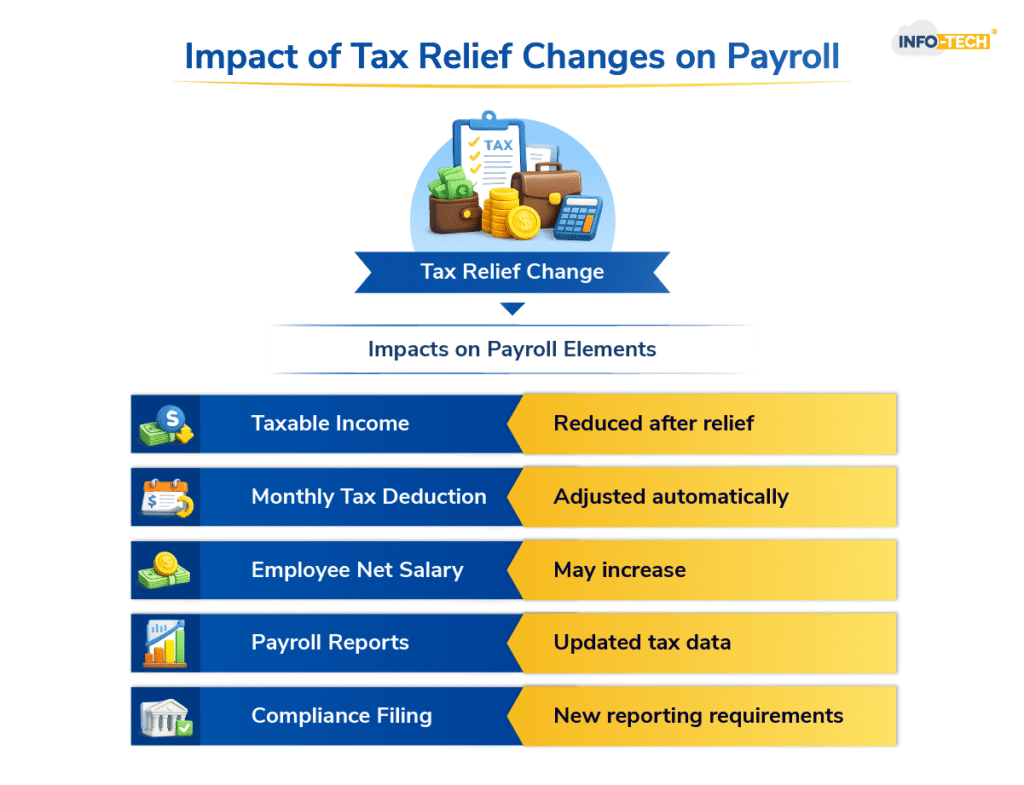
How do tax relief changes affect payroll processing?
Tax relief updates directly impact how taxable income is calculated in payroll systems. When relief limits or eligibility rules change, payroll software must adjust tax deduction formulas to reflect the new regulations. This affects employees’ monthly tax deductions, net salary, and year-end tax reporting, making accurate implementation essential for compliance.
What role does HR play in managing tax relief changes?
HR departments coordinate employee communication, update internal tax declaration processes, and ensure employees submit the correct documentation for tax relief claims. HR also works closely with payroll and finance teams to implement tax rule updates, review employee eligibility, and maintain accurate records for compliance and auditing purposes.