
Unpaid leave is when an employee takes time off from work and does not receive salary for those days. The person is still employed. The job is not terminated. Only the salary for the specific days is reduced.
In Malaysia, unpaid leave is not automatically guaranteed under the Employment Act 1955. It is not a mandatory statutory leave like annual leave or sick leave. Instead, it is usually granted based on company policy or mutual agreement between employer and employee.
Understanding unpaid leave properly is important because it affects more than just salary. It impacts EPF, SOCSO, EIS, PCB, leave balances, bonuses, and even legal risk. If handled incorrectly, it can lead to payroll mistakes or disputes. Both employers and employees should clearly understand how it works.
This guide explains everything you need to know about unpaid leave in Malaysia — what it means, what the law says, how salary is calculated, how it affects statutory contributions, and what employers must be careful about.
What Is Unpaid Leave in Malaysia?
Unpaid leave is an approved period of absence where the employee does not receive wages for the days not worked, but the employment relationship continues. It is usually granted when:
- Annual leave has been fully used
- An employee needs extra time off for personal matters
- There are special circumstances like study or family issues
Unlike annual leave, sick leave, maternity leave, or public holidays, unpaid leave is generally discretionary. This means the employer decides whether to approve it, unless the employment contract specifically provides for it.
In simple terms:
Unpaid leave allows an employee to take time off without pay while still keeping their job. The contract continues. Only the salary is reduced based on the number of unpaid days.
Is Unpaid Leave Provided Under Malaysian Law?
The Employment Act 1955 (amended 2022) sets minimum standards for:
- Annual leave
- Sick leave
- Maternity leave
- Public holidays
- Rest days
However, the Act does not require employers to provide unpaid leave. This means:
- Employers are not legally obligated to grant unpaid leave.
- If unpaid leave is allowed, it should be clearly stated in policy or contract.
- It must be agreed upon by both parties.
- Employers cannot simply force employees to take unpaid leave unless the contract allows it.
If an employer imposes unpaid leave without proper basis or agreement, it could raise issues of constructive dismissal under industrial relations law.
What Unpaid Leave Means For HR?
From an HR and payroll standpoint, unpaid leave is: A temporary absence from work where the employee receives no salary but remains employed. Key points to remember:
- Salary is deducted based on unpaid leave days.
- EPF is calculated based on the reduced wage.
- SOCSO and EIS follow the adjusted salary amount.
- PCB (income tax deduction) is recalculated according to the lower income
- Employment status remains active.
The employee is still part of the organisation. Only the pay changes.
Why Do Employees Apply for Unpaid Leave?
Unpaid leave is usually requested when paid leave is not enough. Common reasons include:
- Family emergencies
- Taking care of family members
- Medical recovery after sick leave is fully used
- Religious pilgrimage
- Personal travel
- Study leave or exams
- Wedding arrangements
- Relocation matters
Temporary company cost-saving arrangements Employers normally review whether the reason is genuine and whether operations can continue smoothly during the employee’s absence.
How Many Days of Unpaid Leave Can Be Taken?
There is no fixed legal limit in Malaysia. The number of days depends on:
- Company policy
- Employment contract
- Management approval
- Mutual agreement
What Is The Practice in Malaysia?
| Type of Situation | Common Duration Approved |
| Short personal matter | 1–3 days |
| Exhausted annual leave | Case-by-case basis |
| Study leave | 1–6 months |
| Sabbatical | 3–12 months (rare, policy-based) |
| Business slowdown arrangement | Short-term agreement |
Some companies set annual limits. Others assess each case individually.
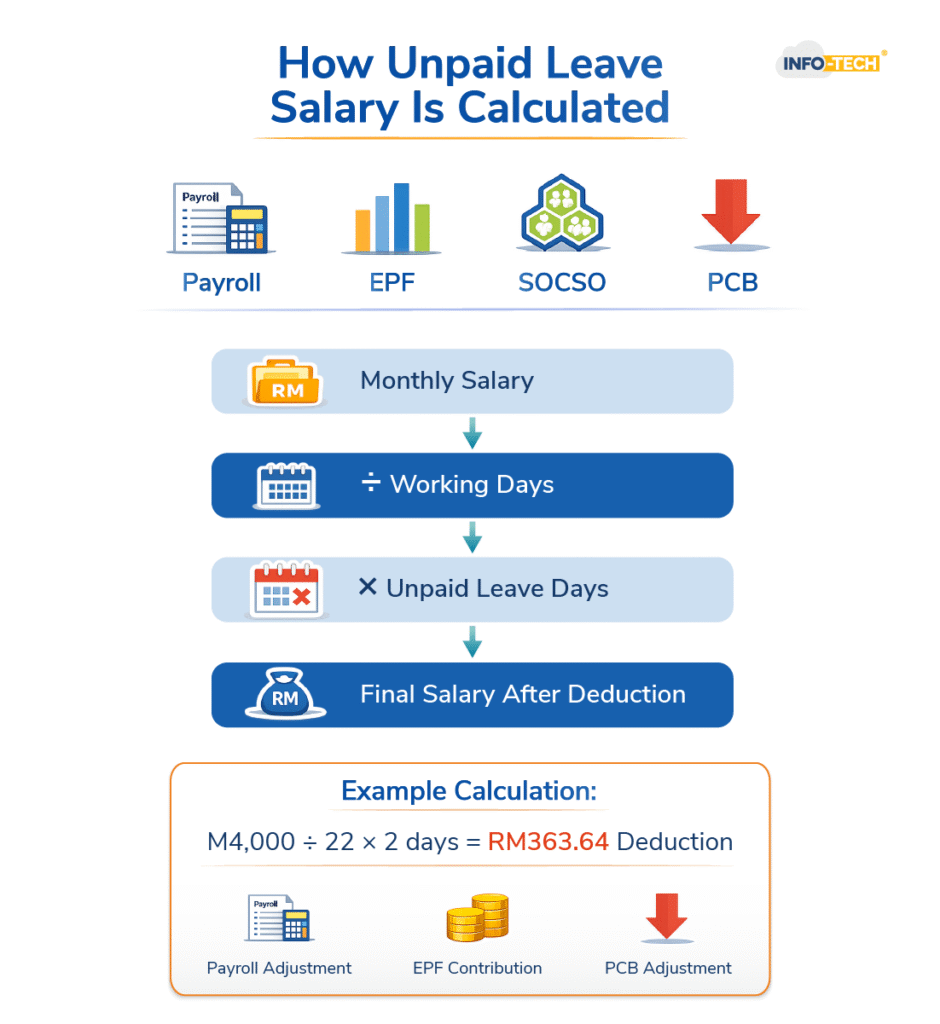
How Is Unpaid Leave Salary Deducted?
Unpaid leave reduces the monthly salary proportionately. Most Malaysian companies use the ordinary rate of pay method. Standard Deduction Formula Monthly Salary ÷ Number of Working Days × Unpaid Leave Days Example Calculation
| Item | Amount |
| Monthly Salary | RM 4,000 |
| Working Days in Month | 22 |
| Unpaid Leave Days | 2 |
| Deduction | RM 363.64 |
Calculation:
RM 4,000 ÷ 22 × 2 = RM 363.64
Adjusted Salary = RM 4,000 – RM 363.64 = RM 3,636.36
Employers must use a consistent method when calculating working days to avoid confusion.
What Is The Impact on EPF, SOCSO, EIS & PCB?
Because unpaid leave reduces salary, statutory contributions are also affected.
EPF (KWSP)
- Calculated based on actual wages paid.
- Lower salary means lower EPF contribution.
- No pay for certain days means no EPF for that portion.
SOCSO & EIS
- Contribution follows the wage category.
- If salary falls into a lower wage band, contribution changes accordingly.
PCB (Monthly Tax Deduction)
- Automatically adjusted based on the lower monthly income.
- Lower income may reduce PCB amount.
Accurate payroll processing is important to prevent underpayment or overpayment of statutory contributions.
Does Unpaid Leave Affect Annual Leave Accrual?
It depends on company policy. Some companies:
- Continue leave accrual during unpaid leave.
- Stop accrual during long unpaid leave periods.
- Prorate entitlement if unpaid leave exceeds a certain limit.
The Employment Act does not clearly state that annual leave must continue accruing during unpaid leave, unless it is provided in the employment contract.
Does Unpaid Leave Affect Bonuses and Increments?
It can. Many companies:
- Exclude unpaid leave periods when calculating performance bonuses.
- Prorate annual bonus based on paid service.
- Delay salary increments if unpaid leave exceeds a specific duration.
This is why policies should clearly explain how unpaid leave affects benefits.
Can Employers Force Employees to Take Unpaid Leave?
In most cases, no. Employers cannot impose unpaid leave unless:
- The contract clearly allows it.
- The employee agrees in writing.
- It is part of a lawful restructuring exercise.
- It is mutually agreed as a cost-saving measure.
If unpaid leave is imposed without consent, it may lead to claims of constructive dismissal.
What Is The Difference Between Unpaid Leave and No Pay Leave?
In Malaysia, both terms usually mean the same thing — time off without salary. However, companies should use consistent terminology in their policies to avoid confusion.
Key Summary
Unpaid leave may look simple. An employee takes time off and salary is reduced. But in reality, it affects payroll calculations, EPF and SOCSO contributions, tax deductions, leave balances, and proper documentation. Even a small error can create unnecessary disputes.
That is why having a clear and structured process is important. When leave approvals and payroll calculations are handled separately, mistakes can happen. When both are managed together, deductions are calculated correctly and statutory contributions are adjusted accurately.
Many Malaysian companies today use integrated payroll software, accounting software and leave management software, to reduce manual errors and keep records organised. It does not replace HR judgement. It simply makes the process easier and more accurate.
At the end of the day, managing unpaid leave properly is about fairness, clarity, and making sure the numbers are right.