
What Is an Inventory Management System
An inventory management system is a software or a tool that tracks, organizes, and controls the stocks of businesses. The software has the data of
- Item lists
- Items available
- Items running low
- Items to be stocked
- The place where each product is stored.
It manages issues such as
- Overstocking
- Stockout
- Operational delays
- Inaccurate data, and
- Lost items.
The inventory management system is also connected with other tools like
- Accounting software
- POS systems
- ERP software
- Warehouse management systems, and
- E-commerce platforms.
Why Inventory Management Matters for Businesses
Managing inventory helps businesses keep the right amount of stock at the right time. Proper management of it reduces waste and increases customer satisfaction, making it an asset for businesses. Common stock problems can be prevented when inventory management is used. Having track of available products, refilling the ones stocking out can help in constant availability of required products.
Better accuracy and planning are possible with a reliable inventory management system. It enables businesses to track fast-selling and slow-moving goods by understanding the buying patterns of customers. This will prevent money loss due to over-investment in unsold goods.
Operational costs can be reduced by cutting down on
- Manual stock taking,
- Time taken in searching for products, and
- Stock errors
Features and Benefits of an Inventory Management System
The key features of an inventory management system help reduce errors, lower costs, and save time.
- Real-time stock tracking: shows data of items sold, purchased, and returned.
- Product categorisation: organises by product name, brand, size, and type.
- Barcode management: supports barcode to quickly scan and identify the product accurately.
- Low-stock alerts: notifies when products are selling fast and predicts requirements to avoid shortages in stock.
- Purchase management: stores supplier details, tracks orders and makes procurement easier.
- Expiry tracking: for food, healthcare, and retail industries, tracking batch numbers and expiry dates can hugely reduce waste.
- Integration with other tools: connects with accounting software, ERP, e-commerce platforms, and HRMS software.
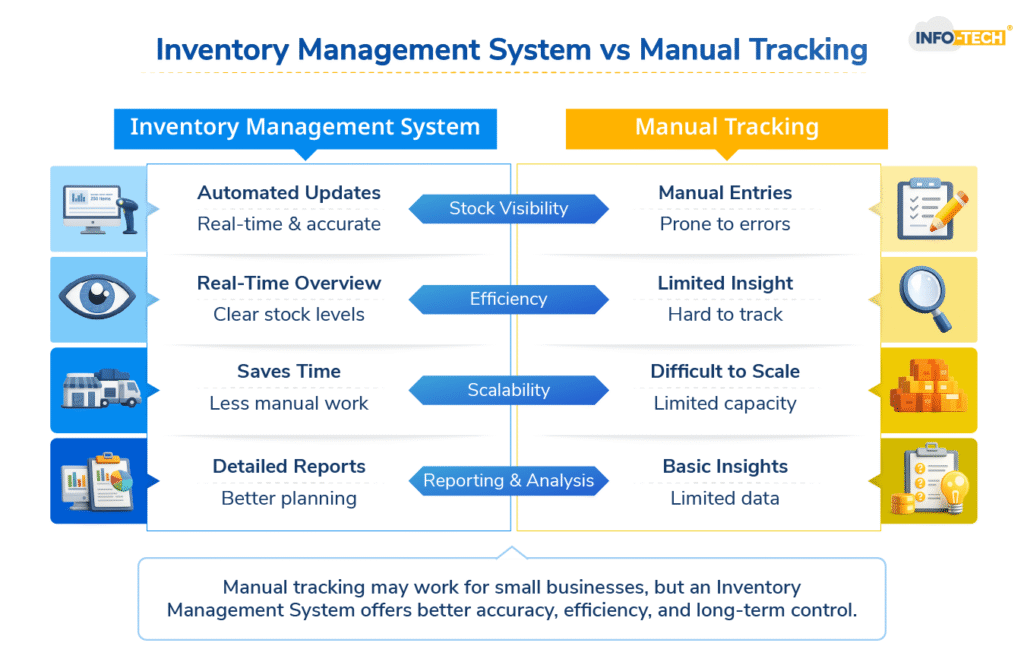
Inventory Management System vs Manual Tracking
Inventory management can be managed either through software or by manual record-keeping using paper records or spreadsheets.
Manual tracking of inventory is
- Vulnerable to human error
- Harder to track exact level of stock
- Requires more staffing
- Provides limited insights
- Cheaper at first
On the other hand, inventory management software
- Automatically maintains and updates accurate records
- Gives clear visibility to stock levels, needs, and storage
- Automates barcode scanning and reporting
- Support multiple other products and channels
- Better accuracy, control, and efficiency
Closing Thoughts
As businesses grow, tracking records manually can be time-consuming and prone to human errors. An inventory management system smartly organises and manages stock and product movement. It not only saves time, but also increases customer satisfaction by promptly stocking products that are in demand.
Inventory Management System Frequently Asked Questions
What are the 4 types of inventory management system?
The 4 main types of inventory management system are: periodic, perpetual, manual, and automated inventory management systems.
Why do we need an inventory management system?
To automate stock entries, reduce data errors, increased efficiency, and customer satisfaction.
What is the most used inventory management software in Malaysia?
Some of the most used inventory management software in Malaysia are HashMicro, AutoCount, SQL Account, Zoho Inventory, and Odoo, depending on business size and needs.
Can I use Excel for inventory management?
Yes, Excel can be used for inventory management, but as stocks increase, there are high chances for errors and difficulty in stock maintenance. So, using a reliable inventory management software is adviced.