

In this article
In today’s competitive business world, delivering the right products to the right customer at the right time becomes more important than ever. Businesses require an effective system to manage things right from sourcing the raw materials to delivering the finished product. This is where the supply chain management comes into role.
Before any products reach the customer, it may have travelled through manufacturers, suppliers, warehouse keepers, transport service providers and distributors.
As the businesses grow, operations become digital, customer expectations increase and companies work with customers and suppliers from various locations. Now, effective SCM becomes increasingly important.
What is Supply Chain Management?
For example, if you buy a smartphone, there is a complex supply chain involved in it. There will be different companies that supply components such as battery, screen, processor and camera. The components will be assembled, packaged, stored and eventually delivered to the customers.
SCM makes the entire process efficient, cost-effective and reliable.
How does Supply Chain Management Work?
The process usually starts by understanding the customer’s demand and delivering them at the right time. Each stage in SCM is interconnected. For example, if the delivery of raw material delays, the production may be delayed. The inventory availability will be affected and eventually this can delay the delivery to the customers.
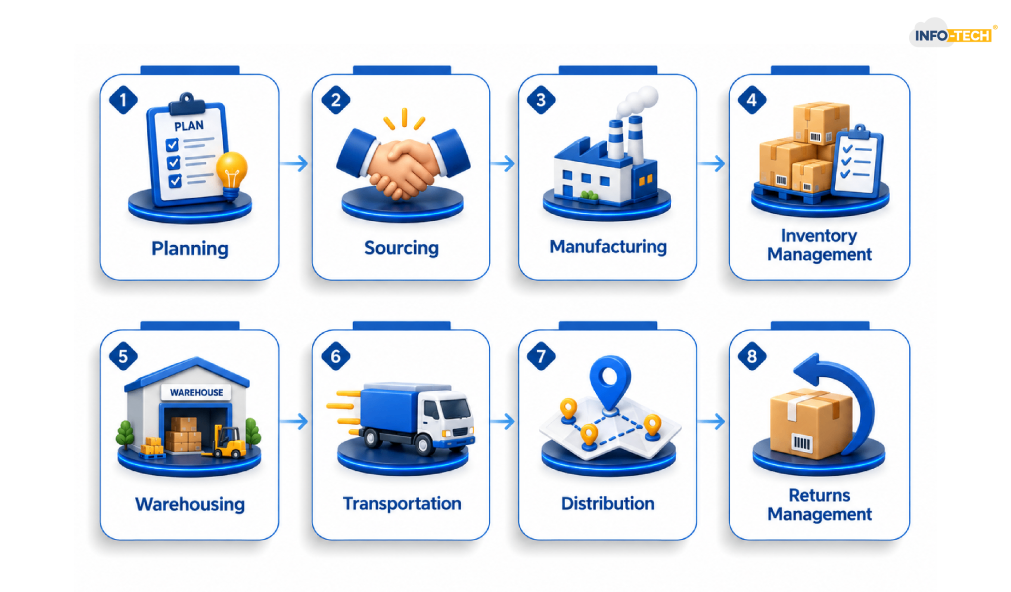
The following is a typical supply chain process,
What are the Key Components of SCM?
Planning:
Planning is the foundation of SCM. Businesses forecast the customer demands and determine how much inventory, production capacity, labour and other resources that they will need. Better planning helps the businesses stay away from excess inventory or shortage of products.Procurement and Sourcing:
Procurement involves purchasing the materials, products or services from the suppliers that the business requires. Suppliers are chosen based on the price, quality, reliability, capacity and delivery performance.Manufacturing:
Manufacturing is the process of converting the raw materials and the components into finished products. Efficient manufacturing helps businesses produce at lower cost while maintaining the quality.Inventory Management:
Inventory management monitors and controls the stocks that a business holds. The idea is to fulfil customer demands without holding excess stocks.Warehousing:
Warehousing involves receiving, organising, picking, packing and dispatching goods.Transportation:
Transportation involves how products move from supplier to the warehouses, distributor and the customers. There are multiple modes of transport to move good from one place to the other including road, rail, sea and air.Distribution:
Distribution ensures that the finished products reach the retailers, businesses or customers at the right time. Some of the common distributors include wholesalers, retailers and distribution centres.Information and Technology:
Information and technology play a crucial role in SCM. Businesses need accurate and real time information about their inventory, orders, shipment and demands.Technologies like automation, Artificial Intelligence and real-time tracking can improve visibility and decision-making.
What are the Benefits of SCM?
Cost Reduction:
Better planning can help businesses reduce their cost by reducing unnecessary purchasing, storage costs, transportation costs and other operational expenses.Customer Satisfaction:
Customers expect their products to be delivered to them on time. Effective SCM with better planning helps businesses fulfil customers’ needs.Better Inventory Control:
Effective SCM helps businesses to plan their inventory better. With this, an appropriate level of inventory can be maintained without the risk of excess stocks or stockouts.What are the Examples of Supply Chain Management?
E-Commerce:
Consider an online retail business. The company purchases the good from the suppliers, stores them in their fulfilment centre and delivers when the customer places an ordered. There are multiple supply chain activities behind this including procurement, inventory, warehousing, transportation and delivery.Food Industry:
The supply chain management in food industry begins with farmers who are the suppliers of raw materials. The raw materials will be transported to the food processing industry where they become finished products. The products are then transported and distributed to supermarkets, restaurants and other customers. The effective supply chain management becomes crucial in the industry as the shelf lives of food products are limited.What is the Difference Between SCM and Logistics?
Therefore, supply chain management focuses on the entire process, and the logistics focuses only on movement of storage of goods.
Read Also: Supply Chain Management Linking Workforce Planning to Logistics
Supply Chain Management FAQs
What is Supply Chain Management?
Supply Chain Management is the process of effectively managing how the products, services, information or resources move from suppliers to the customers.
What are the five main stages of supply chain management?
The five main stages of supply chain management are planning, sourcing, manufacturing, distribution and returns.
What is the difference between SCM and logistics?
The logistics deals with the storage and transportation. Whereas SCM covers the wider range of processes including planning, souring, production, inventory management and logistics.
Why is supply chain management important?
Supply chain management is important because it improves inventory availability, reduces operational costs, delivers on time and improves customer satisfaction.