
To hire foreign professionals in Malaysia, you must answer one key question: which Employment Pass category fits? Companies, HR departments, and expats who don’t grasp this risk having their applications turned down, face setbacks, or run into legal troubles. As Malaysia plans to update Employment Pass salary requirements starting June 1, 2026, employees want to know more about Employment Pass Category 1, 2, and 3 — businesses hiring for top, technical, and digital positions. This breakdown covers the basics, reasons, and steps of Malaysia’s Employment Pass system in simple useful terms — skipping legal talk and staying straightforward.
Quick Look: Malaysia Employment Pass Types (2026)
Malaysia splits its Employment Pass (EP) into three types, each based on pay level, job rank, contract time, and benefits.
- Category 1: Top employers and rare experts
- Category 2: Seasoned pros and team leaders
- Category 3: Capable tech and backup staff
Starting June 1, 2026, the base pay rules can go up a lot. This shows Malaysia wants to focus on bringing in top-notch foreign talent and boost local job participation.
What’s the Malaysia Employment Pass All About?
The EP is the main long-term work visa Malaysia offers to foreigners in pro, management, or specialist jobs. It lets expats live and work in Malaysia with a company that backs them for as long as their approved contract lasts. Unlike quick work permits, the Employment Pass has these features:
- Applies to specific employers
- Needs justification for salary and job
- Needs approval from sectors (like MDEC for digital jobs)
- Decides if family members can join the employee
Why Does Malaysia Have Different Employment Pass Categories?
Malaysia created EP categories to manage the quality, need, and economic value of foreign employees. Each category shows how important the job is for business operations and national growth. In simple terms:
- Higher category = more senior job higher pay more benefits
- Lower category = more checks shorter stay fewer perks
The 2026 pay changes strengthen this system by making sure Employment Passes go to jobs that need foreign experts.
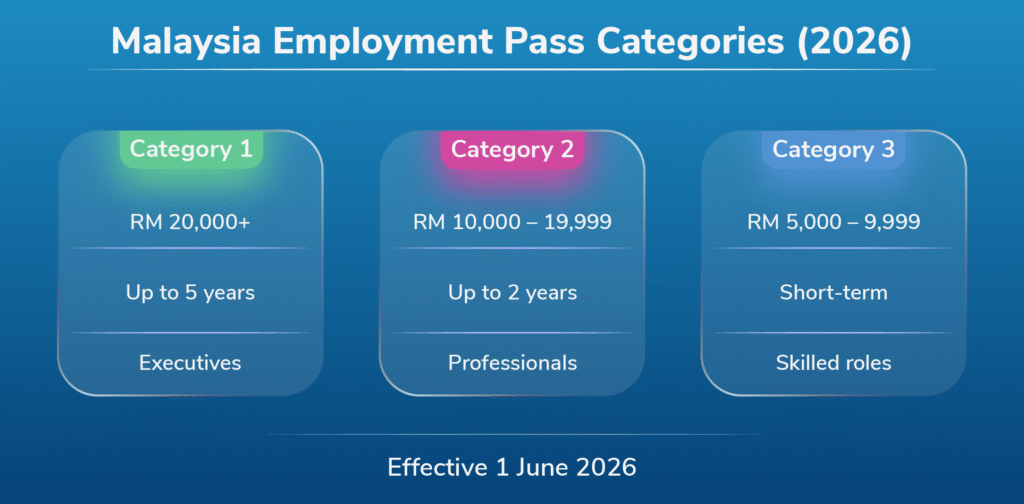
Employment Pass Category 1 (EP Category 1)
Who Is Category 1 For?
Category 1 applies to high-level professionals whose jobs involve leadership key decision-making, or uncommon skills. Typical positions include:
- CEOs and Managing Directors
- Regional Heads and Country Managers
- Chief Technology Officers and Lead Architects
- Senior experts with specialized knowledge
Salary Requirement (Effective 1 June 2026)
RM 20,000 or more per month
Contract Duration
Up to 5 years
Why Category 1 Matters
Category 1 gives you the most freedom in Malaysia’s EP system. The higher pay requirement shows Malaysia wants to bring in top-level talent to boost its economy, not just fill jobs locals could do.
Main Benefits
- Passes last a long time
- Easy to renew
- Can bring your partner and kids
- Might be able to hire a foreign house helper
Employment Pass Category 2 (EP Category 2)
Who Fits in Category 2?
Category 2 is for skilled pros and mid-to-high-level managers who play key roles in running things getting work done, and backing up leaders. Some common jobs include:
- Senior managers
- Engineering and product leads
- Senior consultants and analysts
- Department heads below executive level
Salary Range (Effective 1 June 2026)
RM 10,000 – RM 19,999 per month
Contract Duration
Up to 2 years renewable
Why Category 2 Exists
Category 2 fills the gap between executive leadership and technical specialists. It lets companies hire skilled foreign professionals while keeping salaries competitive and maintaining oversight.
Key Privileges
- Renewable Employment Pass
- Option to bring dependents
- Some flexibility compared to Category 1
Employment Pass Category 3 (EP Category 3)
Who Is Category 3 For?
Category 3 targets foreign employees with specific skills in jobs that need technical know-how but aren’t top-level management. Common positions include:
- Tech experts
- Designers and techs
- IT help staff
- Capable operations employees
Salary Range (Starts 1 June 2026)
RM 5,000 – RM 9,999 monthly
Contract Length
Often 12 months, with few chances to extend
Key Restrictions
Category 3 passes have stricter rules. They might limit renewals and don’t allow family members to join. Employers must show good reasons why locals can’t do the job.

Employment Pass Category Comparison (2026)
| Criteria | Category 1 | Category 2 | Category 3 |
| Monthly Salary | RM 20,000+ | RM 10,000–19,999 | RM 5,000–9,999 |
| Contract Length | Up to 5 years | Up to 2 years | Up to 1–2 years |
| Renewal | Yes | Yes | Limited |
| Dependents | Allowed | Allowed | Usually not allowed |
| Seniority Level | Executive / Expert | Professional / Managerial | Skilled / Technical |
What Is MDEC Employment Pass Approval?
Companies in technology, digital, and knowledge-based industries often need MDEC (Malaysia Digital Economy Corporation) to endorse Employment Pass applications before Immigration gives approval. MDEC evaluates:
- How this job helps Malaysia’s digital economy
- Pay compared to market rates
- Reasons for hiring from abroad
- Plans to teach skills to local employees
Companies often need to explain these points for Category 2 and Category 3 jobs in IT and digital fields.
Reasons Behind Malaysia’s Higher Employment Pass Salary Rules in 2026
The 2026 changes aim to:
- Focus on high-value foreign roles
- Stop misuse of cheaper Employment Passes
- Help grow local talent
- Match immigration rules with rising wages
The point is clear: Employment Passes are for key hires, not for cutting costs.
Final Takeaway
The Employment Pass system in Malaysia for 2026 has a clearer structure tighter selection, and sharper focus than before. Knowing the ins and outs of Category 1 Category 2, and Category 3 isn’t just key for getting approved – it’s crucial for planning your workforce and staying on the right side of the law in the long run. This isn’t just about ticking boxes for immigration anymore. It’s a big deal for your business strategy.
Frequently Asked Questions
What is the difference between Employment Pass Category 1 and Category 2 in Malaysia?
What is Employment Pass Category 3 in Malaysia?
Can Employment Pass holders bring family members to Malaysia?
Will the new 2026 salary rules affect Employment Pass renewals?
{ “@context”: “https://schema.org”, “@type”: “FAQPage”, “mainEntity”: [{ “@type”: “Question”, “name”: “What is the difference between Employment Pass Category 1 and Category 2 in Malaysia?”, “acceptedAnswer”: { “@type”: “Answer”, “text”: “Category 1 suits senior executives and specialists who earn RM20,000 or more. Their contracts can last up to five years. Category 2 fits experienced professionals who earn RM10,000–RM19,999. These passes stay valid for up to two years.” } },{ “@type”: “Question”, “name”: “What is Employment Pass Category 3 in Malaysia?”, “acceptedAnswer”: { “@type”: “Answer”, “text”: “Employment Pass Category 3 targets skilled foreign employees who earn RM5,000–RM9,999. It has a shorter valid period fewer chances to renew, and less perks than Category 1 and 2.” } },{ “@type”: “Question”, “name”: “Can Employment Pass holders bring family members to Malaysia?”, “acceptedAnswer”: { “@type”: “Answer”, “text”: “Category 1 and Category 2 pass holders can bring dependents like spouses and kids. Category 3 holders can’t bring dependents.” } },{ “@type”: “Question”, “name”: “Will the new 2026 salary rules affect Employment Pass renewals?”, “acceptedAnswer”: { “@type”: “Answer”, “text”: “Yes. Any Employment Pass application or renewal filed on or after June 1, 2026 must meet the updated salary thresholds.” } }] }