
Understanding Labour Law in Malaysia is crucial for both employers and employees. Knowing the basic legal rules around it helps prevent disputes and penalties in the workplace. With recent amendments to the Employment Act of 1955, compliance has become even more important for businesses of all sizes, especially for SMEs.
By the end of this guide, you will get a clear understanding of how laws regulate important areas such as working hours, wages, overtime, leave entitlements, employment contracts, and termination procedures.
What is Labour Law in Malaysia
Malaysian Labour Law is the set of rules and regulations that manages the relationship between the employer and the employee. The legal framework for entities such as working hours, wages, leave entitlements, employment contracts, and termination is set through this law. Its main purpose is to
- Protect employee rights
- Ensure fair treatment in the workplace
- Regulate employer responsibilities
- Maintain industrial harmony
Regardless of the salary level, the Labour Law of Malaysia is now applicable to most of the employees, although certain provision still applies to some employees based on job scope and wage threshold.
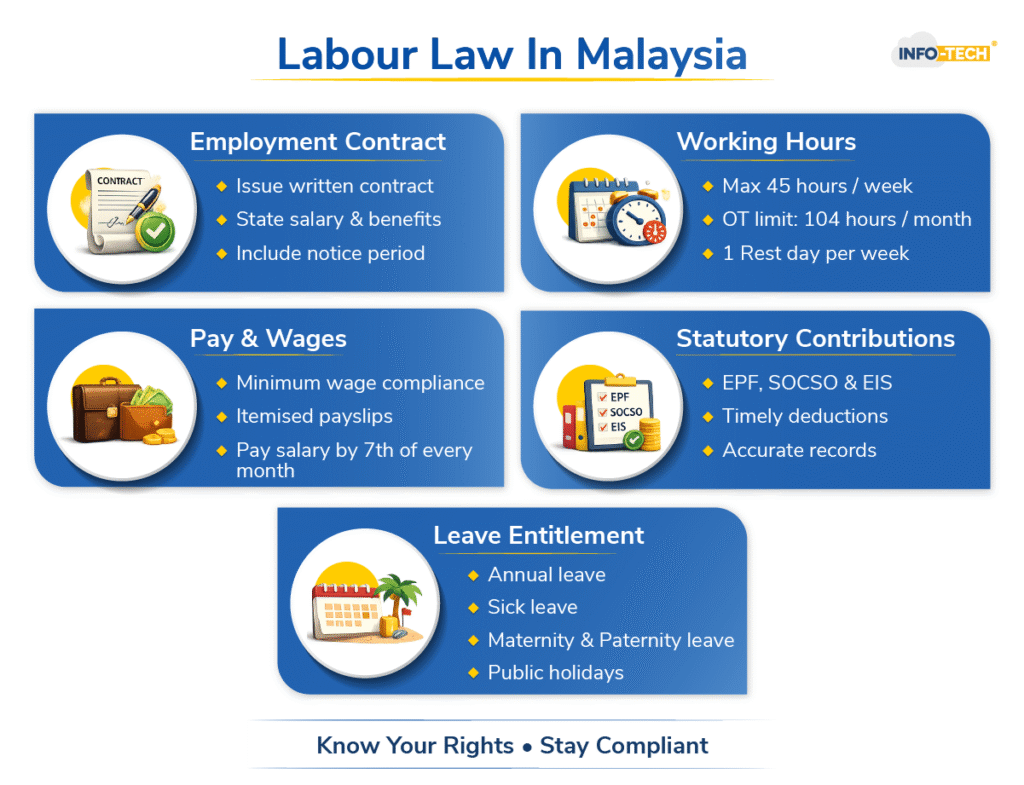
Employment Contracts Under Malaysian Labour Law
An Employment Contract is an agreement between the employer and the employee that legally binds them by outlining the terms and conditions of employment. Under the labour law of Malaysia, employment contracts should comply with the Employment Act of 1955 and other related legislations.
An employment contract must include:
- Job title
- Salary and payment terms
- Working hours and rest days
- Overtime rates
- Leave entitlements (annual, sick, public holidays, etc.)
- Probation period (if applicable)
- Notice period
- Benefits and allowances
Written vs Verbal Contracts
Employment contracts in Malaysia can be in two forms:
- Written – A formal document signed by both parties.
- Verbal – An agreement that is orally made.
Tip: For the contracts lasting more than one month, it is legally safer to have a written contract clearly stating the employment terms, in order to avoid any sort of issues.
A well-drafted employment contract helps:
- Prevent misunderstanding
- Reduce legal risk
- Ensure compliance with Malaysian Labour Law
- Create transparency and workplace professionalism
Working Hours and Overtime Rules
Rules for working hours and overtime can protect employees from working excessively, while ensuring they are appropriately compensated for their extra time at work.
Standard Working Hours in Malaysia
According to the Employment Act, employees
- Should not work more than 8 hours per day
- Not work more than 45 hours per week
- Must be given at least one rest day per week
- Cannot work more than 5 consecutive hours without a break (minimum 30 minutes break enititled)
Overtime Rules and Calculation
Overtime (OT) is applicable when an employee works beyond normal work hours.
Rules for OT:
- Overtime must be paid at not less than 1.5 times the normal hourly rate
- Working on a rest day should be paid at a higher rate (depending on hours worked)
- Working on a public holiday should be paid 2 times or more than the normal pay
- Total overtime should not exceed a total of 104 hours per month
Employers cannot simply offer “time off” instead of overtime pay unless it complies with legal requirements.
To calculate overtime:
- Determine the employee’s hourly rate
- Multiply it by the overtime rate (e.g., 1.5x)
- Multiply by the hours of overtime worked
Example:
Consider
- Monthly salary: RM3,000
- OT hours worked: 2 hours
- OT rate (normal day): 1.5x
Steps to calculate overtime pay:
- Find daily pay:
RM3,000 ÷ 26 = RM115.38 - Find hourly pay:
RM115.38 ÷ 8 = RM14.42 per hour - Find OT hourly pay (1.5x):
RM14.42 × 1.5 = RM21.63 per OT hour - Calculate total OT (2 hours):
RM21.63 × 2 = RM43.26
✅ OT Pay = RM43.26
Minimum Wage Requirements in Malaysia
The minimum wage in Malaysia refers to the lowest salary an employee is entitled to be paid by the employer under the minimum wages order. The current minimum wage of 2025-2026 is RM1,700 per month effective 1 February 2025 for employers with more than or equal to 5 employees, and 1 August 2025 for all employees. Most employees, including foreign employees under a contract of service as a full-time, part-time or hourly worker, are covered under this. But this generally does not apply to domestic workers of Malaysia.
Non-compliance may lead to fines, penalties, or even imprisonment, for repeated breaches. This minimum wage rule essentially protects the welfare of the employee and promotes fair pay across sectors.
Leave Entitlements Under Labour Law Malaysia
Various leaves entitled under the labour law ensure proper rest, medical well-being and family support of the employee.
- Annual Leave: depends on the employee’s length of service- less than 2 years: minimum 8 days per year; 2 to 5 years: minimum 12 days per year; more than 5 years: minimum 16 days per year. Unused leave may be carried forward depending on the company policy.
- Sick Leave:service years less than 2 years:14 days;2 to 5 years:18 days, more than 5 years: 22 days
- HospitalisationLeave: 60 days of paid leave per year, apart from normal sick leave.
- Maternity and Paternity Leave: 98 consecutive days of paid maternity leave (subject to eligibility conditions). While 7 consecutive days of paid paternity leave (for up to 5 births).
- Public Holidays: 11 paid public holidays per year
Employee Benefits and Social Protection
Employees Provident Fund
EPF (KWSP) is a mandatory retirement savings scheme where both employers and employees must contribute on a monthly basis. These contributions are based on the employee’s salary. EPF provides long-term financial security.
Social Security Organisation (SOCSO / PERKESO)
SOCSO provides protection for injuries and disabilities that are work-related or non-work related. It covers instances such as workplace accidents, diseases, and non-work-related disability. Depending on the the scheme, both employers and employees may contribute.
Employment Insurance System (EIS)
EIS gives temporary assistance to employees who have lost their jobs. It involves financial support for a certain period, assistance in job search, and training programs. Contribution to EIS must be done by both: employers and employees.
Employer Responsibilities
Employers must legally ensure fair treatment of employees and proper compliance with statutory requirements of the Malaysian labour law. Below is the list of key responsibilities of an employer.
- Provide a Lawful Employment Contract
- Pay Wages on Time
- Comply with Working Hours and Leave Rules
- Make Statutory Contributions
- Ensure Lawful Termination
To Wrap Up
It is a legal responsibility of an employer to ensure compliance with statutory requirements from minimum wage and overtime rules to leave entitlements to contributions like EPF, SOCSO, and EIS. However, manually calculating overtime, managing leave balances and working hours, and ensuring timely payments can be redundant and complex. Even a small error in calculation can result in disputes, penalties, and audits. Using a trustworthy and safe HRMS software to automate these tasks can be a great solution.
Contact Us to know about our service!
Labour Law Malaysia Frequently Asked Questions
Is salary calculated 26 days or 30 days in Malaysia?
In Malaysia, monthly salary is generally considered fixed (not based on 26 or 30 days), but for overtime calculations, employers commonly use the 26-day formula to determine the daily rate.
What is the notice period for resignation in Malaysia?
The minimum resignation notice period under the Malaysian Employment Act of 1955 is 4 weeks (less than 2 years of service), 6 weeks (2–5 years), and 8 weeks (more than 5 years). However, the employment contract may specify a longer notice period, which will apply if agreed by the employer and the employee.
Can an employee work more than 12 hours a day in Malaysia?
Under Malaysian labour law, employees generally should not work more than 12 hours in a day, including overtime, except in specific situations such as emergencies. Employers must still comply with overtime limits and payment requirements.
What is the overtime limit in Malaysia?
The general overtime limit in Malaysia under the Employment Act is 104 hours per month.