

In this article
- 1. What is a Warehouse Management System?
- 2. How Does a Warehouse Management System Work?
- 3. What are the Types of Warehouse Management Systems?
- 4. What are the Key Features of Warehouse Management System?
- 5. What are the Benefits of Using a Warehouse Management System?
- 6. Why is WMS Important for Businesses in Malaysia?
- 7. How to Choose the Right WMS?
- 8. Warehouse Management System FAQs
Warehouse management involves much more than storing the products on shelves. The business needs to know what products have arrived, where they are stored, how much inventory is available, what are the orders that are yet to be fulfilled and when goods leave the warehouse.
As the number of products, orders and warehouse locations increase managing all this information manually can become difficult. That is exactly when warehouse management comes into play.
What is a Warehouse Management System?
Instead of relying heavily on spreadsheets and paper records, this software brings all the important information about the warehouse in one centralised platform. This is a more structured approach and can reduce the unnecessary manual work.
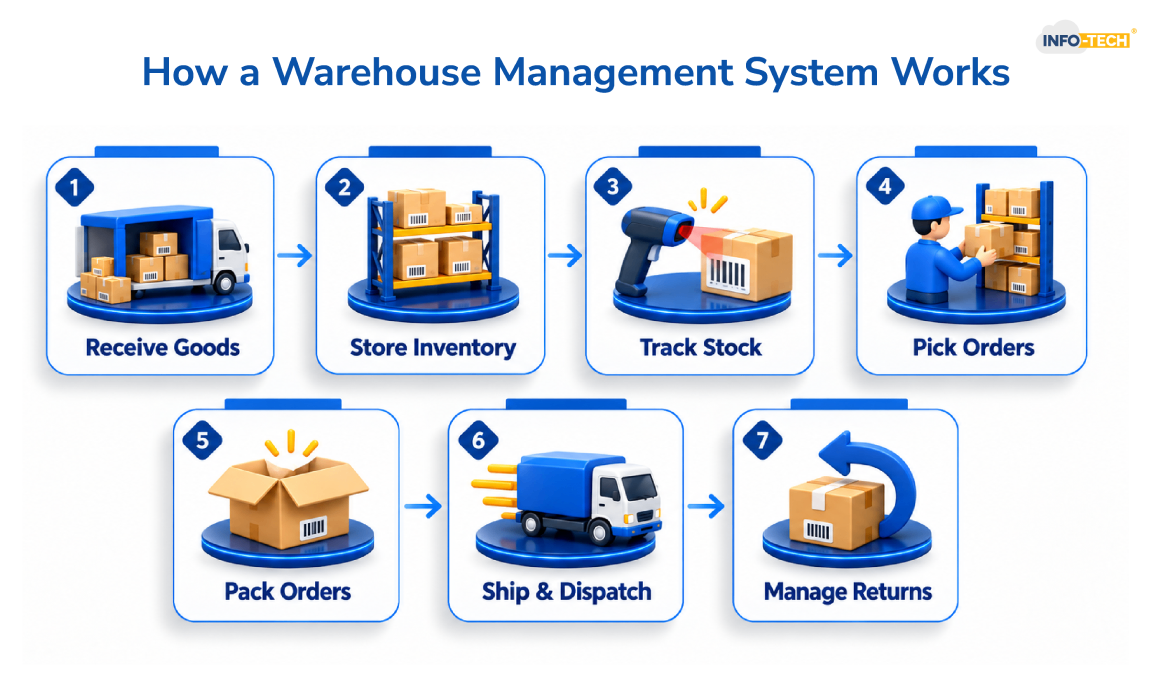
How Does a Warehouse Management System Work?
Receiving Goods: The warehouse process begins when the products arrive from the suppliers, manufacturers or other facilities. The warehouse employees may record details such as product information, quantity received, supplier details and Purchase order information.
Putaway and Storage: After receiving the inventory, the products must move to the appropriate locations based on factors such as product type, available space, demand, Weight and expiry information.
Inventory Tracking: Inventory tracking is one of the key functions of warehouse management system. This gives information on stock quantities and where the stock is available as they move through the warehouse. This gives better visibility to available inventory.
Order Picking: When a customer places an order, the employees in warehouse must locate and collect the right products.
Packing: Once the products are picked, they must be checked and packed for shipment. The WMS helps verify if right products are picked for packing.
Shipping and Dispatch: After an order is packed, it becomes prepared for shipment. Depending on the systems, WMS can integrate with the transportation of shipping systems.
Returns Management: A WMS can help warehouse teams track returned items and determine if they must be returned to inventory, repaired or replaced.
What are the Types of Warehouse Management Systems?
Standalone WMS: A standalone WMS is an independent software solution dedicated solely to manage the warehouse operations without integrating with any other enterprise systems.
Cloud-based WMS: A cloud-based WMS is hosted online rather than installed locally. This system enables real-time inventory tracking and remote access from any device.
Integrated WMS: An integrated WMS connects the warehouse operations with other business systems such as payroll, ERP, e-commerce, accounting and transportation services.
Enterprise WMS: Businesses with complex warehouse networks may use enterprise WMS with advanced capabilities for automation, multiple warehouse management and sophisticated inventory management.
Also Read: ERP System Malaysia: Meaning, Types and Benefits
What are the Key Features of Warehouse Management System?
- Businesses can identify the accurate information on stock levels and location. This helps the warehouse management teams to make informed decisions.
- Barcode scanning helps the employees to scan the products when receiving, picking, packing and other warehouse processes.
- A WMS maintains a clear information about where the products are stored, helping the employees locate them easily.
- From receiving the product from the supplier to delivering it to customers, this system can track the entire process.
- Warehouse employees get structured information for picking and packing the products and this may potentially reduce the manual errors.
- Many WMS solutions may integrate with the e-commerce, ERP and other enterprise systems.
What are the Benefits of Using a Warehouse Management System?
- Manual inventory management can result in data-entry errors. Whereas WMS helps businesses with accurate inventory management.
- A WMS can help the businesses understand how the space in the warehouse is being used. So that suitable locations for the products can be chosen.
- Automated workflows and barcode scanning can reduce the reliance on paperwork. So, the manual errors can be avoided.
- A WMS can support higher inventory volumes; additional storage locations and more orders can also be managed efficiently.
Why is WMS Important for Businesses in Malaysia?
How to Choose the Right WMS?
Here are the main factors to consider,
- Identify the process that needs improvement. This may include receiving, storing, picking, packing, shipping, distributing or returns.
- Make sure the WMS that you are choosing can integrate with your existing ERP, e-commerce, accounting software, transport and courier services or any other relevant services.
- Choose a software that can support your future growth including additional products, more users, warehouses or orders.
- A system with complicated interface can make it difficult for the employees to adapt and learn. Choose a system that warehouse employees and learn and use efficiently.
- Adapt a system that has reporting and analytics features. Managers can make use of this feature to better understand the warehouse performance and identify the areas of improvement.
However, choosing the WMS should always begin with understanding the needs of your business. The ideal solution depends on the business size, inventory complexity, warehouse layout, integration requirements and future growth.
The warehouse management systems with automation, visibility, integration and inventory control could bring huge difference in the operations.