
In this article
- 1. What is EIS And Why It Matters?
- 2. Who Needs To Contribute To EIS?
- 3. How Much Do You Pay For EIS Every Month?
- 4. What Changed With The New Wage Ceiling In 2024?
- 5. What Does EIS Contribution Table Look Like?
- 6. Are There Different Contribution Rules For Other Schemes?
- 7. What Are the Benefits of EIS?
- 8. When Do Employers Need To Pay EIS Contributions?
- 9. Why is EIS Important??
- 10. Conclusion
- 11. EIS Contribution FAQs
If you’re working in Malaysia, chances are you’ve seen “EIS” on your payslip and didn’t think much about it. It’s one of those deductions people tend to ignore until suddenly, it matters. The truth is, EIS isn’t just another statutory requirement. It’s there for a very specific reason: to help when things don’t go as planned, like losing a job unexpectedly. Let’s walk through it properly and know how it actually works in real life.
What is EIS And Why It Matters?
Who Needs To Contribute To EIS?
- Government employees aren’t included
- Foreign workers are excluded
- Domestic workers usually don’t fall under EIS
- People above 60 (compulsory retirement age)
- Employees aged 57 and above who have no prior contributions
For employers, keeping employee details and employment records up to date also makes it easier to determine who needs to be included in statutory contributions. HR software can help keep this information organised alongside other employee records.
How Much Do You Pay For EIS Every Month?
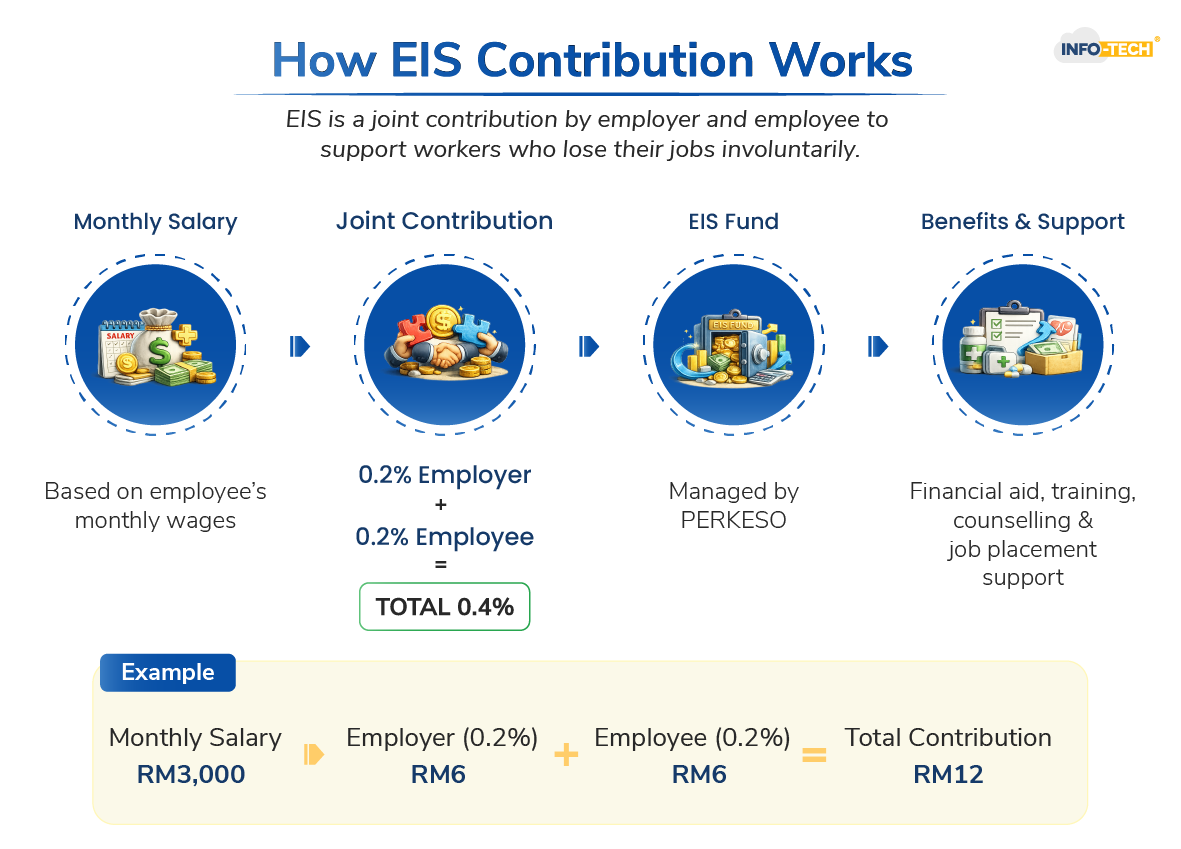
- 0.2% from the employer
- 0.2% from the employee
What Changed With The New Wage Ceiling In 2024?
What Does EIS Contribution Table Look Like?
EIS Table 2026
| Monthly Wages | Employer Contribution | Employee Contribution | Total Contribution |
| Wages up to RM30 | 5 sen | 5 sen | 10 sen |
| Exceed RM30 but not exceed RM50 | 10 sen | 10 sen | 20 sen |
| Exceed RM50 but not exceed RM70 | 15 sen | 15 sen | 30 sen |
| Exceed RM70 but not exceed RM100 | 20 sen | 20 sen | 40 sen |
| Exceed RM100 but not exceed RM140 | 25 sen | 25 sen | 50 sen |
| Exceed RM140 but not exceed RM200 | 35 sen | 35 sen | 70 sen |
| Exceed RM200 but not exceed RM300 | 50 sen | 50 sen | RM1.00 |
| Exceed RM300 but not exceed RM400 | 70 sen | 70 sen | RM1.40 |
| Exceed RM400 but not exceed RM500 | 90 sen | 90 sen | RM1.80 |
| Exceed RM500 but not exceed RM600 | RM1.10 | RM1.10 | RM2.20 |
| Exceed RM600 but not exceed RM700 | RM1.30 | RM1.30 | RM2.60 |
| Exceed RM700 but not exceed RM800 | RM1.50 | RM1.50 | RM3.00 |
| Exceed RM800 but not exceed RM900 | RM1.70 | RM1.70 | RM3.40 |
| Exceed RM900 but not exceed RM1,000 | RM1.90 | RM1.90 | RM3.80 |
| Exceed RM1,000 but not exceed RM1,100 | RM2.10 | RM2.10 | RM4.20 |
| Exceed RM1,100 but not exceed RM1,200 | RM2.30 | RM2.30 | RM4.60 |
| Exceed RM1,200 but not exceed RM1,300 | RM2.50 | RM2.50 | RM5.00 |
| Exceed RM1,300 but not exceed RM1,400 | RM2.70 | RM2.70 | RM5.40 |
| Exceed RM1,400 but not exceed RM1,500 | RM2.90 | RM2.90 | RM5.80 |
| Exceed RM1,500 but not exceed RM1,600 | RM3.10 | RM3.10 | RM6.20 |
| Exceed RM1,600 but not exceed RM1,700 | RM3.30 | RM3.30 | RM6.60 |
| Exceed RM1,700 but not exceed RM1,800 | RM3.50 | RM3.50 | RM7.00 |
| Exceed RM1,800 but not exceed RM1,900 | RM3.70 | RM3.70 | RM7.40 |
| Exceed RM1,900 but not exceed RM2,000 | RM3.90 | RM3.90 | RM7.80 |
| Exceed RM2,000 but not exceed RM2,100 | RM4.10 | RM4.10 | RM8.20 |
| Exceed RM2,100 but not exceed RM2,200 | RM4.30 | RM4.30 | RM8.60 |
| Exceed RM2,200 but not exceed RM2,300 | RM4.50 | RM4.50 | RM9.00 |
| Exceed RM2,300 but not exceed RM2,400 | RM4.70 | RM4.70 | RM9.40 |
| Exceed RM2,400 but not exceed RM2,500 | RM4.90 | RM4.90 | RM9.80 |
| Exceed RM2,500 but not exceed RM2,600 | RM5.10 | RM5.10 | RM10.20 |
| Exceed RM2,600 but not exceed RM2,700 | RM5.30 | RM5.30 | RM10.60 |
| Exceed RM2,700 but not exceed RM2,800 | RM5.50 | RM5.50 | RM11.00 |
| Exceed RM2,800 but not exceed RM2,900 | RM5.70 | RM5.70 | RM11.40 |
| Exceed RM2,900 but not exceed RM3,000 | RM5.90 | RM5.90 | RM11.80 |
| Exceed RM3,000 but not exceed RM3,100 | RM6.10 | RM6.10 | RM12.20 |
| Exceed RM3,100 but not exceed RM3,200 | RM6.30 | RM6.30 | RM12.60 |
| Exceed RM3,200 but not exceed RM3,300 | RM6.50 | RM6.50 | RM13.00 |
| Exceed RM3,300 but not exceed RM3,400 | RM6.70 | RM6.70 | RM13.40 |
| Exceed RM3,400 but not exceed RM3,500 | RM6.90 | RM6.90 | RM13.80 |
| Exceed RM3,500 but not exceed RM3,600 | RM7.10 | RM7.10 | RM14.20 |
| Exceed RM3,600 but not exceed RM3,700 | RM7.30 | RM7.30 | RM14.60 |
| Exceed RM3,700 but not exceed RM3,800 | RM7.50 | RM7.50 | RM15.00 |
| Exceed RM3,800 but not exceed RM3,900 | RM7.70 | RM7.70 | RM15.40 |
| Exceed RM3,900 but not exceed RM4,000 | RM7.90 | RM7.90 | RM15.80 |
| Exceed RM4,000 but not exceed RM4,100 | RM8.10 | RM8.10 | RM16.20 |
| Exceed RM4,100 but not exceed RM4,200 | RM8.30 | RM8.30 | RM16.60 |
| Exceed RM4,200 but not exceed RM4,300 | RM8.50 | RM8.50 | RM17.00 |
| Exceed RM4,300 but not exceed RM4,400 | RM8.70 | RM8.70 | RM17.40 |
| Exceed RM4,400 but not exceed RM4,500 | RM8.90 | RM8.90 | RM17.80 |
| Exceed RM4,500 but not exceed RM4,600 | RM9.10 | RM9.10 | RM18.20 |
| Exceed RM4,600 but not exceed RM4,700 | RM9.30 | RM9.30 | RM18.60 |
| Exceed RM4,700 but not exceed RM4,800 | RM9.50 | RM9.50 | RM19.00 |
| Exceed RM4,800 but not exceed RM4,900 | RM9.70 | RM9.70 | RM19.40 |
| Exceed RM4,900 but not exceed RM5,000 | RM9.90 | RM9.90 | RM19.80 |
| Exceed RM5,000 but not exceed RM5,100 | RM10.10 | RM10.10 | RM20.20 |
| Exceed RM5,100 but not exceed RM5,200 | RM10.30 | RM10.30 | RM20.60 |
| Exceed RM5,200 but not exceed RM5,300 | RM10.50 | RM10.50 | RM21.00 |
| Exceed RM5,300 but not exceed RM5,400 | RM10.70 | RM10.70 | RM21.40 |
| Exceed RM5,400 but not exceed RM5,500 | RM10.90 | RM10.90 | RM21.80 |
| Exceed RM5,500 but not exceed RM5,600 | RM11.10 | RM11.10 | RM22.20 |
| Exceed RM5,600 but not exceed RM5,700 | RM11.30 | RM11.30 | RM22.60 |
| Exceed RM5,700 but not exceed RM5,800 | RM11.50 | RM11.50 | RM23.00 |
| Exceed RM5,800 but not exceed RM5,900 | RM11.70 | RM11.70 | RM23.40 |
| Exceed RM5,900 but not exceed RM6,000 | RM11.90 | RM11.90 | RM23.80 |
| Exceed RM6,000 | RM11.90 | RM11.90 | RM23.80 |
Are There Different Contribution Rules For Other Schemes?
- Act 4 (SOCSO contributions)
- Self-Employment Social Security Scheme (Act 789)
- Housewives’ Social Security Scheme (Act 838)
What Are the Benefits of EIS?
- Monthly income support (Job Search Allowance)
- Incentives for finding a job early
- Extra help if the new job pays less
- Training programmes with allowance
- Career counselling and job placement support
When Do Employers Need To Pay EIS Contributions?
- Penalties
- Interest charges
- Possible enforcement action
Why is EIS Important?
Conclusion
At the end of the day, EIS is one of those things that quietly runs in the background and is important, but easy to overlook until something goes wrong. For employers, though, getting it right every month isn’t optional. Between EIS, EPF, SOCSO, and tax deductions, payroll can get messy pretty quickly if you’re handling it manually.
That’s where a good payroll software really makes a difference. It takes care of calculations, applies the latest contribution rates (including changes like the new wage ceiling), and ensures everything is submitted on time without the usual back-and-forth. Instead of worrying about compliance errors or missed deadlines, you can focus on running your business, knowing the numbers are handled properly behind the scenes.
Payroll doesn’t have to sit separately from the rest of your financial records either. With accounting software that integrates with payroll, payroll records can flow into your accounts, reducing duplicate data entry and making it easier to keep financial records organised.
EIS Contribution FAQs
How much can I claim from EIS?
What is the difference between EIS and SOCSO?
Can you claim EIS if you resign?
Can you claim EIS relief over 2 years?
No, you can’t claim EIS relief over 2 years continuously. EIS benefits (like the Job Search Allowance) are typically paid for a maximum of 6 months per claim, but you may qualify for a new claim in the future if you meet the contribution and eligibility conditions again after returning to work.