

In this article
-
- 1. What Actually Changed in 2025?
- 2. Why Is Everyone Underestimating This?
- 3. Are You Treating Foreign Workers Like Local Employees in Your System?
- 4. Is Your Payroll System Doing the Work?
- 5. Are You Getting the Timing Right or Just Hoping You Are??
- 6. Have You Thought About How This Looks to Your Employees?
- 7. What’s the Real Risk If You Get It Wrong?
- 8. What Does “Getting It Right” Actually Look Like?
- 9. Is This Just a One-Time Adjustment?
- 10. Where Does Payroll Software Actually Make a Difference?
- 11. EPF for Foreign Workers FAQs?
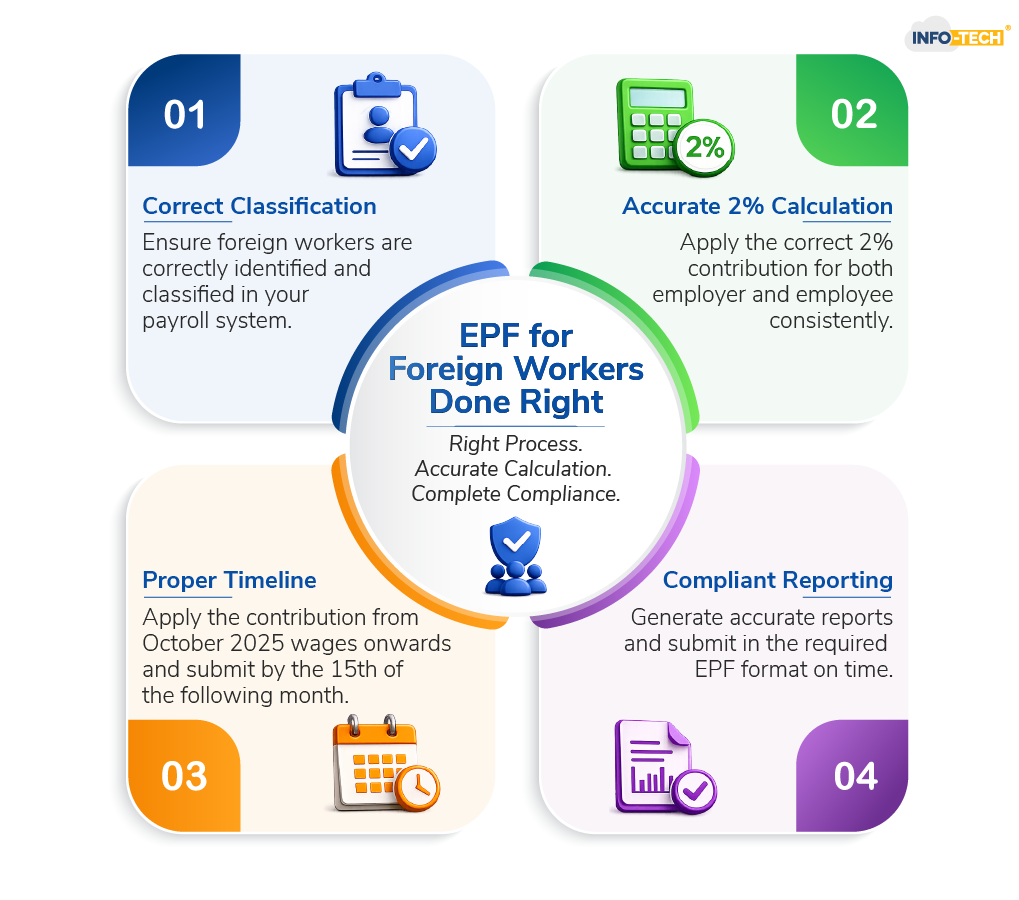
Let’s be honest—EPF for Foreign Workers was never something most employers worried about. It sat there in the background for years, optional, easy to ignore, and rarely enforced in any meaningful way. Payroll teams had bigger things to deal with—PCB, SOCSO, deadlines, audits. EPF for foreign staff? Not urgent. Until now. With the mandatory 2% contribution kicking in from October 2025 wages, this “small” change has quietly become a compliance pressure point. And what’s interesting is not the rule itself—it’s how many businesses think they’ve handled it… when they actually haven’t.
What Actually Changed in 2025?
The law didn’t introduce anything complicated. In fact, that’s part of the problem—it looks too simple. From October 2025:
- Employers contribute 2%
- Foreign employees contribute 2%
- Payment is due by the usual 15th of the following month
Previously, foreign workers could opt in. Most didn’t. Now, there’s no decision to make—it’s mandatory across the board. But payroll isn’t just about knowing the rule. It’s about how that rule gets translated into real calculations, real systems, and real payslips.
Why Is Everyone Underestimating This?
Because 2% doesn’t feel like a big deal. It doesn’t disrupt cash flow. It doesn’t require major restructuring. It doesn’t even look different on a high-level payroll summary. But here’s where it gets tricky—EPF for Foreign Workers isn’t just a percentage change. It’s a structural change. You now have:
- Two different EPF frameworks running side by side
- A need for accurate employee classification
- New reporting expectations tied to compliance
And if any one of those is off, the 2% becomes the least of your problems.
Are You Treating Foreign Workers Like Local Employees in Your System?
This is the most common mistake—and it usually happens quietly. Payroll systems are built on logic. Once that logic is set, people rarely revisit it unless something breaks. So when this new rule comes in, many teams take the easiest route: they slot foreign workers into existing EPF structures. On paper, everything looks fine. In reality, you might be:
- Applying the wrong employer rate
- Triggering incorrect calculations behind the scenes
- Generating reports that don’t match EPF expectations
And the worst part? You won’t notice immediately. It only becomes obvious when someone audits the details.
Is Your Payroll System Doing the Work—or Are You?
This is where things separate very quickly. If your system is fully set up for EPF for Foreign Workers, the process should be almost invisible. It calculates correctly, reflects accurately, and flows into reports without manual intervention. But if it’s not? Then you’ll recognise this pattern:
- Someone adjusts the numbers manually
- Someone else double-checks it “just in case”
- Notes get passed around to remember what was done last month
That’s not a system. That’s a workaround. And workarounds don’t scale. They depend on memory, consistency, and people not making mistakes—which, in payroll, is a risky assumption.
Are You Getting the Timing Right—or Just Hoping You Are?
The rule applies from October 2025 wages. That sounds straightforward. But in practice, companies tend to fall into one of two traps: They either start too early—just to be safe—or delay implementation because their system isn’t ready yet. Both create problems. Starting early affects employee take-home pay unnecessarily. Starting late creates compliance gaps. And inconsistent application across departments? That’s the kind of thing that raises red flags during audits.
Have You Thought About How This Looks to Your Employees?
From your side, it’s a regulatory update. From their side, it’s a deduction that didn’t exist before. Foreign employees who suddenly see EPF contributions on their payslip are going to ask questions. And if the answer isn’t clear, or worse, inconsistent, it affects trust. This isn’t about over-communicating. It’s about not leaving room for confusion. A short explanation goes a long way here—but many companies skip it entirely.
What’s the Real Risk If You Get It Wrong?
It’s not just about penalties—although those are real. The bigger issue is how small mistakes compound over time. A slight miscalculation, repeated across months and multiple employees, turns into:
- Backdated corrections
- Administrative cleanup
- Potential audit exposure
And by the time you catch it, you’re not fixing one payroll cycle—you’re fixing six.
What Does “Getting It Right” Actually Look Like?
It’s not about overcomplicating things. It’s about removing ambiguity. You should be able to say, with confidence:
- Foreign workers are clearly identified in your system
- The 2% contribution is applied consistently and correctly
- The implementation started exactly when it should
- Your reports match what EPF expects to see
If you have to pause and “check,” that’s usually where the gap is.
Is This Just a One-Time Adjustment?
Probably not. This move is part of a broader direction—Malaysia is tightening how workforce contributions are managed. There’s more structure, more visibility, and less tolerance for manual inconsistencies. EPF for Foreign Workers is just one piece of that shift. And if your payroll setup struggles with this, it’s a sign that future changes won’t get any easier.
Where Does Payroll Software Actually Make a Difference?
This is where things become very practical. A solid payroll software doesn’t just calculate—it removes doubt. It should:
- Apply the correct EPF logic automatically
- Separate local and foreign contribution structures cleanly
- Adapt when regulations change
- Produce submission-ready reports without manual fixes
If you still feel the need to “double-check everything,” that’s not peace of mind—it’s a warning sign.
Final Thoughts
The irony of this whole situation is that the number itself—2%—is what makes it dangerous. It’s small enough to ignore, easy enough to assume, and subtle enough to miss. But payroll errors don’t come from big, obvious mistakes. They come from small assumptions that go unchallenged. And right now, EPF for Foreign Workers is one of those assumptions.