

In this article
- 1. What Is the Gross Profit Margin Formula?
- 2. How To Calculate Gross Profit Margin Step By Step?
- 3. What Exactly Goes Into the Gross Profit Margin Formula?
- 4. What Is the Difference Between Gross Profit And Gross Profit Margin?
- 5. What Is A Good Gross Profit Margin?
- 6. Why Is Gross Profit Margin Important For Your Business?
- 7. How To Track Gross Profit Margin?
- 8. What Mistakes Should You Avoid When Calculating Gross Profit Margin?
- 9. How Can You Improve Your Gross Profit Margin?
- 10. How Is Gross Profit Margin Different From Other Profit Metrics?
- 11. How Can Software Help You Track Gross Profit Margin?
- 12. Gross Profit Margin FAQs
If you run a business (or even just manage finances), a numerical value you really shouldn’t ignore is your gross profit margin. It tells you something very simple but very important; how much money you actually keep after covering the direct cost of what you sell.
Sounds basic, but this one metric can quietly decide whether your business grows or struggles.
What Is the Gross Profit Margin Formula?
The gross profit margin formula shows the percentage of revenue left after you subtract the cost of goods sold (COGS).
In plain terms, it answers this:
“After paying for what it costs to deliver my product or service, how much am I left with?”
Here’s the formula:
Gross Profit Margin = [(Revenue − COGS) ÷ Revenue] × 100
So instead of just looking at total profit, you’re looking at efficiency and how well your business is turning sales into actual profit.
How To Calculate Gross Profit Margin Step By Step?
You don’t need complicated tools for this. Just break it down:
- Start with your total sales (revenue)
- Add up your direct costs (COGS)
- Subtract costs from revenue → this gives your gross profit
- Divide that by your revenue
- Multiply by 100 to get the percentage
Once you’ve done it a couple of times, it becomes second nature.
What Exactly Goes Into the Gross Profit Margin Formula?
This part matters more than people think. If you get the inputs wrong, the whole number becomes misleading.
Revenue includes:
- Sales of products
- Service income
COGS includes:
- Raw materials
- Direct labour
- Production or service delivery costs
What you should NOT include:
- Rent
- Marketing
- Office expenses
Those come later when calculating other profit metrics.
What Is the Difference Between Gross Profit And Gross Profit Margin?
This is where a lot of people mix things up.
| Metric | Meaning |
| Gross Profit | The actual amount you earn after costs |
| Gross Profit Margin | The percentage of revenue you keep |
So if gross profit is the number, margin is the story behind it.
What Is A Good Gross Profit Margin?
There’s no one-size-fits-all answer here. It really depends on what kind of business you run:
- Higher margins (50%+) → services, software, premium products
- Mid range (30–50%) → retail, manufacturing
- Lower margins (<30%) → groceries, electronics
The key is not chasing a “perfect” number, but making sure your margin is enough to cover your other expenses and still leave profit.
Why Is Gross Profit Margin Important For Your Business?
Gross Profit Margin gives you quick clarity on how your business is actually performing. It helps you:
- See if your pricing makes sense
- Spot rising costs early
- Understand which products are worth focusing on
- Measure how efficiently you operate
A healthy margin usually means things are under control. A shrinking one is often a warning sign that something needs attention.
How To Track Gross Profit Margin?
Checking it once isn’t enough. The real value comes from tracking the profit margin regularly. You can review it:
- Every month
- Across different products
- Before and after price changes
- Year by year
When you do this, patterns start to show up and that’s where better decisions come from.
What Mistakes Should You Avoid When Calculating Gross Profit Margin?
A few small errors can throw everything off. Common errors include:
- Adding operating costs into COGS
- Using revenue after deductions instead of using it for total sales
- Forgetting about labour costs
- Confusing profit with margin
It’s worth double-checking your numbers before relying on them.
How Can You Improve Your Gross Profit Margin?
If your margin feels too less, don’t worry, there are practical ways to improve it.
Adjust your pricing
- Increase prices competitively
- Add more value to the product instead of just raising its rate
Reduce your costs
- Negotiate better supplier deals
- Cut unnecessary additions
Improve efficiency
- Streamline processes
- Avoid overstocking inventory
- Automate work wherever possible
Even small improvements here can make a big difference over time. 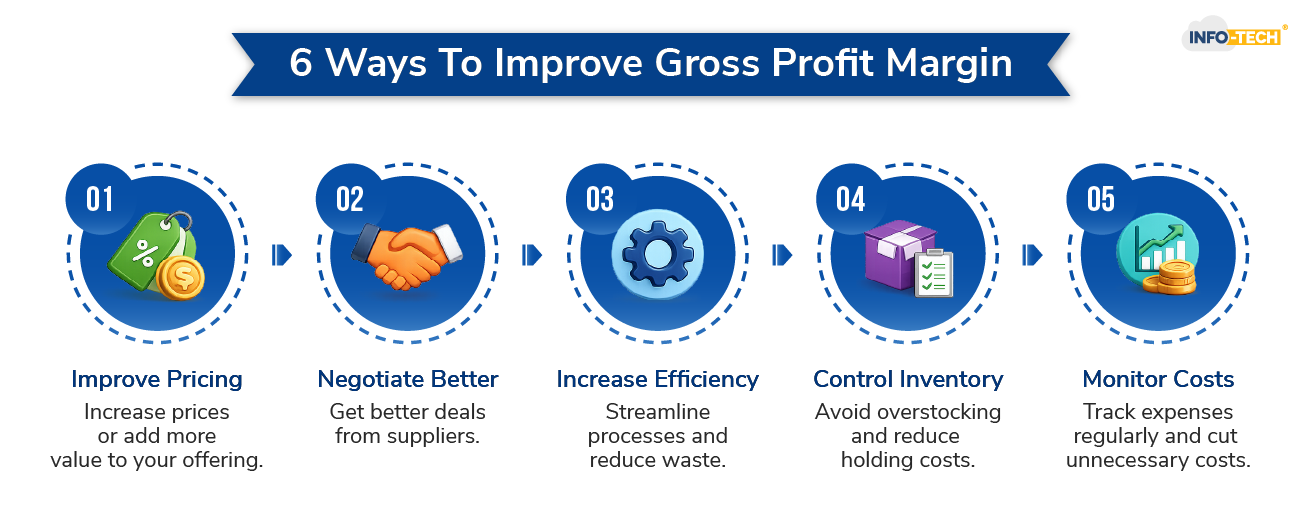
How Is Gross Profit Margin Different From Other Profit Metrics?
Think of gross profit margin as the starting point.
- Gross profit margin → focuses on direct costs
- Operating margin → includes running expenses
- Net profit margin → shows final profit after everything
You need all three, but gross margin is usually the first signal of how things are actually going.
How Can Software Help You Track Gross Profit Margin?
Tracking gross profit margin manually might work in the beginning, but as your business grows, things can quickly get confusing; costs get scattered, numbers don’t match, and it becomes harder to see where your profit is actually going. That’s where the right software makes a real difference.
-
Keeps all your financial data in one place
Accounting software brings together your sales, expenses, and cost data in a single system. Instead of pulling numbers from different sources, you get a clear and consistent view of your revenue and cost of goods sold (COGS), which are essential for calculating your gross profit margin.
-
Automatically calculates your margins
Rather than calculating margins manually every time, the software does it for you. It uses real-time data to show:
- Gross profit
- Gross profit margin (%)
- Changes over time
This not only saves time but also reduces errors.
-
Gives real-time visibility into costs
Project Cost Management Software goes a step further by tracking costs at a more detailed level especially useful if your business runs on projects or client work. You can:
- Track labour, materials, and other direct costs
- Monitor budgets vs actual spending
- Identify cost overruns early
This helps you understand exactly where your money is going.
-
Shows profitability at a project or product level
Instead of just seeing overall business profit, you can break it down:
- Which project is most profitable
- Which product has the highest margin
- Which areas are underperforming
This kind of insight makes decision-making much easier.
-
Helps you spot problems early
If your gross profit margin starts dropping, the software helps you catch it quickly. You can identify whether the issue is:
- Rising costs
- Pricing issues
- Inefficiencies in operations
Catching these early means you can fix them before they affect your overall profitability.
-
Improves decision-making with reports and insights
Both accounting and project cost tools provide reports and dashboards that make your numbers easier to understand. Instead of guessing, you can:
- Adjust pricing confidently
- Cut unnecessary costs
- Plan budgets more accurately
-
Saves time and reduces manual work
Manually tracking costs and margins takes time and increases the chances of mistakes. With automation:
- Data entry is reduced
- Calculations are instant
- Reports are generated quickly
This gives you more time to focus on growing your business. Accounting software gives you the big financial picture, while Project Cost Management software gives you the detailed breakdown behind it. When used together, they give you complete visibility over your gross profit margin, from overall performance down to individual projects.
At the end of the day, the gross profit margin formula isn’t just a calculation. It’s a simple way to stay in control of your business. Once you start paying attention to it regularly, you’ll notice problems sooner, make smarter pricing decisions, and run things with a lot more confidence.
Gross Profit Margin FAQs
How do I calculate gross profit margin?
To calculate gross profit margin in Malaysia, the method is the same as anywhere else—you take your total sales (revenue in RM), subtract your cost of goods sold (COGS), then divide the result by your revenue and multiply by 100. The formula is ((Revenue − COGS) ÷ Revenue) × 100. For example, if your business earns RM100,000 in sales and your direct costs are RM60,000, your gross profit is RM40,000, giving you a gross profit margin of 40%. This percentage shows how much you retain from every Ringgit after covering production or service costs, before accounting for expenses like rent, salaries, or taxes.
What does 20% gross margin mean?
A 20% gross margin means that for every RM100 your business earns in sales, you keep RM20 as gross profit after covering the direct costs of producing your product or service, while the remaining RM80 goes towards those costs (COGS). In simple terms, it shows that only a small portion of your revenue is left to cover other expenses like rent, salaries, and marketing—so while it may be normal in some low-margin industries, it also means there’s less room for profit unless costs are controlled or pricing is improved.
What is the gross profit margin ratio?
The gross profit margin ratio is a financial metric that shows the percentage of revenue a business keeps after subtracting the direct costs of producing its goods or services (COGS). In simple terms, it tells you how efficiently your business is turning sales into profit before other expenses are considered. It is calculated using the formula ((Revenue − COGS) ÷ Revenue) × 100, and the result is expressed as a percentage. A higher ratio means better profitability and cost control, while a lower ratio may indicate that production costs are too high or pricing needs adjustment.
What is a good gross profit margin?
A “good” gross profit margin really depends on the type of business you’re running, because different industries have very different cost structures. As a general guide, a margin of 50% or more is considered strong, 30% to 50% is fairly healthy, and below 30% is on the lower side. For example, service-based or software businesses often have higher margins since their direct costs are low, while industries like retail or food typically operate on tighter margins. Instead of chasing a fixed number, the key is making sure your margin is high enough to comfortably cover your operating expenses and still leave you with a profit.