
In this article
- 1. Why is salary management such a big deal in Malaysia?
- 2. What should I actually check every month to avoid payroll mistakes?
- 3. Where do most businesses actually go wrong with payroll?
- 4. Can Payroll Software really help reduce payroll risks?
- 5. What’s the difference between manual payroll and automated software?
- 6. Is this really just about avoiding fines—or something bigger?
- 7. What’s the smarter way forward for businesses?
- 8. Frequently Asked Questions
If you’ve ever had that quiet thought—“Are we actually doing payroll properly?”—you’re definitely not the only one.
In Malaysia, salary management isn’t just about paying employees on time. It’s about getting a lot of small details right, month after month. And the tricky part? Most problems don’t come from big mistakes. They come from the small things people overlook.
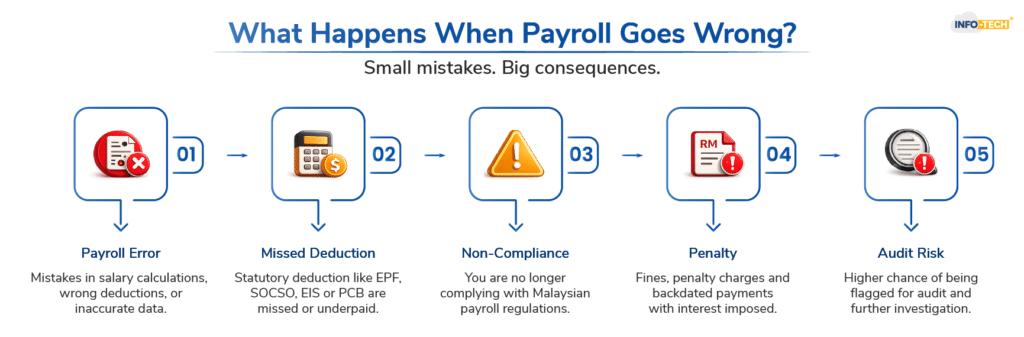
A wrong deduction here, a missed deadline there… and suddenly you’re dealing with penalties, employee complaints, or worse—an audit notice.
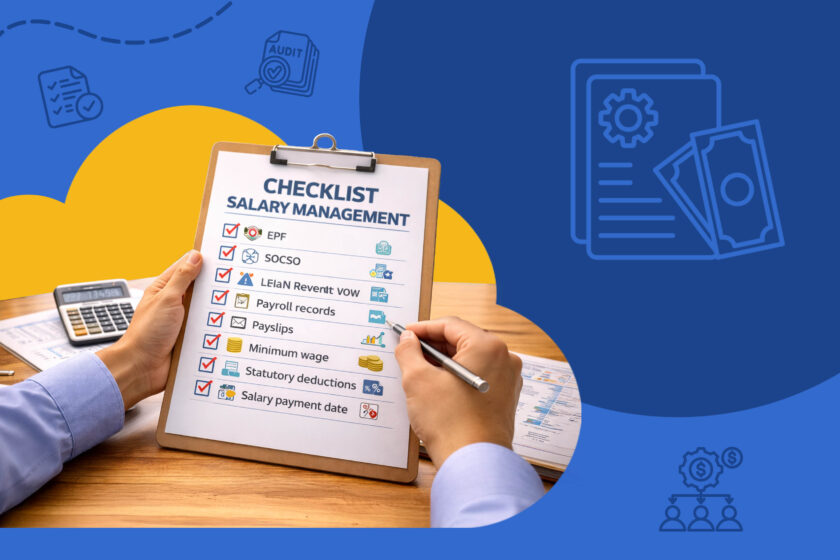
That’s why having a proper checklist isn’t just “good practice.” It’s what keeps things from going sideways.
Why is salary management such a big deal in Malaysia?
Because there’s no room for guesswork.
You’re not dealing with just one system—you’re handling LHDN for tax, EPF for retirement, SOCSO and EIS for social protection. Each one has its own rules, its own deadlines, and its own way of calculating things.
And if something doesn’t match?
That’s when problems start showing up.
- You might get hit with penalties
- You may have to pay backdated contributions with interest
- Authorities could flag your company for further checks
- And internally, employees start questioning their payslips
What’s changed in recent years is this: everything is more digital now. That means agencies can spot inconsistencies much faster. You’re no longer flying under the radar.
What should I actually check every month to avoid payroll mistakes?
This is where things get practical.
You don’t need complicated systems to understand payroll—you just need to be consistent with what you check every month. Most companies that run into trouble aren’t careless… they just miss something small.
Am I calculating salaries correctly every single time?
It sounds basic, but this is where everything begins.
Salary isn’t just “basic pay + a few extras.” There are layers to it:
- Fixed vs variable allowances
- Overtime calculations (especially for eligible employees)
- Deductions for unpaid leave
- Bonuses or commissions
And now, another layer has been added.
Starting October 2025 salaries, employers must include EPF contributions for foreign employees, which were previously not mandatory.
- 2% contribution from the employer
- 2% contribution from the foreign employee
This means payroll calculations now need to account for a group of employees that many companies previously excluded from EPF.
If this isn’t handled properly, it’s not just a calculation error—it’s a compliance issue.
Are my statutory deductions still accurate and up to date?
This is one of those areas where things can quietly go wrong.
Rates change. Contribution limits get updated. And if no one is actively checking, it’s easy to keep using outdated figures.
Here’s what you should always keep an eye on:
|
Deduction Type |
What to Watch For |
|
EPF (KWSP) |
Updated contribution rates, including 2% for foreign employees (effective Oct 2025) |
|
SOCSO |
Salary ceiling and category classification |
|
EIS |
Accurate 0.2% contributions for both sides |
|
PCB (MTD) |
Updated tax calculations based on latest LHDN tables |
It might seem small, but even minor differences—multiplied across employees—can turn into a compliance issue.
Am I meeting all payroll deadlines without fail?
This one’s straightforward… but also one of the most commonly missed.
Payroll deadlines in Malaysia aren’t flexible. Once you miss them, penalties kick in.
The usual timeline looks like this:
- EPF: By the 15th of the following month
- SOCSO & EIS: By the 15th
- PCB (Tax): By the 15th
And the longer the delay, the higher the penalty.
Sometimes it’s not even about negligence—it’s just poor tracking. But from a compliance point of view, that doesn’t make a difference.
Are my employee records clean and ready if someone audits me?
If an audit ever happens, this is where things get tested.
It’s not just about whether your numbers are right—it’s about whether you can prove they’re right.
Now, this also includes:
- Registration records of foreign employees under EPF
- Proof of correct contribution percentages (2% + 2%)
- Updated payroll records reflecting the new structure
You should be able to pull up:
- Employment contracts
- Salary breakdowns
- Payslips
- Leave and attendance records
If your records are scattered across folders, emails, or spreadsheets, things can get messy fast. And that’s usually when deeper checks begin.
Are my payslips clear enough for employees to understand?
A payslip shouldn’t feel like a puzzle.
Employees should be able to look at it and immediately understand what they’re being paid—and what’s being deducted.
At minimum, it should show:
- Gross salary
- Breakdown of earnings
- Deductions (EPF, SOCSO, PCB, etc.)
- Net pay
Now, for foreign employees, payslips should clearly show:
- EPF deduction (2%)
- Employer contribution (for internal tracking)
When payslips aren’t clear, questions start coming in. And sometimes, those questions lead to bigger issues.
Am I handling resignations and final salary correctly?
Final pay is one of the easiest places to make mistakes.
There are usually a few moving parts:
- Unused leave that needs to be paid out
- Notice period adjustments
- Final statutory deductions
Because it’s a one-off calculation, people don’t always double-check it the way they would regular payroll. But this is exactly where disputes tend to happen.
Am I keeping up with Malaysia’s changing payroll rules?
This is where many businesses fall behind without realising it.
Things change more often than people expect—EPF rates, SOCSO limits, tax updates, even broader shifts like e-invoicing requirements that affect reporting.
If you’re still relying on the same spreadsheet you used a year ago… chances are, something’s already outdated.
Where do most businesses actually go wrong with payroll?
Honestly? It’s not a lack of knowledge.
Most teams know what needs to be done. The problem is how it’s being done.
In many companies, payroll still looks like this:
- Calculations done in Excel
- Numbers double-checked manually
- Submissions handled across different portals
- Updates tracked through memory or emails
It works—until someone misses something.
And when something does go wrong, it’s usually not obvious right away. It only comes up later, during a check or audit.
Can Payroll Software really help reduce payroll risks?
This is where things start to shift.
Using Payroll Software isn’t just about convenience—it’s about removing the weak points in the process.
Instead of relying on manual work, the system:
- Automatically apply new rules like the 2% EPF contribution for foreign employees
- Calculates salaries and deductions automatically
- Applies the latest statutory rules
- Generates payslips instantly
- Tracks deadlines so nothing gets missed
- Keeps everything in one place for easy access
In simple terms, it reduces the chances of human error—which is where most problems start.
What’s the difference between manual payroll and automated software?
|
Area |
Manual Payroll |
Payroll Software |
|
Accuracy |
Prone to human error |
Automated calculations |
|
Compliance |
Depends on manual updates |
Always aligned with latest rules |
|
Time |
Takes hours every month |
Done much faster |
|
Audit Readiness |
Records scattered |
Everything organized |
|
Risk Level |
Higher |
Lower |
Is this really just about avoiding fines—or something bigger?
Avoiding fines is just one part of it.
Payroll touches more areas than most people realise.
It affects how employees feel about the company. It affects how smoothly operations run. It even impacts how confident management feels about their numbers.
When payroll is messy, it creates friction everywhere.
When it’s clean and consistent, everything feels more under control.
So what’s the smarter way forward for businesses?
Salary management in Malaysia isn’t something you can afford to “just manage somehow.” There’s too much at stake.
Having a checklist helps. But relying entirely on manual processes to follow that checklist? That’s where things start to break down.
That’s why more companies are turning to Payroll Software—not because it’s new or fancy, but because it solves the everyday issues that manual systems struggle with.
If payroll currently feels stressful, inconsistent, or too dependent on one person getting everything right… that’s usually a sign.
Better to fix it now—before someone else points it out.