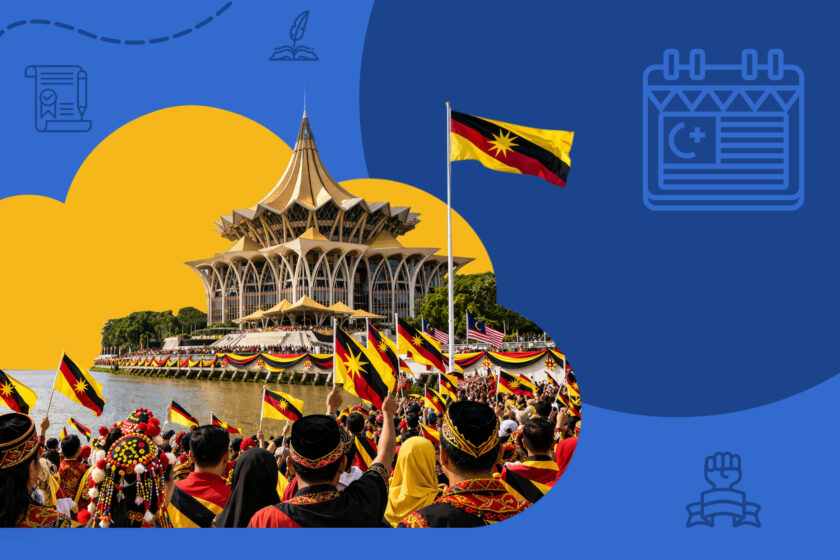
Sarawak is an East Malaysian state located in the island of Borneo. It is the largest state in Malaysia with Kuching as its capital city. Before joining Malaysia, Sarawak was ruled by White Rajahs (Brooke family), then became a British colony, and later gained self-government in 1963. With its rich cultural diversity, lush rainforests, and unique history, Sarawak is a home to many indigenous ethnic groups.
When is Sarawak Independence Day 2026
Every year, Sarawak meaningfully celebrates its independence from the British control on 22 July. In 2026, Sarawak Independence Day falls on a Wednesday, marking Sarawak’s 63rd independence anniversary. It is a public holiday for Sarawak state. In 2016, this day was declared a public holiday, giving it more recognition.
Note: This day celebrates the self-government, not the full independence as a separate nation. 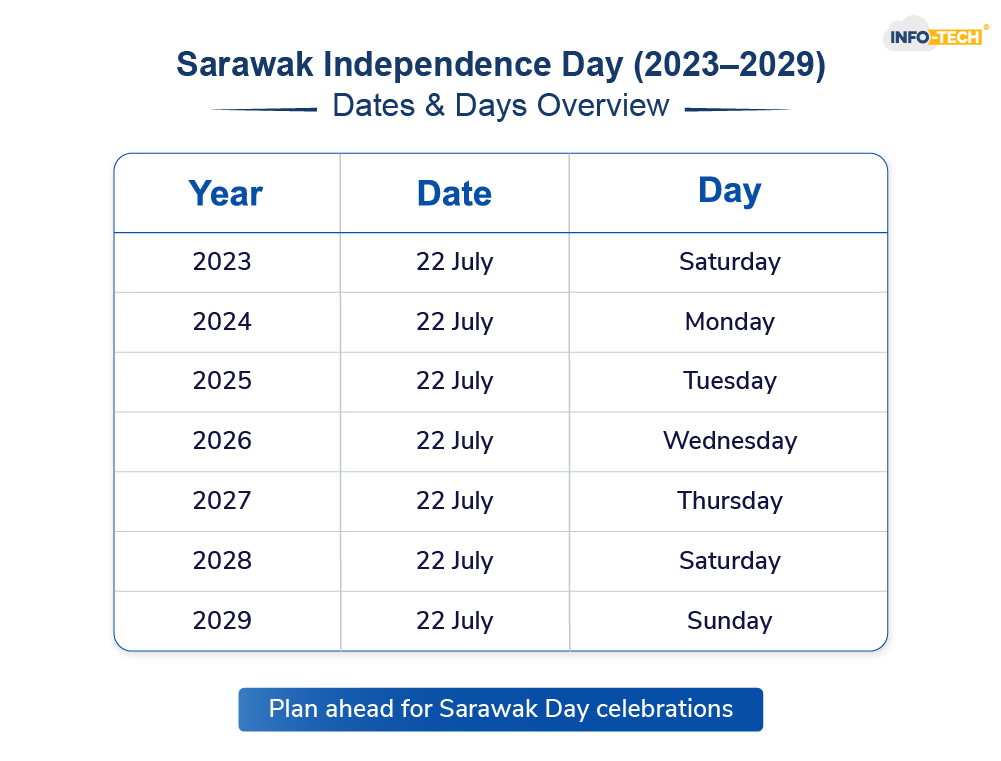
Why Is Sarawak Independence Day Celebrated
Sarawak Independence Day marks the historic moment when Sarawak gained self-government from the British rule. It also marks some iconic events such as:
- End of colonial rule
- Beginning of self-governance
- Key step towards joining Malaysia
- Celebration of heritage
The History Behind Sarawak Independence Day
Before 1963
Sarawak was earlier ruled by the White Rajahs (the Brooke family) and in 1946, it became one of the British colonies.
Self-Governance
On 22 July 1963, Sarawak gained self-government and was then run by the local leaders.
After 1963
Just a few months later, on 16 September 1963, Sarawak joined Sabah, Malaya, and Singapore to form the Federation of Malaysia, making it one of the founding members of Malaysia.
Significance of Sarawak Independence Day
Celebrating June 22 creates a sense of pride in the people of the state. It also strengthens the feeling of unity and togetherness through celebrations where various communities come together for events, parades, and performances. The deep connection to their past and how far they have come is constantly remembered by them through the celebrations of this day.
Sarawakians consider this day as a proud reminder of their rights and self-governance. Their strength and progress as a state over the years is also realized. More than just a public holiday for the state, it is a day that people in Sarawak cherish and celebrate.
How Sarawak Independence Day Is Celebrated
The special day is celebrated with vibrant events and public participation across the state, and especially in Kuching.
Official Events
Ceremonies such as flag raising, speeches by leaders and narration of the state’s history take place at a state-level.
Parades
Parades feature schools and all cultural groups, signifying pride and unity.
Cultural Ceremonies
Performances like traditional dance and music of the diverse communities living in the state are exhibited.
Fireworks & Public Activities
The sky is lit up with fireworks and concerts, competitions, and exhibitions are held to celebrate the day.
Conclusion: Honouring Sarawak’s Legacy and Identity
Every country that is independent celebrates their Independence Day. But what makes Sarawak Independence Day special is that it is a state that is celebrating its self-governance, not a country. Just like Sarawak, some other states in the world also celebrate it separately, such as Hawaii and Texas. This generally represents that even within larger nations, particular regions can have strong histories that are worth celebrating.
Sarawak Independence Day FAQs
When did Sarawak get independence?
Though Sarawak did not gain its complete independence as a country, it gained self-governance rights on 22 July 1963. This day marked the end of British colonial rule and the beginning of local governance.
Why do we celebrate Sarawak Day?
Sarawak Day is celebrated in honor of claiming self-government from the British colonial rule on 22nd July 1963.
When did Sabah and Sarawak join Malaysia?
Sabah and Sarawak officially joined Malaysia on 16 September 1963, which is celebrated annually as Malaysia Day.
Why is it called Sarawak?
The name “Sarawak” is believed to come either from a Malay word for ‘antimony’, a mineral found in the region, or from words describing its ‘many wide rivers’. Both these meanings reflect the state’s natural features.