
Why Income Tax 2026 Feels Overwhelming
Most people don’t hate taxes—they hate how confusing taxes feel.
You sit down to file, open the MyTax portal, and you’re dealing with forms, numbers, and terms that don’t make immediate sense. That’s where the stress starts. But here’s the thing: income tax 2026 is a structured process, not a tough one.
Once you understand what’s required—what income to declare when to submit and how to pay—it becomes much more manageable. Think of it less like a difficult task and more like following a checklist.
Understanding How Income Tax Works in Malaysia
Malaysia uses something called a Self-Assessment System. In simple terms, this means you have the responsibility to declare your own income and calculate your tax.
LHDN doesn’t prepare your taxes for you. Instead, they expect you to:
- Report your income
- Claim valid reliefs
- Submit your return on time
They step in if something looks incorrect or missing. So the system gives you control—but also expects accuracy.
Important Dates for Income Tax 2026
Deadlines are one of the most essential parts of tax filing and missing them can cost you money.
For income tax 2026 (Year of Assessment 2025) here’s what you need to know:
|
Type of Taxpayer |
Deadline |
Grace Period |
|
Salary earners (no business income) |
30 April 2026 |
Until 15 May 2026 |
|
Individuals with business income |
30 June 2026 |
Until 15 July 2026 |
Keep in mind: file earlier rather than later. You avoid penalties and last-minute stress when the system gets busy.
Who Needs to File Income Tax?
This is where many people get confused. Some assume that if their income is not very high, they don’t need to file—but that’s not always true.
If your annual chargeable income is above RM10,000, you are required to file income tax. This includes not just your salary, but also any additional income you may have earned throughout the year.
For example, income can come from:
- Freelance or part-time work
- Rental properties
- Small business activities
- Commissions or side gigs
Even if these are not your main source of income, they still need to be declared.
Why Residency Status Matters
Your tax amount depends on whether you are considered a tax resident in Malaysia.
If you stay in Malaysia for 182 days or more in a year, you are treated as a resident. This means you benefit from lower tax rates and can claim tax reliefs.
If you stay for less than that, you are considered a non-resident and taxed at a flat 30%, without access to reliefs.
So, something as simple as the number of days you are in the country can have a direct effect on how much tax you pay.
What Is MTD (Monthly Tax Deduction)?
If you work for a company, you’ve noticed a portion of your salary getting deducted every month. This is called MTD or PCB.
It’s a system where your employer has a responsibility to pay part of your tax on your behalf every month. This helps reduce the amount you need to pay at the end of the year.
Some people assume this means they don’t need to file taxes at all. While that can be true in certain cases, it’s not always the best choice—if you want to claim tax reliefs and reduce your overall tax.
|
A New Update for Income Tax 2026 From this assessment year onward, there’s a small but key change with dividends. If you receive more than RM100,000 in dividends in a year, a 2% tax will apply to that amount. While this doesn’t affect everyone, it’s something investors and high-income earners should be aware of. |
How to File Income Tax 2026 (Step by Step)
Filing your tax might feel intimidating, but once you go through it once, it becomes routine.
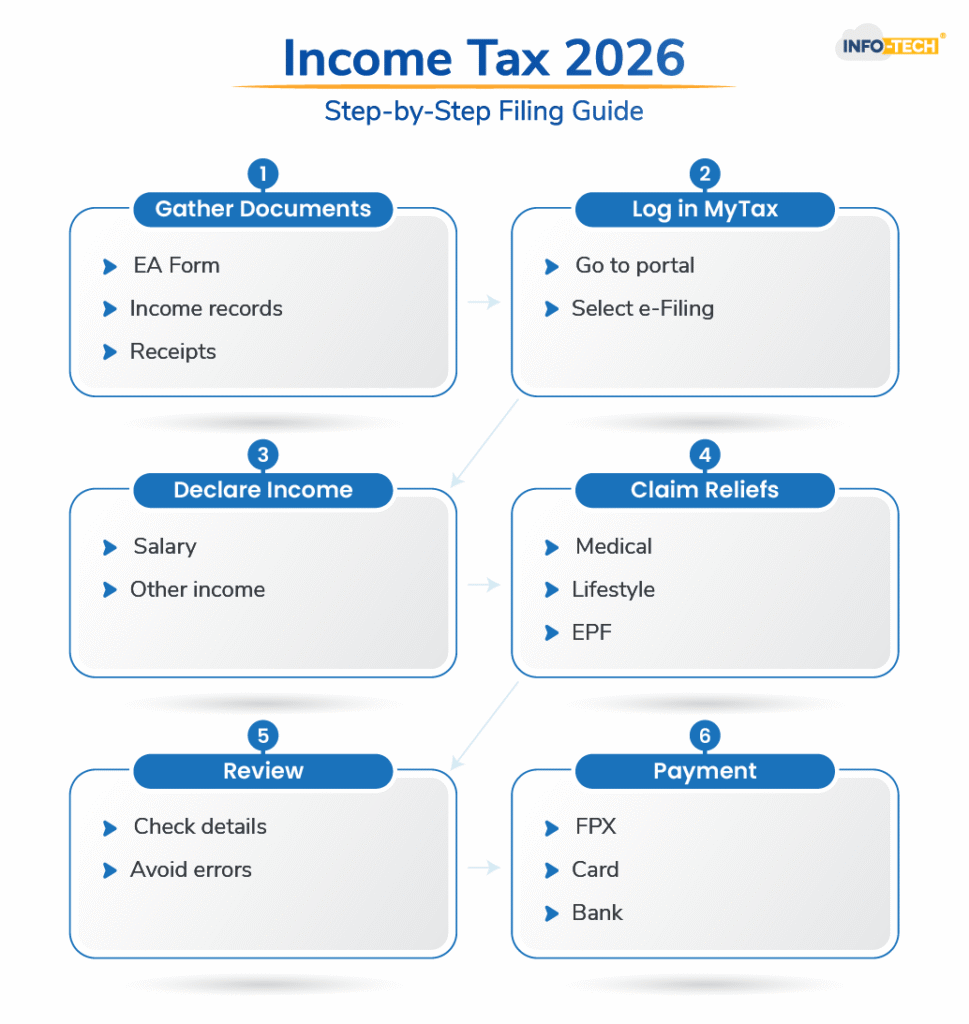
First, make sure you have your Tax Identification Number (TIN). Most Malaysians already have this, but if not, you can register online through the MyTax portal.
Next, collect all your documents. This includes your EA form from your employer, records of any additional income, and receipts for expenses you want to claim as tax relief. Having everything ready before you start will save you a lot of time.
Once that’s done, log in to the MyTax portal and access the e-Filing section. Choose the correct form—usually e-BE if you have employment income—and start filling in your details. The system will guide you through each section, so you don’t have to figure everything out on your own.
Before you submit, take a moment to review everything. Small details are easy to miss and correcting them later can be troublesome. After you submit, you’ll receive a confirmation receipt—keep this for your records.
How to Pay Your Income Tax
If there is any balance left after filing, you’ll need to make a payment.
The easiest way is through online banking (FPX), which allows you to transfer money to LHDN. Other options include credit card payments or manual payments through banks.
You’ll need to use your TIN or bill number when you make a payment so that LHDN can match it to your account.
How Tax Reliefs Help You Save Money
One of the best parts of filing your income tax is being able to reduce how much you pay through tax reliefs.
These are expenses that the government allows you to deduct from your income before it calculates your tax. Common examples include EPF contributions, insurance, education fees and medical expenses.
Many people miss out on these because they don’t keep their receipts or don’t know what they can claim. Over time, this can mean paying more tax than necessary.
Common Mistakes You Should Avoid
Most tax problems don’t happen because people are trying to avoid paying—they happen because of simple mistakes.
Filing late forgetting to declare extra income or entering incorrect figures are some of the most common issues. These can lead to penalties even if the mistake was unintentional.
Taking a bit of extra time to check your details can save you a lot of trouble later.
What Happens If You Miss the Deadline?
LHDN does impose penalties, and they can add up.
|
Situation |
Penalty |
|
Late payment |
10% extra |
|
Incorrect information |
Fine + additional tax |
|
No filing |
Heavier penalties |
For instance, if you owe RM1,000 and miss the deadline, you’ll end up paying RM1,100 after the penalty. It’s a small delay, but it has a real cost.
Final Thoughts: Make Income Tax 2026 Easier for Yourself
At the end of the day, income tax isn’t hard to understand—it just requires a bit of planning.
If your records are clean and your documents are ready, filing becomes a quick process. But if everything is scattered, it turns into stress you don’t need.
That’s why many businesses today rely on Info-Tech payroll and accounting software. It keeps everything in one place—income records, deductions and reports—so when tax season comes, you’re already prepared.
Income Tax Filing FAQs
When should I file income tax 2026 in Malaysia?
CFor income tax 2026 resident individuals without business income must file by 30 April 2026, while those with business income have until 30 June 2026. E-Filing may provide slight deadline extensions. Early submission helps avoid system congestion and ensures faster processing.
What happens if I miss the income tax deadline?
Those who fail to furnish the ITRF, without reasonable excuse, will be subject to a fine of RM200 to RM20,000 or imprisonment for a term not exceeding 6 months or both. Filing late is always better than not filing at all, but prompt submission is advised.
Can I file income tax 2026 online?
Yes, Malaysia’s LHDN provides an e-Filing system through the MyTax portal allowing taxpayers to submit returns, calculate tax, and make payments online. It is the fastest and most convenient method reducing paperwork and minimizing errors compared to manual filing.
Do freelancers need to file income tax in 2026?
Yes, freelancers must declare all income earned during the year under income tax 2026. This includes part-time gigs digital income, and side projects. Failure to report such income can lead to penalties, as LHDN tracks multiple income streams.