Handling taxes has quietly become one of the most demanding parts of running a business. It’s no longer just about filing returns on time. It’s about keeping up with constant changes, tighter regulations, and increasing scrutiny from authorities.
At the same time, technology is reshaping how taxes are managed. Many businesses are now turning to digital solutions, not because they want to, but because they have to.
Why Tax Digitalization Is Gaining Attention
If you’ve noticed, tax authorities are no longer working the old way. They’re not waiting months for reports to come in. Instead, they’re moving towards systems where data is shared almost instantly. This shift changes everything.
For businesses, it means your numbers need to be accurate from the start, not corrected later on. There’s less room for delays, and even lesser room for mistakes.
In Malaysia, the move towards e-invoicing is a clear example of this direction. Transactions are becoming more transparent and easier, and reporting is becoming more immediate.
So, What Changes When You Go Digital?
The biggest difference isn’t just speed, it’s how everything connects.
Instead of working with separate spreadsheets, emails, and manual checks, digital systems bring everything together. Data flows from one place to another without constant human input. Here’s a simple way to look at it:
| Traditional Approach | Digital Approach |
| Work is done after transactions | Work happens alongside transactions |
| Heavy manual input | Automated processes |
| Errors are found late | Errors are flagged early |
| Reports take time to prepare | Reports are almost instant |
It’s less about doing things faster, and more about doing them right from the very beginning. 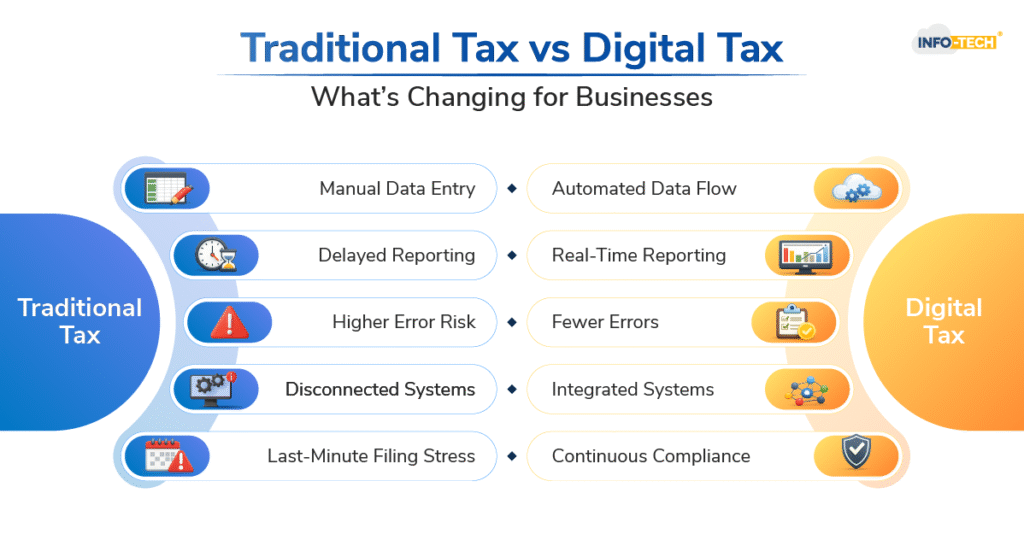
Practical Benefits Businesses Actually Feel
Fewer mistakes
Anyone who has worked with manual tax data knows how easy and quick it is for small, unnoticed errors to slip in. And those small errors can turn into bigger issues later.
With automation, a lot of that risk is reduced. Calculations are handled by the system, and data doesn’t need to be entered repeatedly. It’s not perfect, but it’s definitely safer and better.
Less last-minute pressure
Deadlines used to mean long hours and rushed work. Digital tools help spread that workload out. When your data is already organised and updated regularly, there’s no need for that last-minute scramble. Things feel more under control.
You actually understand your numbers
One underrated benefit of going digital is visibility. Instead of just preparing reports because you have to, you start seeing patterns in your data. You can spot unusual transactions, understand where your tax exposure is coming from, and make better decisions.
It’s a subtle shift, but an important one.
Time goes back to your team
A lot of tax work is repetitive from checking, matching, to recalculating.
When those tasks are automated, your team can focus on things that actually need human thinking. Planning, reviewing, improving processes and the other kind of work that adds value.
Keeping up with changing rules becomes easier
Tax regulations aren’t slowing down. If anything, they’re becoming more detailed and more connected across countries.
Digital systems don’t solve everything, but they make it easier to adjust. When your data is already structured properly, adapting to new requirements is more effective and less painful.
But It’s Not As Simple As It Sounds
Here’s the part many businesses don’t talk about openly: switching to digital tax processes isn’t just about buying software. It takes effort, sometimes even more than expected.
Data needs to be cleaned. Systems need to be aligned. People need to learn new ways of working. Some companies jump in expecting quick results and then realise it’s a longer journey.
That doesn’t mean it’s not worth it; just that it needs to be done properly.
A More Realistic Way to Approach Tax Digitalization
Instead of trying to change everything at once, it’s usually better to start small.
Look at where most of your time is going right now.
Where do errors usually happen?
What feels unnecessarily complicated?
Fix those areas first. From there, you can gradually build a system that actually works for your business, rather than forcing your business to fit into a system.
Where Tax Digitalization is Heading
Tax is slowly moving away from being just a compliance task. With the right setup, it becomes something more useful, a source of insight, a way to manage risk better, even a support for business decisions.
Digitalization is what makes that shift possible.
Final Thoughts
Tax digitalization isn’t really about technology. It’s about adapting to how things are changing. Businesses that move in this direction tend to feel more in control, with fewer surprises, fewer last-minute issues, and a clearer understanding of where they stand. Those that don’t may find things getting more complicated over time. There’s no perfect way to start but doing nothing is usually the harder option in the long run.
E-invoicing is a key part of tax digitalization, and most modern accounting software supports it. Invoices can be generated, validated, and submitted electronically to tax authorities, reducing manual intervention and speeding up the reporting process. In fact, with solutions like Info-Tech’s accounting software and e-invoicing software, businesses can handle invoicing, tax calculations, and compliance within a single platform. This kind of integration makes it easier to manage day-to-day operations while staying aligned with digital tax requirements of Malaysia.
Tax Digitalization FAQs
What is the digitization of taxation?
Tax digitization (or tax digitalization) simply means using technology to handle tax-related work instead of doing everything manually.
What are the disadvantages of making tax digital?
Tax digitalization, while beneficial, comes with a few challenges that businesses need to be prepared for. One of the main drawbacks is the high initial cost, as companies often need to invest in software, system upgrades, and training. The setup process can also be time-consuming, requiring data cleanup and system integration. Once implemented, businesses become heavily dependent on technology, meaning system failures or technical issues can disrupt operations. There are also concerns around data security, as sensitive financial information is stored digitally.
What is the digital tax in Malaysia?
Digital tax in Malaysia generally refers to taxes applied to digital activities and the use of digital systems for tax reporting and compliance.
What is the Malaysia digital tax incentive?
Malaysia’s digital tax incentives are government initiatives designed to encourage businesses to adopt digital technologies and invest in digital transformation. These incentives reduce the tax burden for companies that invest in things like automation, digital systems, software, and Industry 4.0 technologies.