
Warehouses, logistics hubs, and distribution centers in Malaysia depend on shift workers to keep operations going 24/7. Night shifts, rotating schedules, overtime, and public holiday work make warehouse labor management tricky. Even a tiny mistake in tracking attendance or shifts can result in wrong payroll, arguments, and legal risks.
This highlights the importance of integrating a Warehouse Management System (WMS) to payroll. When data from warehouse operations flows straight into payroll calculations, companies can make sure shift workers get the right salary, on schedule, and in line with Malaysian labor laws.
This guide sheds light on WMS, the importance of payroll integration, and how businesses in Malaysia use WMS–payroll integration to cut down on mistakes and boost workforce precision.
What Is a Warehouse Management System (WMS)?
A Warehouse Management System (WMS) is a software tool that helps to manage and improve warehouse operations. It allows companies to keep tabs on inventory movements, handle storage location, coordinate picking and packing, and keep an eye on workforce activities in the warehouse. At its core, a WMS answers key operational questions like:
- What items are in stock?
- Where can we find them?
- Who dealt with them, and when?
- How much time did tasks need?
Today’s WMS systems do more than just track inventory. They often keep tabs on employee activities, work hours, job completion, and labour utilisation, which makes them super useful to get payroll right.
What does WMS mean?WMS is short for Warehouse Management System. It’s a tool that helps run warehouse operations like keeping track of stock filling orders making the most of storage space and managing worker tasks. |
Why It’s Hard to Get Payroll Right for Warehouse Workers on Shifts?
Calculating warehouse payroll is trickier than regular monthly salaries. In Malaysia, warehouse staff often work:
- Rotating shifts
- Night shifts
- Overtime hours
- Public holidays
- Split shifts or extended hours during peak seasons
When companies handle attendance, shift info, and overtime logs manually or in separate systems, payroll staff often run into:
- Missing or duplicated attendance records
- Incorrect overtime calculations
- Misaligned shift allowances
- Disputes over night differential pay
- Delays in payroll processing
These problems don’t just annoy employees. They also make it more likely that companies won’t follow job contracts and their own pay rules.
How WMS and Payroll Systems Team Up?
When a WMS links up with payroll software or workforce tools, warehouse floor data goes straight into wage calculations. This creates one place where both operations and payroll teams can find the truth. Common data that moves from WMS to payroll includes:
- Clock-in and clock-out times linked to warehouse shifts
- Task duration and productivity metrics
- Overtime hours triggered by extended shifts
- Night shift and public holiday indicators
- Approved exceptions or supervisor overrides
Payroll math uses real warehouse activity instead of manual data entry cutting down on mistakes and office work. 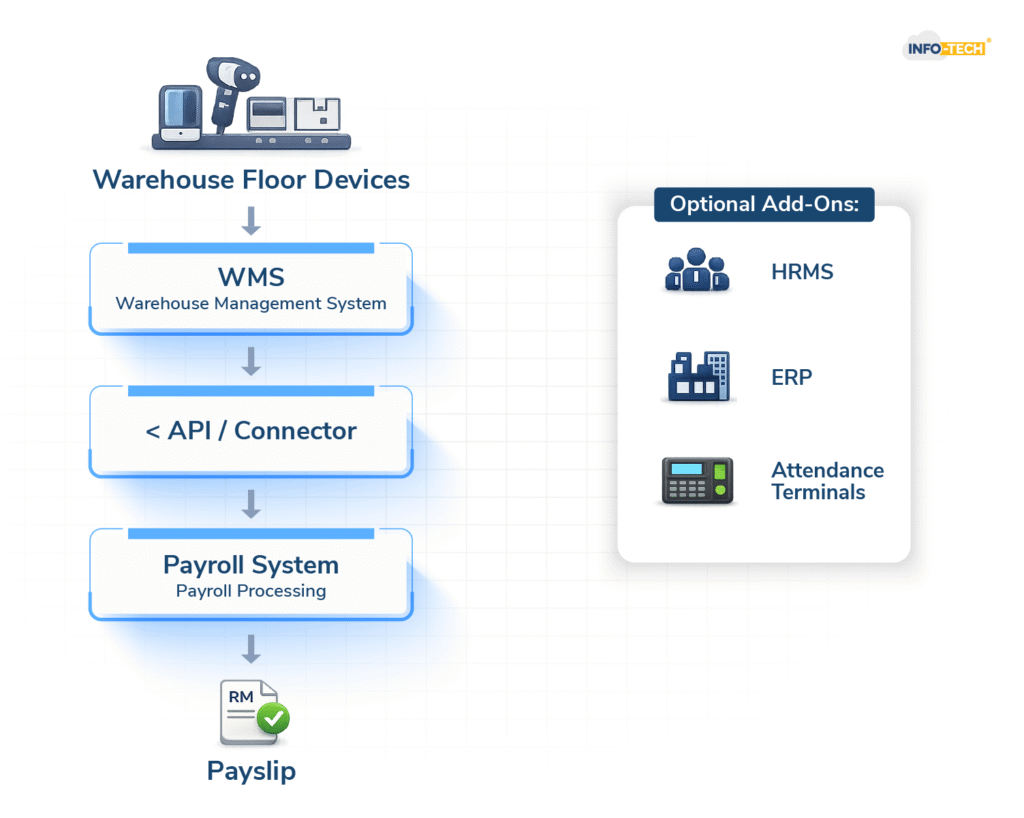
What Are The Advantages of Integrating WMS to Payroll in Malaysia?
1. Precise Pay Calculations Based on Shifts
Integrating these systems makes sure workers get the right pay for:
- Hours they worked
- What kind of shift (day, night, or rotating)
- When overtime kicks in
- Extra hours that got the okay
This matters a lot in warehouses that never close.
2. Fewer Payroll Mistakes and Disputes
When payroll matches WMS records, companies can resolve disputes about missing hours or wrong overtime, easier. Employers can depend on data backed by the system instead of manual logs or spreadsheets.
3. Quicker Payroll Processing
The automatic flow of data gets rid of repetitive data entry. This allows payroll teams to process wages more even during busy seasons with lots of workers.
4. Clearer View of Workforce Costs
By connecting labor hours to warehouse activities, businesses can:
- Analyse labor cost for each shift
- Spot operations that need a lot of overtime
- Plan their workforce better
What Data Is Shared Between WMS and Payroll?
| WMS Data Element | Payroll Impact |
| Shift start and end times | Basic wage calculation |
| Overtime flags | Overtime pay |
| Night shift indicators | Shift allowance |
| Task duration | Productivity-based pay |
| Attendance exceptions | Adjustments and approvals |
This alignment makes sure payroll shows actual warehouse work, not estimated or manually adjusted data.
How WMS–Payroll Integration Helps Follow Rules in Malaysia?
While Malaysian work laws let shifts be flexible, companies still need to:
- Pay employees according to agreed working hours
- Compensate overtime correctly
- Maintain proper wage records
A system that works together helps businesses:
- Maintain accurate payroll documentation
- Respond quickly to employee queries
- Demonstrate consistency in wage calculations
This has special value for logistics and warehousing businesses with many hourly workers.
What Are The Types of WMS Used in Warehouse Operations?
WMS platforms come in different forms. Companies pick various types based on their size and complexity.
What are the four types?
The four main types of Warehouse Management Systems include:
- Standalone WMS – Software made just for warehouses
- ERP-Integrated WMS – Part of ERP systems
- Cloud-Based WMS – Online and easy to scale
- Supply Chain Execution WMS – Advanced systems focused on logistics
Each type offers different ways to connect with workforce and payroll systems.
Is SAP an ERP or WMS?
SAP works as an ERP (Enterprise Resource Planning) system, but it also provides WMS modules as part of its supply chain offerings. These modules connect warehouse tasks with finance, HR, and payroll jobs. ERP systems handle company-wide tasks, while WMS zeros in on warehouse work. Integration between the two bridges operations and payroll.
What Are The Most Popular WMS?
Some of the most used platforms include:
- SAP Extended Warehouse Management (EWM)
- Oracle Warehouse Management
- Manhattan Associates
- Blue Yonder (JDA)
- Infor WMS
Big logistics and distribution companies often pick these systems because they can grow and link up with other tools.
How Businesses Connect WMS with Payroll Systems?
Businesses can integrate these systems through:
- ERP systems with built-in connectors
- APIs to sync attendance and shift data
- Middleware platforms to link operations and payroll
- Scheduled data exports and checks
The aim is to make sure clean, approved data goes into payroll, with little need for manual work.
Why Integrating Systems Matters for Shift Workers?
Shift workers get paid for their time, not just a set salary. When WMS and payroll work together:
- Every worked hour gets recorded
- The system captures overtime automatically
- Payroll shows what happened during operations
This reduces wage disputes and improves trust between employees and employers.
Final Thoughts: Why Good Payroll Starts in the Warehouse
In Malaysian warehouses, payroll accuracy begins on the warehouse floor, not in the finance department. When a WMS captures shift data, attendance, and operational activity and integrates it into payroll, companies cut down on mistakes, stick to regulations better, and gain their workers’ trust. As warehouse operations become more intricate, WMS–payroll software integration is now essential to pay shift workers accurately, not just an option.
WMS Frequently Asked Questions
What does WMS stand for?
WMS means Warehouse Management System. It’s software that manages warehouse operations, inventory movement, and workforce activities.
Is SAP an ERP or WMS?
SAP is an ERP system that has WMS features through modules like SAP Extended Warehouse Management.
What are the most popular WMS?
Well-known WMS platforms include SAP EWM, Oracle WMS, Manhattan Associates, Blue Yonder, and Infor WMS
What are the four types of WMS?
The four types are standalone WMS, ERP-integrated WMS, cloud-based WMS, and supply chain execution WMS.