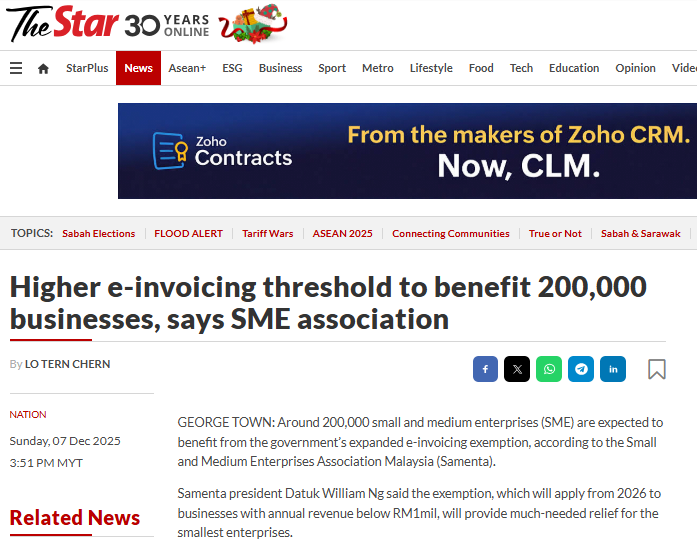
Malaysia’s push toward nationwide e-invoicing took an important turn recently, with the government confirming that businesses earning below RM1 million a year will no longer be required to adopt e-invoicing when the mandate reaches its final stage in 2026. This is a sizeable shift from the earlier exemption limit of RM150,000, and it immediately changes the expectations for thousands of micro and small enterprises across the country.
The announcement has brought a mix of relief, clarity and, for some businesses, new questions. Many micro-entrepreneurs who were preparing for the July 2026 implementation phase now find themselves exempt, while businesses above the new threshold still need to continue preparing for mandatory adoption. Because the government’s digital tax roadmap remains intact, and because LHDN will continue expanding the MyInvois ecosystem, companies that fall outside the exemption still need to move forward with e-invoice readiness plans.
But what does this change actually mean in practice? And how should SMEs respond?
| Timeline | Exemption Threshold |
|---|---|
| Earlier LHDN guideline | RM500,000 |
| Updated Dec 2025 policy | RM1,000,000 |
What Small Businesses Must Know?
The expanded threshold sends a very direct signal: Malaysia wants to modernise its tax system, but not at the expense of the smallest businesses in the economy. Over the past year, feedback from SME associations, rural traders, micro-entrepreneurs and industry bodies made it clear that many small enterprises lack the systems, staff capacity or digital infrastructure needed for structured invoicing.
Raising the exemption to RM1 million acknowledges that:
- A significant number of micro businesses still manage records manually.
- POS upgrades and accounting software subscriptions may be financially unrealistic for very small operators.
- Implementation timelines for tiny enterprises would risk compliance issues and operational disruptions.
So although Malaysia is still committed to digital tax reporting, the approach is now more measured and more in tune with the realities of the local business landscape.
Who Needs to Implement E-Invoicing?
The exemption may simplify life for micro-enterprises, but most medium-sized and growing SMEs still fall within the mandatory bracket. Any business generating more than RM1 million a year will need to comply with e-invoice requirements.
This includes companies across retail, F&B, logistics, e-commerce, construction, services, healthcare, manufacturing and many others. For businesses with structured finance teams, existing accounting systems, or multi-outlet operations, e-invoicing isn’t just a compliance requirement — it’s fast becoming the backbone of modern financial reporting.
And importantly, nothing changes for larger companies that have already been phased into the system. The deadlines and requirements for the 2025 adopters remain unchanged.
What Is an E-Invoice and Why It Matters?
Even with the new exemption, it helps to understand what e-invoicing actually involves. Under LHDN’s framework, every invoice — whether for goods, services or rental — is prepared in a standardised digital format and submitted through the MyInvois platform or an API-linked accounting software. The invoice is then checked, validated and issued with a unique identifier before being sent to the buyer.
This process replaces the variety of invoice formats Malaysians are used to: handwritten receipts, PDF invoices, Excel templates and even printed POS slips. The goal is consistency, accuracy and traceability — all of which feed into Malaysia’s larger digital tax modernisation agenda.
What is the Implementation Timeline?
| Phase | Implementation Date | Annual Turnover |
|---|---|---|
| Phase 1 | 1 Aug 2024 | > RM100 million |
| Phase 2 | 1 Jan 2025 | RM25m – RM100m |
| Phase 3 | 1 Jul 2025 | RM5m – RM25m |
| Phase 4 | 1 Jan 2026 | RM1m – RM5m |
| Phase 5 | 1 Jul 2026 | Remaining taxpayers (except exemptions) |
What Changes (and What Doesn’t) for SME Compliance?
Businesses above the RM1 million mark still need to make sure their internal systems are ready. This means preparing for structured data requirements, validation checks, potential submission rejections, and seven-year record keeping.
Some businesses have already discovered practical challenges, such as:
- Older POS systems that cannot integrate with MyInvois.
- Sales teams unfamiliar with structured invoice formatting.
- Manual uploads slowing down payment cycles.
- Multi-channel businesses struggling to consolidate their records.
These issues won’t disappear on their own — which is why early preparation matters. For SMEs with fast-moving inventory, multiple outlets or online sales, automation becomes crucial. Manual submission will not be able to keep up with daily transaction volumes once e-invoicing becomes mandatory.
What SMEs Should Be Doing Now if They’re Above RM1 Million?
The first step is to review your current systems. Not every POS or accounting software in the market is capable of generating LHDN-ready invoice formats or connecting to the MyInvois API.
Businesses should check whether:
- Their POS or accounting platform supports API integration.
- Sales, finance and operations teams understand validation requirements.
- All sales channels — retail, online, invoiced services — are feeding into a central system.
- They have a reliable method for storing validated invoices for seven years.
For many SMEs, this is a good opportunity to upgrade disjointed systems and move toward a single, integrated workflow. Cloud accounting solutions, in particular, reduce errors, streamline documentation, and allow businesses to automate large parts of the process.
What Is The New RM10,000 Transaction Rule for 2026?
Starting 1 January 2026:
• Transactions above RM10,000 cannot be consolidated into monthly invoices
• They must be issued as individual e-invoices.
Previously, businesses could consolidate small transactions.
If You’re Below RM1 Million, Should You Still Consider E-Invoicing?
Even if a business is below RM1 million, it may still need e-invoices if:
- it supplies to large companies
- the buyer requires e-invoices for tax deduction.
Even though micro businesses are exempt, going digital has its advantages. A structured invoicing system can make it easier to track sales, apply for loans, manage taxes, and prepare for future regulation changes. Banks, investors and grant bodies often prefer businesses with clear, digital financial records.
Several micro businesses have already expressed interest in voluntary adoption simply because it helps reduce bookkeeping chaos and adds a layer of professionalism when dealing with customers.
In other words: while it’s no longer mandatory, it’s still beneficial.
What Happens If Your Business Grows Beyond RM1 Million?
If a business:
- was previously exempt
- later exceeds RM1 million revenue
Then e-invoicing becomes mandatory starting 1 January of the second year after the threshold is crossed.
| Year | Revenue | Obligation |
|---|---|---|
| 2025 | RM800k | Exempt |
| 2026 | RM1.2m | Must implement |
| 2028 | Implementation required |
How Info-Tech Fits Into This New Compliance Landscape?
Info-Tech’s ecosystem already supports businesses preparing for LHDN’s e-invoicing model. Companies above RM1 million can automate MyInvois submissions, track validation status in real time, store records securely, and ensure every invoice is formatted correctly before it reaches LHDN.
Meanwhile, smaller businesses that want to modernise voluntarily can use the same platform for:
- Digital invoicing
- Cash flow tracking
- Expense and income management
- Audit-friendly reporting
Whether a business is exempt or required to comply, digitalisation is becoming an undeniable part of Malaysia’s business environment — and Info-Tech sits right at the centre of that transition.
A Turning Point, Not a Step Back
The RM1 million exemption is not a rollback of Malaysia’s digitalisation plans. Instead, it’s a recalibrated, more realistic rollout that keeps the long-term vision intact while easing pressure on the smallest businesses.
Companies above the new threshold should keep preparing — the timeline hasn’t changed for them. Micro businesses can take this moment to strengthen their financial documentation at their own pace. And the country as a whole continues its shift toward a more transparent, structured and digitally reliable tax ecosystem.
Digital compliance may be unfolding in stages, but the direction is clear — and 2026 remains a pivotal year for businesses ready to move forward.
E invoice Guidelines FAQs
Are businesses below RM1 million required to implement e-invoicing?
No. Businesses with annual revenue below RM1 million are now exempted from mandatory implementation.
Who must comply with e-invoicing in 2026?
Businesses earning above RM1 million annually must adopt LHDN’s e-invoice system.
Does the exemption affect the original rollout phases?
Yes. It primarily affects the smaller businesses included in Phase 5 (July 2026).
Can exempt businesses adopt e-invoicing voluntarily?
Yes, and LHDN encourages voluntary adoption for improved financial organisation and digital readiness.